In this chapter
In this chapter
Towers behind the city
The painted panel behind the island already held rows of distant city. A row of tall landmarks now stands between the far row and the middle one. Each tower’s shaft steps back twice toward its crown, about seven in ten carry a one-pixel mast with a red aviation light, the windows run in floors, and about half have a thin vertical line of cyan or magenta neon. There are six slots across a frame and four in ten are filled, so the default Harbour view shows one tower and the canal quarter two.
The rows now sit in their haze through a mix done in gamma space, which darkens them, so by day and at golden hour they read as silhouettes. By day the middle row stands 24 luma under the sky, up from 17. At night the panel’s neon is 1.8 times as bright. The far windows used to add light like small lamps, and the final image pass drew its dark outline around many of them. They now only lift their facade a little, below the brightness at which the outline starts, and the share of far-window pixels with an outline fell from 41.9 to 0.8 per cent on the Harbour at night. The panel’s brightest pixels now sit below the town’s own lit windows, 86 against 121. The skyline’s tallest point measures 13.4 per cent of the frame there, inside the plan’s 10 to 20; before, the tallest masts reached about 10.4.
Review found nothing that had to be fixed but noted what it costs. At night the haze packs the rows only 2 to 6 luma apart, so the layers separate by small steps, and with the far windows no longer glowing the panel’s windows nearly vanish. The creator accepted the dimmer windows. The beacons and half of the landmark neon can blink, but only when a new Scenery switch, “Blinking skyline beacons”, is on. They are steady by default, and a scene that never had the switch saves byte for byte as before. The creator’s one-word answer on blinking, “toggleable”, was read that way. Timed with vsync off at 1920 by 1080 and rain at 0.45, the skyline cost nothing measurable, and the suite passed with 40 suites and 19,880 checks.
A ring that was never drawn
The art review had described the city behind the island as about a hundred near-identical boxes in a 3D ring, and the plan asked for them to be varied. This stage found that the ring had never been drawn. The function that builds it had no caller in any saved version of the game since the first commit; what the review had seen were the painted rows. A probe that called it showed why it was best left out: in an orthographic view the near side of the ring stands between the camera and the island and covers the front of the Harbour and most of the canal quarter.
The skyline work still gave the unused ring set-backs, spires and neon, then asked the creator what to do with it. The answer was to delete it. A small fix pass removed the code, its 13 tests and its switch hook, and new checks confirm that it is gone and that a scene saved before the skyline work still loads with the skyline on.
A violet glow and a heavier deck
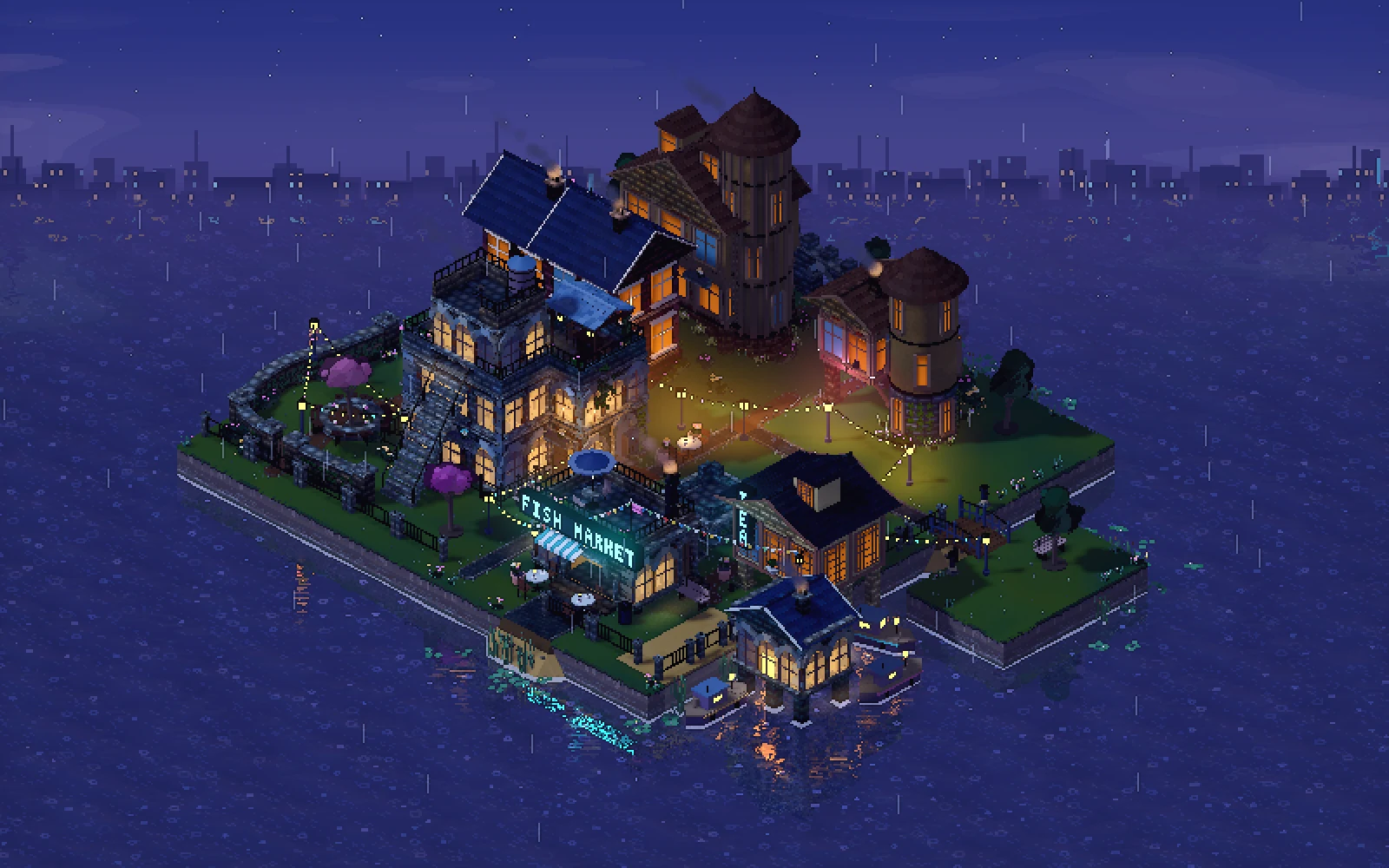
At night the sky near the city now turns toward violet instead of getting brighter. The glow colour is matched to the sky’s own brightness. It is strongest at the horizon and fades out between a fifth and four fifths of the way up the panel, so the zenith keeps its colour. The undersides of the clouds take the same hue. At night the cloud deck is heavier in the rain, and its edges are dithered in a two-by-two pattern laid on the cloud layer’s own pixels, so the pattern drifts with the clouds. At 05:45 and 20:45 the glow is at half strength. By day and at golden hour the sky draws exactly as before. The Glade look takes none of it, so its night keeps the bluer-green sky the creator asked for during the night stage.
Review found that the heavier deck existed mostly in the shader’s mask. Its clouds had been darkened toward the zenith colour and matched in brightness to the tinted sky, so they merged into it: on the Harbour at night the share of cloud pixels standing visibly apart from their clear sky fell from 18.4 to 7.7 per cent. The fix draws the deck as dark indigo masses with violet undersides lit from below, and the low deck lit nearly all over. A recheck then found that the lit undersides had turned the band just above the skyline into a lighter lilac strip, its median on the canal quarter up from 74 to 80.8 where the plan allowed 2 luma of change. Lowering the underside lift in that band brought it back to 74.4, against 73.8 before the stage, and cloud still stands apart from the clear sky on 41.6 per cent of the Harbour’s sky, over the plan’s 40. Going further, to no lift at all, put the band 3.7 under its old value and let the deck vanish again. The hue above the skyline is 257 to 258, inside the plan’s 250 to 280.
With the deck in contrast the dither shows more. A short film showed it shimmering on the step edges as the deck drifts: from one 200-millisecond frame to the next, 16.6 per cent of the canal quarter’s sky pixels changed by 3 luma or more, against 6.1 before the change. The creator chose to keep it. Puddles still mirror the plain sky without the city’s tint; that was left for later.
A quay of lamps on the horizon
A dark far quay now runs along the horizon, 2 to 4 render pixels tall and stepping every 40, and hides with the rest of the skyline under its switch. A one-pixel lamp sits every 13 pixels along its top; six in ten are lit, mostly warm, with a few cyan and pink. The lamps come up with the evening and are off by day, when the quay shows only as a grey line. They became the brightest points on the panel, and the final image pass gave each one a dark outline cross. The creator asked for them 15 per cent dimmer. On the Harbour at night their brightest pixels went from 215 to 197, still about 1.6 times the town’s tower windows, and the dark outline pixels beside them are still there. Neither the deck nor the quay cost anything measurable, and after the recheck the suite passed with 40 suites and 19,944 checks.
Columns on the bay
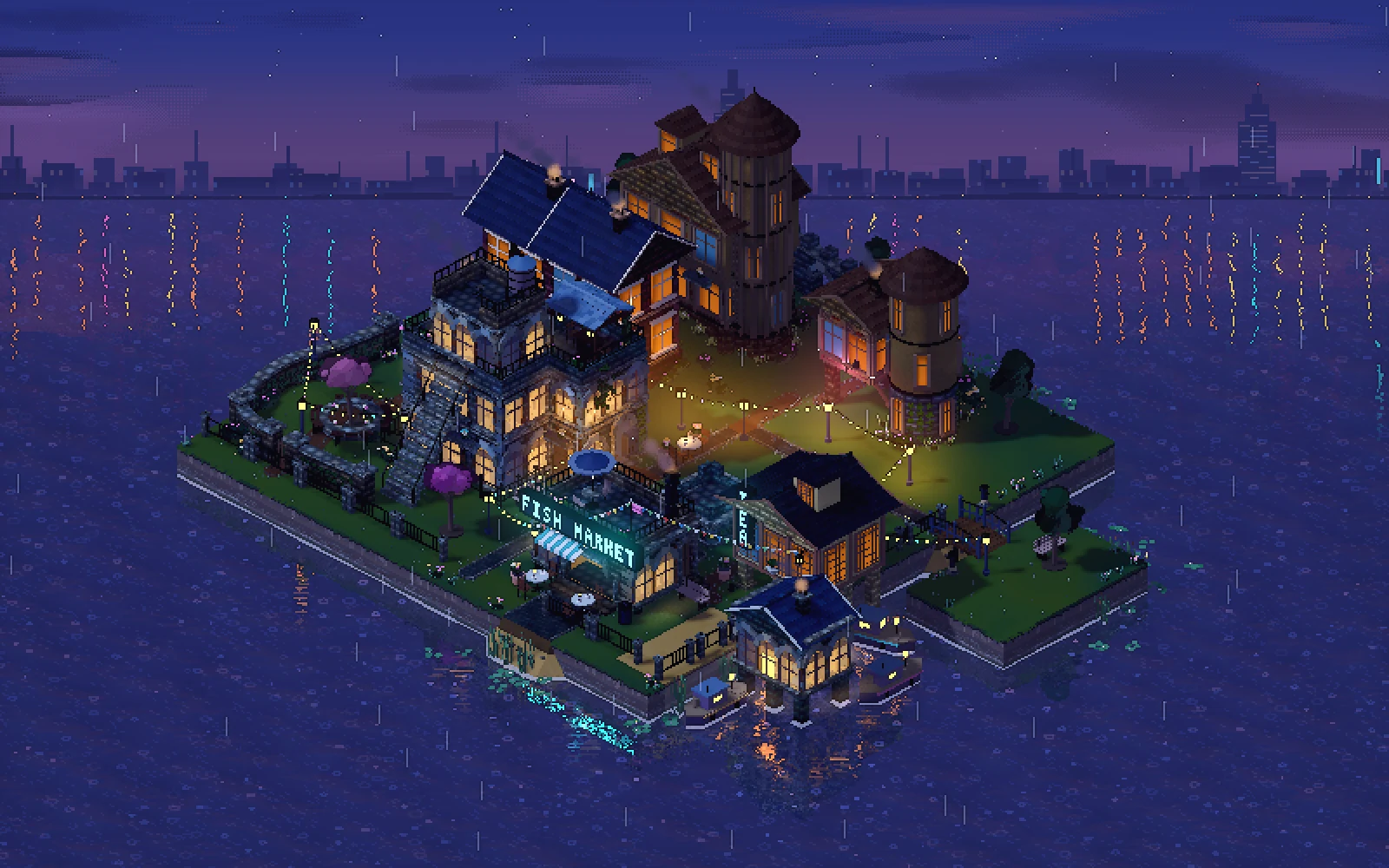
The open bay used to mirror the painted panel point for point. With the far windows dimmed, the only lights low on the panel were one-pixel lamps, and squashed toward the horizon they made dashes about eight pixels long. Each reflected pixel now takes the brightest of a run of eight samples toward the horizon, so a single lamp lays a column about 67 render pixels long on the water. Pairs of rows shift sideways by up to a pixel and a half, a rain ring landing on a column shivers it, and about a third of each column drops out in short dashes that re-roll one and a half times a second. The columns appear only at night and at half strength at 05:45 and 20:45. The sun and moon are cut out of what the water reads, so there is no second column under them.
On the Harbour at night the final version shows 12 to 14 columns between 30 and 120 render pixels long, the longest 72 to 92, where the build before had none or one. By day the open water is unchanged, in the Glade too. The canal’s own mirrored light columns come from a separate pass and stayed within capture noise.
Review found that the squashed read had taken something away without saying so. At 05:45 and 20:45 the old read had laid a mauve-pink wash of reflected clouds across the upper bay, part of a twilight the creator had already approved. The fix adds a second, soft read of the painted sky and clouds at every hour. It takes the dimmest of four neighbouring samples, so any light smaller than three pixels drops out and stays the columns’ job. The wash came back about half a luma under its old median on the far bay, because the soft read wears a pixel off the cloud edges. The columns cost the Harbour 0.06 milliseconds at night and were slower in all three rounds.
On some turns of the camera the viaduct’s row of lamps falls inside the read and makes a dense cyan comb of columns. The Glade first kept faint grey-blue columns of its own. Since the creator wanted the Glade kept out of the city glow, it now draws none: four before the fix, none after. A planned pass that would have rippled the night water was not run, following the plan’s default.
A sky that knows where the sun is
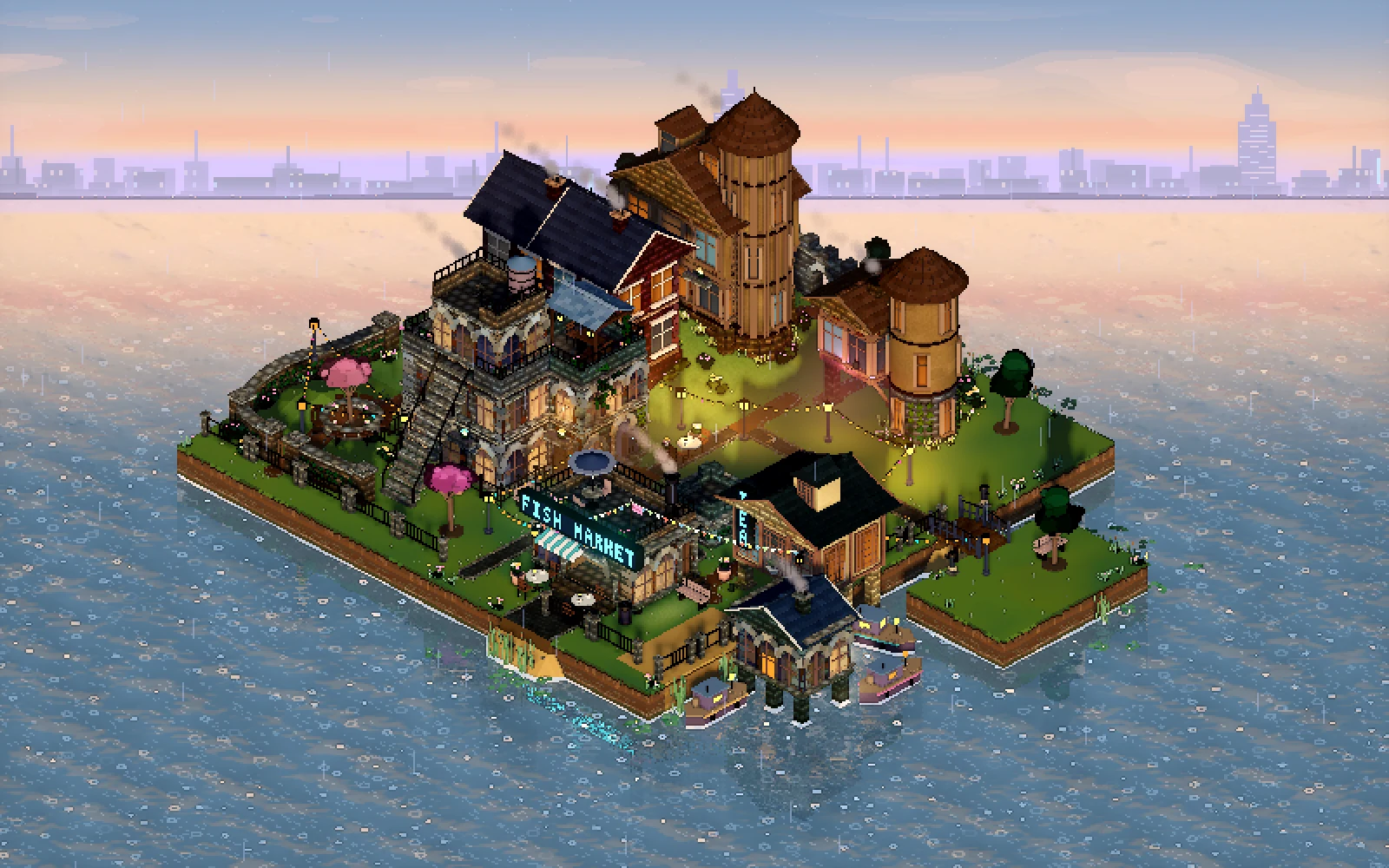
Before this change the golden sky looked the same in every direction. Now each column of the painted sky knows which way it faces relative to the sun. Facing away, a pink band, the Belt of Venus, sits about a third of the way up the panel over a cooler band, the Earth’s shadow. Facing toward the sun, a warm glow sits low down. The far water mirrors the belt, and at golden hour it fades further into the low sky. The golden fog went from 0.78 to 0.62 with a retuned haze colour, and the meadow brightens by up to 45 per cent in the low light. All of it scales with how low the sun is, so the day and night skies draw exactly as before.
On the Harbour at golden hour the far water’s saturation went from about 10 to 25 per cent, right on the plan’s line. The city stands 23.6 luma under the sky above it, inside the plan’s 15 to 25, and the lawn went from 54.5 to 91.3, 0.79 times the water’s 116.3 against a floor of 0.7. The plan also proposed darkening the city into a stronger silhouette; measured, that put it 45 luma under the sky, far outside the band, so it was left out. A one-pixel warm rim on block tops facing the sun, which the art review suggested, was not built.
Review found two faults. Between 21:00 and 21:30, and again between 05:40 and 06:10, the belt and glow faced the moon, because the sky took its direction from whichever body the disc showed; a separate sun direction fixed it. And no cool band showed at all, because the shadow sat behind the far rows and under the mist. It was rebuilt so that the whole low band away from the sun turns cool, and the sky just over the rows went from a warm hue of 22 to a lavender 261. In the water the same band is only a faint mauve strip. In three trials a stronger strip pulled the far water’s saturation under the 25 per cent line, so it was left faint for the creator to judge.
The recheck then found hard-edged peach and blue patches on the far water at dawn, from 06:00 to 06:12. Their cause turned out to be in the neon bay’s soft read rather than the golden sky. That read mirrors only what the panel adds above its plain painted sky, and its idea of the plain sky did not include the new sun side, so the belt showed through and the swell cut it into patches. The baseline now turns with the sun side too, and the dawn water is even again. A last check of the records corrected one figure: the first measurement of the cool band as built, a hue of 27.6 to 26.6, had not been saved and did not reproduce; measured again it is 21.8 to 20.2. The Glade inherits the golden sky, fog and water, but its meadow takes only 15 per cent of the lift, because the full lift turned it lime. Timed at 19:30 and at night, the golden hour showed no change beyond noise, and the suite passed with 40 suites and 20,081 checks.
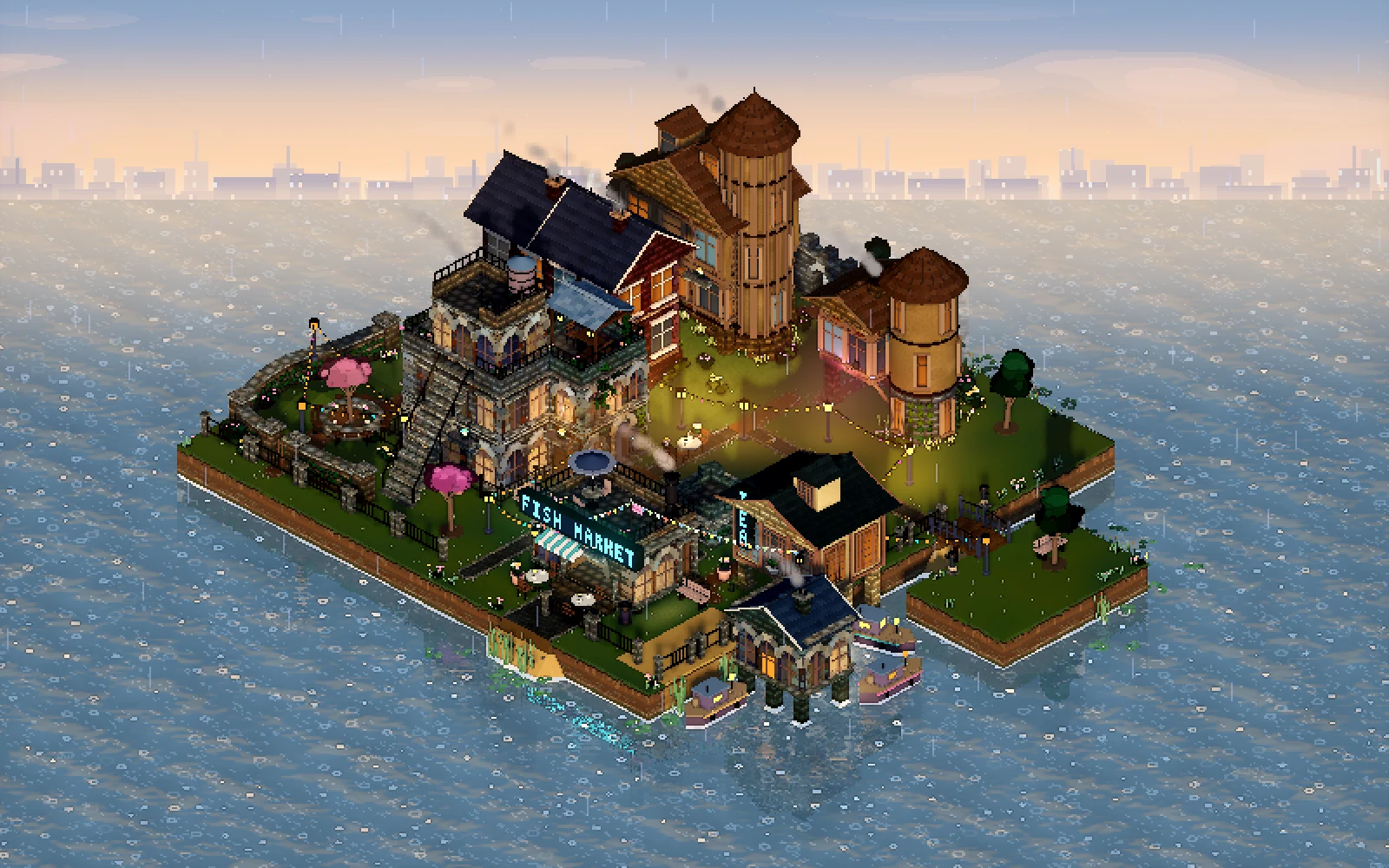
The creator’s answers
The creator answered seven questions after seeing before-and-after pages of the skyline and the violet sky: delete the 3D ring, accept the dimmer panel windows, keep the slight shimmer of the cloud dither, dim the quay lamps by 15 per cent, keep the 20:45 sunset hue that the half-strength glow moves about 12 degrees toward magenta, and keep the Glade out of the city glow. The seventh was about bookkeeping: each change is now saved to the project’s history as soon as it finishes. The ring deletion and the dimmer lamps went in as one small fix pass after the neon bay, which also took the columns out of the Glade. It cost nothing measurable, and the suite passed with 40 suites and 20,005 checks.
The stage measured as a whole
The checks that closed the stage ran on the final code in the early hours of 1 October. The full suite passed with 40 suites and 20,085 checks and no failures; four of those checks came from sound changes made in between, which replaced the synthesised water ambience with a recording and removed the wind. On the six journey views every count, draw calls included, matched the previous stage, as each change had declared. By eye the tower and the violet sky with its two-tone deck stand behind both Harbour views and the quarter, the columns lie on the night bay, the tower is a pale silhouette by day, and the town and island are unchanged.
The protected looks held. The canal’s mirrored light columns are the same streaks, the neon sign cores stayed within noise, the 05:45 and 20:45 zeniths are identical, and their horizon bands changed only as the parts intended. The Glade’s night sky did not change, and the tree-style grove held by day. At 19:30 the grove changes on 86 per cent of its frame because of the lawn lift and the golden haze, while its crowns moved by 2.4 luma. The stage-end captures repeat the parts’ lines: twelve columns 30 to 120 pixels long on the Harbour at night, the city 23.9 and 23.6 luma under the golden sky, the far water at 25 per cent saturation and the lawn at 0.79 of the water.
Timed against the build from before the stage, with vsync off at 1920 by 1080, rain at 0.45 and mains power, over three interleaved rounds at night, 13:00 and 19:30, the stage costs a small, steady amount. The dense test scene went from 13.27 to 13.33 milliseconds at night, 13.21 to 13.24 at 13:00 and 15.07 to 15.12 at 19:30. The Harbour went from 6.63 to 6.72, 6.61 to 6.68 and 6.50 to 6.59. That is about 0.05 milliseconds on the dense scene and 0.04 to 0.11 on the Harbour, 1 to 1.6 per cent, and the final code was slower in 17 of the 18 paired rounds. It comes from the extra sky and water work in the shaders. Each change’s own benchmark had read it as no change beyond noise; added up over the stage, it shows. Draw calls did not change.
Where the stage stands
The stage’s summary sheet has fourteen pages. Three things were flagged on it and left unchanged: the Glade shows the new tower row, the rain rings near the horizon dissolve into the smooth peach band at golden hour, and the 06:00 water is even but carries soft lighter swirls. The creator signed the sheet off on 1 October as it stood, including the golden water as built, with only a faint mauve strip where a cool band was wanted. Puddles still mirror the sky without the city’s tint, and the warm rim on block tops was not built.
Later that day, at the creator’s request, a milestone build of the signed-off code was exported for Mac and Windows; neither was launched for this record. A planned change that would have put hills in place of the grey city behind the Glade was dropped by the creator on 1 October, so the Glade keeps the tower row. Everything ran on a Mac; Windows was not run.
From the project notebook
This chapter draws on the project’s records as they stood on 1 October 2026.
- docs/visual-handoff.md · Beautify skyline entry: landmark row, gamma-space haze, brighter neon and the ring finding, with its review, 30 September
- docs/visual-handoff.md · Beautify violet cloud deck and lit far quay entry, with the review fix and the recheck fix, 30 September
- docs/visual-handoff.md · Beautify neon bay entry, with its review fix, 30 September
- docs/visual-handoff.md · Beautify fix pass for the creator’s answers: ring deleted, quay lamps dimmed, Glade without columns, 30 September
- docs/visual-handoff.md · Beautify golden hour entry, with the review fix and the recheck fix, 30 September
- docs/visual-handoff.md · Skyline, neon bay and golden hour stage close: suite, journey, protected looks, whole-stage benchmark and summary sheet, 1 October
- artifacts/beautify/owner-decisions.md · The creator’s answers on the skyline and violet sky, the stage sign-off and the dropped Glade hills, 30 September and 1 October
- artifacts/beautify/22-P4/ · Per-part captures, metrics, benchmarks and suites, and the stage-close captures and sheet