In this chapter
In this chapter
A crag and its stairs
The grounds stage began on the afternoon of 15 October, straight after the architecture stage’s follow-up part. Its first part is a crag: a rock drawn as one closed stroke, simplified to at most 16 points, standing 3 to 16 metres over the water, 8 by default. Its faces lean in towards the top in stepped bands of different tones, with moss on the ledges and boulders at the waterline. The top is a terrace: a tower stands on it without the skirt it gets on a slope, a bridge can land on it, and a house hanging over the edge is refused with a hint. A cliff stair winds round the faces from the waterline to the top, with a landing at each corner. Before anything was measured the orchestrator asked for a heavier rock with moss that shows, grey rock at dusk, a boulder shore and stairs that wrap the faces, and accepted the remade sheets the same afternoon.
The first review found that the bank beside a crag was drawn from the crag’s land, so its terrain could go stale, and that the cat’s first nap site was a roof on a crag top it could never reach. The fix pass draws the terrain from the ground alone, keeps naps off crags, and refuses a crag that would bury a bridge’s landing. The recheck asked for one more change: what stands on the top now rides with it. Raising or lowering a crag carries its bridge ends and its stair’s head along, and each bridge style’s own rules decide whether the result stands; a lift bridge, which needs equal landings, is refused with its own line. The suite passed with 31,647 checks. On a realistic scene a 1-metre Height change costs 42.7 milliseconds on release, most of it the rock’s own rebuild, and six 16-metre crags took a frame from 2.50 to 2.52 milliseconds. Creatures do not walk crag tops yet, and close up the faceting reads as a regular sawtooth.
A boathouse and lantern boats
The boathouse is a 5 by 7 metre building of stone or timber, with a gable or hipped roof and a round or pointed water door. Released within 3 metres of a quay’s edge or a crag’s foot, it snaps to the nearer one with its back on the edge and its door to the water. A boat up to 3.7 metres long released in its channel berths there, bow to the door, with no mooring line. Two torches flank the door; that torch was written to be shared with the banners and braziers of a later part. A rowing boat can now carry a bow lantern on a pole, which lights in the lamplighter’s round and leaves a streak on the water. Torches and lanterns rank below every town lamp for the limited set of real lights, and on a stress scene at dusk 32 of them shared the 16 lights with none left dark.
Two reviews each led to a fix pass. A boat berthed in a boathouse now rides with it when a crag edit or a hand move shifts the house, a boat too long for the channel is told the 3.7-metre limit, and a house pushed into rock gets the rock’s line where it had got the water’s. The suite passed with 31,882 checks. On the Harbour a lantern row costs 0.06 milliseconds more on release. On a stress scene, the boathouses present add about a millisecond to every commit; that was accepted, because the check is flat with scene size and the Harbour has no boathouse.
A glasshouse, perches, stones and pumpkins
That evening a glasshouse joined the tray: 3 to 12 metres long, gabled or domed (at 3 metres a domed one is a round pavilion), with a white, green or black frame, a bed of shrubs, a staging bench of pots and a small lamp at each shrub. A stone circle has 5 to 13 stones on a radius of 3 to 10 metres, each with a lean, height and moss of its own and standing on the ground under it, with an altar slab or a sundial in the middle if wanted. Pumpkins come in three sizes. A tower can take a row called Perches, which the plan called an owl tower: the windows of its top floor become dovecote openings with timber landing boards, and a flock of six rock pigeons circles the cap and takes turns on the ledges. Tower birds have a cap of 18 of their own, outside the town’s limit of 30 creatures. After the orchestrator’s look notes the glass was made thinner and lit lower down, so the bars and the planting show at dusk.
Two rounds of review and fixing followed. A perched tower joined to a hall at first drew nothing at all, birds could sit on ledges hidden inside another building, grass tufts grew through a glasshouse floor, a stone circle could straddle a crag’s edge, and once glasshouses were drawn as one shared mesh per chunk of ground they fell out of the lamplighter’s round. All of these were fixed. After the second pass, rebuilding a chunk that holds 20 glasshouses takes 3.78 milliseconds instead of 22.98. A glasshouse placed at dusk can now light or go out about a second after it settles, which was accepted as a note. The suite passed with 32,124 checks, although its integration check stalled twice before two clean runs of the same code; the cause was not found, and the stall did not come back in the rest of the stage.
Arcades, a fountain and gate toppers
The run paused for the end of the week after the glasshouse part and resumed on the morning of 20 October. An arcade is a row of 2 to 8 arches a face under a slate lean-to, 4 to 20 metres long, round or pointed. Set against a house’s side or a freehand wall it seats its solid back on that face; on its own it is open on both sides; as a cloister it is one piece of four walks round a square of lawn. A fountain has one to three tiers on a basin of 2 to 5 metres, with water running from each lip; the running water of every fountain in a scene is one draw call, and it stands still when ambient motion is off. An iron gate’s posts can carry a stone topper: an orb, a pinecone, a stag, a heron or a cat, the beasts the creator allowed in place of statues.
Review found that a raise or lower of the ground by more than half a metre left an arcade, a fountain or a glasshouse behind, buried or hanging, and that each new fountain took 2.2 to 3.2 milliseconds to draw, enough to push its placement over the release budget. The fix pass lets them follow the ground and builds each fountain’s shapes once: drawing a fountain now takes 0.58 to 0.91 milliseconds the first time in a session and 0.05 to 0.08 after that, with every vertex as before. The suite passed with 32,546 checks. Some limits of the arcade went to the creator as look calls, among them that its back wall can cover a house’s ground-floor doors and windows.
Banners, torches and braziers
Banners hang from an iron rod on a house front or a tower: 1 to 6 metres long, with a swallowtail hem, in any pair of seven colours (wine, navy, forest, ochre, slate, cream and black), and they move in the same wind as the flags. Wall torches are fixed 3.2 metres up and can lean 18 degrees either way. Braziers come in three sizes for the ground, a quay, a crag’s top or a flat roof. Torches and braziers share one flame, breathe like the other night lights and light in the lamplighter’s round; there are no embers. With 10 torches and 6 braziers added to the Harbour, no town lamp lost its light.
The review found that the check for hanging parts walked the whole scene once for every part on a tower, and that a bartizan and a banner could be placed into each other. The fix pass answers from one walk per pass and keeps the two apart, refusing whichever comes second with its own line. The suite passed with 32,881 checks. Placing a banner or a torch costs 78 milliseconds on the Harbour against 27.6 for a pot, and 265 to 272 on the Castle starter, because the building it hangs on is rebuilt; a clock face at the same spot costs the same. The orchestrator accepted that and passed the size of the hitch to the creator.
A castle on the loch
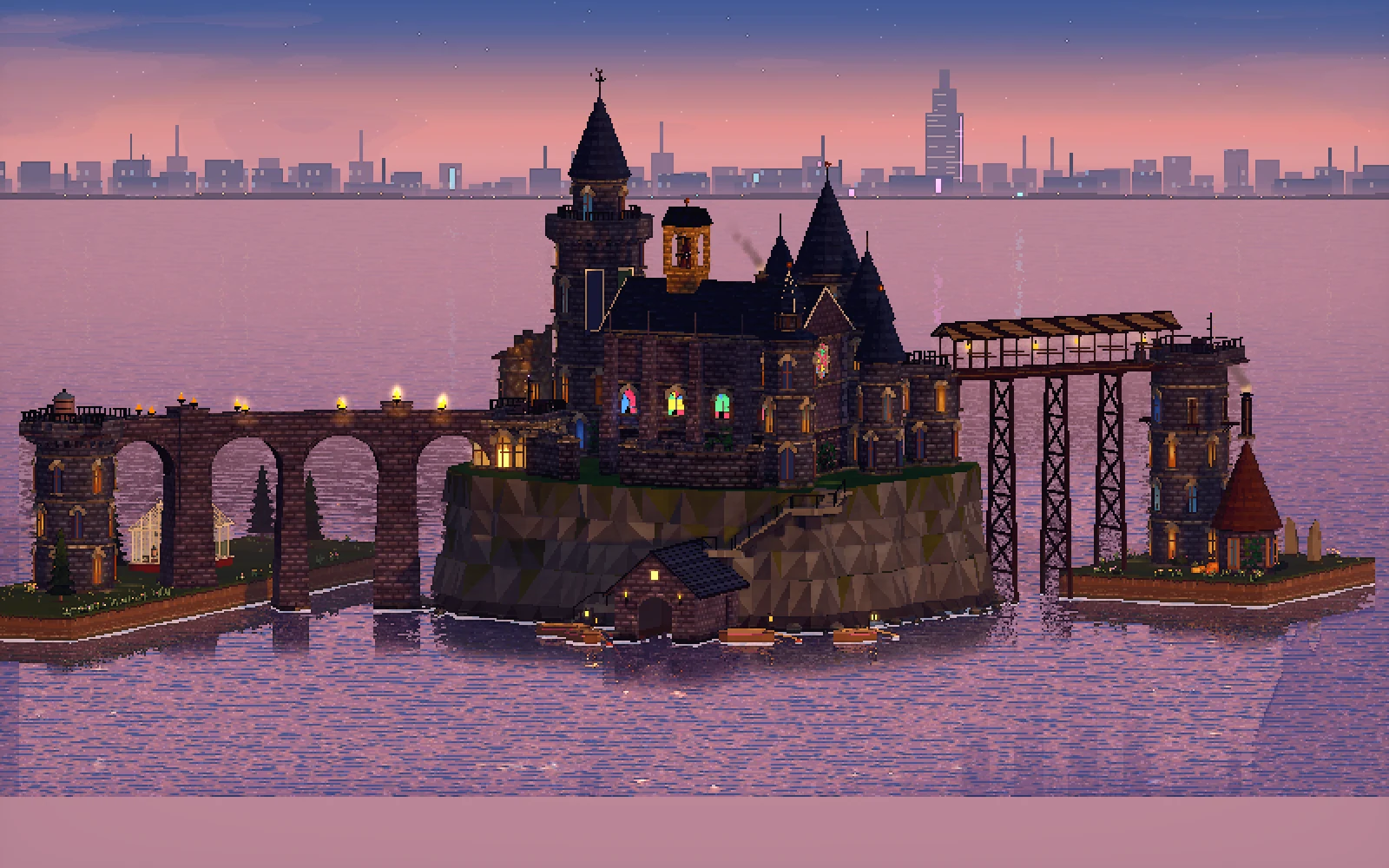
The last part built a scene from the new pieces. The Loch castle is a new starter in the scene menu, after the Castle, with a generic name, no crest and banners in navy and forest. Its 54 parts stand on and around an 8-metre crag: a 13-metre great tower with a spire tower on its terrace and a vane 30.5 metres up, a clump of four spires of 11, 9.5, 8.5 and 6.5 metres, a hall with stained lights, a rose window and a belfry, an ogee tower, a ruined tower, a four-arch viaduct to the mainland and a covered bridge to an islet. On the islet stand the perched tower, a stone circle with a sundial, a round cottage and four pumpkins. A boathouse sits at the crag’s foot with a cliff stair and four lantern boats, and there is a glasshouse on the mainland. The scene opens at 20:45.
Both long bridges land on tower terraces, because the game refuses a viaduct or covered bridge whose deck meets a crag’s rock. A frame at dusk took 5.22 milliseconds at the median with 680 draw calls. Placing a small tower costs 6 to 8 milliseconds more here than on the Harbour, the cost of the scene’s crag, towers and bridges, which the orchestrator accepted. The review’s one must-fix, a missing entry in the test harness’s list of scenes, was fixed by the orchestrator. The suite passed with 32,947 checks.
The grounds measured as a stage
The stage close ran in the late afternoon of 20 October on the final code. The suite passed with 61 suites and 32,948 checks, and the integration check that had stalled after the glasshouse part did not stall. Existing scenes kept identical counts in all 23 views of the close and in the six views of the journey, and the protected colours held within their noise. On both benchmark scenes the frame time stayed within 0.07 milliseconds of the code from before the stage, measured side by side. The dense scene took 63.1 milliseconds longer to load, which is not traced. The Harbour’s grip drag measured 55.92 milliseconds against 55.62 before the stage, with 53.7 as its baseline. And one new finding: the Harbour’s Height slider released in 20.5 milliseconds on the old code in all six runs, and on the new code in either 21.1 or 49.4, three runs each.
The Loch castle was judged against the castle plan’s seven cues from across the water. The height, the spire cluster, the cliff over water, the long links and the grown plan read. The hall reads as a church, though its buttresses show only close up, and the warm lights read under a pink and violet sky where the plan had a cool blue. The 8-metre crag is modest beside the towers.
The stage also brought the castle plan’s milestone, the third of the decor work, with the Loch castle as the thing to show. Both exported without an error at 17:44: a Mac zip of 67,142,035 bytes and a Windows zip of 44,028,313 bytes. On the Mac the exported app opened the Harbour at night, the Loch castle and the Castle starter, drew the Loch at dusk and quit cleanly each time; a separate check on the development copy matched the Loch scene to the starter’s recorded fingerprint. The Windows build was exported, not run. Its checklist has 22 rows for a PC, among them saving the Loch castle and comparing the saved file’s fingerprint with the one recorded on the Mac. The close moved 188 of its captures to the macOS Trash and brought back the 72 that its sheet and its record cite. The sheet for the creator ran to eleven pages, with thirteen questions, A to M, on pages 8 and 9.
A slow release, traced
The close recommended tracing the slider before the next part, and the orchestrator added a small part for it that evening. Ten runs on each side reproduced the split: the slow release came in 5 of 10 runs on the new code and 1 of 10 on the old, so it was not new. Timing the release in phases put the extra 28 milliseconds in one rebuild of the Harbour’s main house. Since 24 September a drag rebuilds at full detail at most once every 80 milliseconds, and the release builds any step still waiting for its turn. Over 150 timed releases, all 42 slow ones had a step waiting and none of the 108 fast ones did; in the fast runs the same build had happened a frame or two earlier, where the release time does not count it.
A bisect across the parts found no part that brings the slow mode in. The grounds parts’ few tenths of a millisecond only tip the race more often; on a fast release the whole stage costs 0.7 milliseconds. No game code changed; the ruling is that future benchmarks are to report the release together with that catch-up build.
The creator’s answers
On 21 October the creator answered the sheet’s thirteen items. The answers were drafted by the assistant at the creator’s request and recorded on their word, and each can still change. Kept: the banner and torch placement hitch, with a part to draw them apart from their building only if it bothers them; the Loch castle’s refused crag Height row, which is right because both bridges land on terraces; the arcade’s back-wall height and its stand-off under a jetty, as limits of the form; the flat, bright cloister lawn; the hidden dusk lantern under an arcade’s roof, for now; the 1-metre banner that reads as a tile; the torch lean, which is correct and shows close up; and the cautious clearance between bartizans and banners. Deferred: the pink and violet sky at 20:45, a lighting question for every starter.
Changed: the Loch cottage’s chimney, which reads as a tall black pipe in front of the perched tower, is to be dropped or moved off the cone’s tip; the covered bridge’s trestles, which read as iron, are to be recoloured toward weathered timber when convenient; an arcade’s back wall is not to hide a house’s ground-floor doors and windows, or, if that proves too large for now, that is to be recorded as a limit; a house dropped into a cloister’s lawn is to be refused with a hint; and a brazier, pot or fountain left under a lifted or moved house is to be refused with a hint or lifted with the house. These changes are queued, not built, in a follow-up stage that also plans other distant views, such as mountains and forest, as alternatives to the city.
Where the work stands
The six grounds parts and the stage close are built, reviewed and closed, and the trace is done. The crag went to the project’s repository with the architecture stage on 15 October; the rest of the grounds stage, with the control parts of the next chapter, followed early on 21 October when the creator wrote “gamepad connected, push it”. This milestone’s Windows build was exported, not run, and its checklist waits for a PC with those of the first two decor milestones. Carried forward, among many smaller notes: creatures do not walk crag tops, a house left straddling a crag’s edge by a crag move keeps standing, the dense scene’s slower first load is not traced, and placing a banner or torch still costs a rebuild of its building.
From the project notebook
This chapter draws on the project’s records as they stood on 21 October 2026.
- docs/castle-elements-plan.md · The grounds stage R8a to R8f, the seven cues and the milestone M-R4, intent only, 12 October
- docs/visual-handoff.md · Castle crag and cliff stairs; boathouse and lantern boats; glasshouse, owl tower, stone circle and pumpkins entries, with their reviews and fix passes, 15 and 16 October
- docs/visual-handoff.md · Castle arcade, fountain and gate toppers; banners, torches and braziers; Loch castle starter entries, with their reviews and fix passes, 20 October
- docs/visual-handoff.md · Castle grounds stage close and milestone M-R4; Harbour slider-release trace entries, 20 October
- artifacts/decor/owner-decisions.md · The rulings from each review of 15, 16 and 20 October, the push of 21 October and the creator’s answers on the sheet items A to M, 21 October
- docs/decor-orchestration-handoff.md · State of the work, 15 and 20 October
- artifacts/decor/m-r4/windows-checklist.md · The castle milestone’s Windows checklist, 20 October
- artifacts/decor/36-R8/ · Per-part tests, captures, sheets and costs, the stage close’s captures, sheet and carried notes, and the slider trace