In this chapter
In this chapter
- Cables one pixel wide
- Replanting the harbour
- A beacon you can place
- Quay swags and grey rainy days
- Roof specks, measured and left alone
- Bigger pixels in a bigger window
- A pixel font: the options
- Turning the answers on
- The third round measured together
- Pixelify Sans in the interface
- Checking the new text
- Where the stage stands
Cables one pixel wide
Every cable was a thin beam 1.8 to 2.8 centimetres across, which covered only a third to a half of an art pixel and broke into dashes on screen. Festoon cables, washing and bunting cords, the cables and swags of string lights and every bulb’s hanger are now drawn as plain lines, one art pixel wide and unbroken at every zoom. They are lit like the other painted surfaces, so a cable reads dark grey-blue by day and lighter at night where its own bulbs light it. When the camera zooms far out, each festoon bulb grows to at least one art pixel so it no longer drops between pixels.
Measured on masks that colour only the cables, across 14 views, the cables fell into 1,789 separate pieces before and 416 after, and the scraps of three pixels or less went from 1,144 to 89. What breaks a cable now is a bulb, a lamp head or a facade in front of it. At the far zoom the lit bulbs covered 340 art pixels instead of 291. Draw calls rose by 2 or 3 on the Harbour views and by 6 in the quarter. In the Glade, whose art pixels are smaller, the cables became hair-thin lines.
Review found that the switch for going back to the old beams crashed the shader warm-up at start-up; it was fixed and the old look checked again. The Harbour’s slowest frames at golden hour were 0.48 milliseconds slower over 11 rounds, under the plan’s limit for the dense scene but reported. The pale washing and bunting cords now read as continuous near-white lines by day, and the cable colour at night was not tuned toward the darker shade the art review suggested; both went to the creator, who approved the change as it is. The suite passed with 46 suites and 24,376 checks.
Replanting the harbour
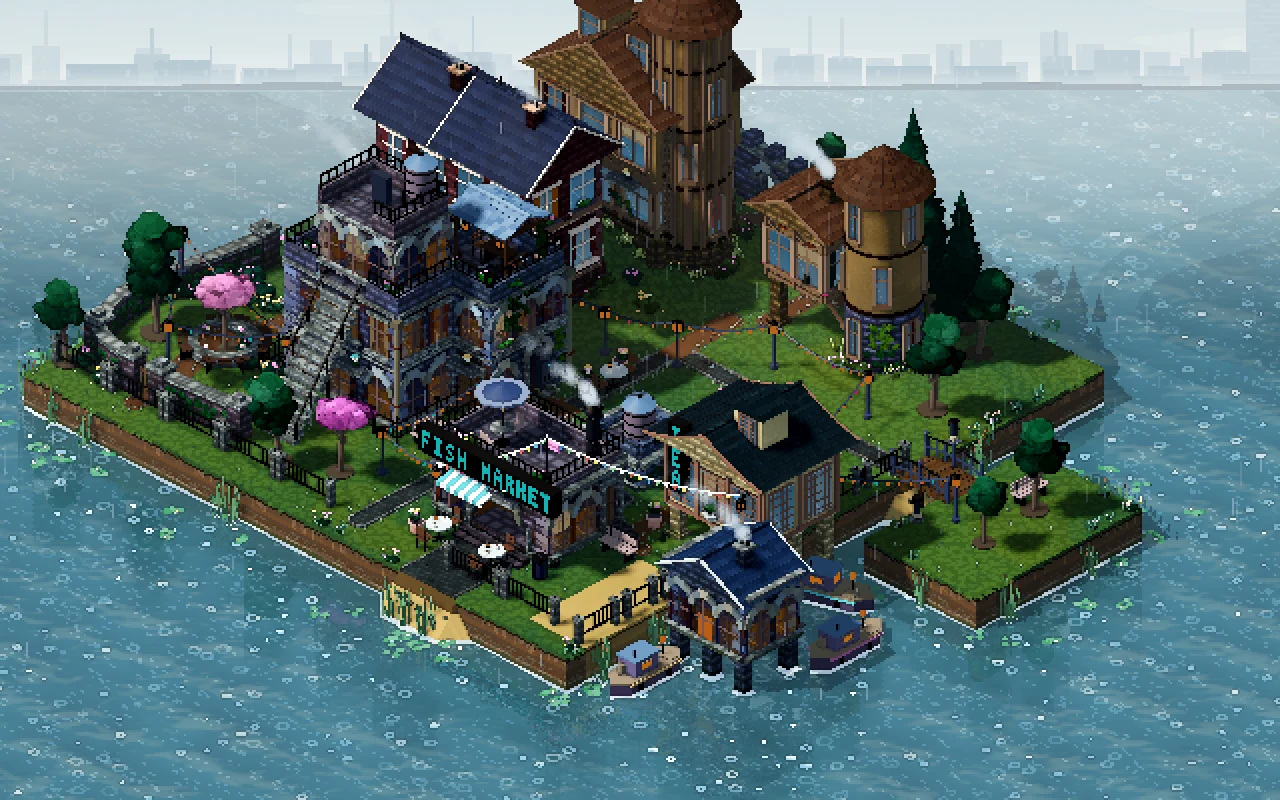
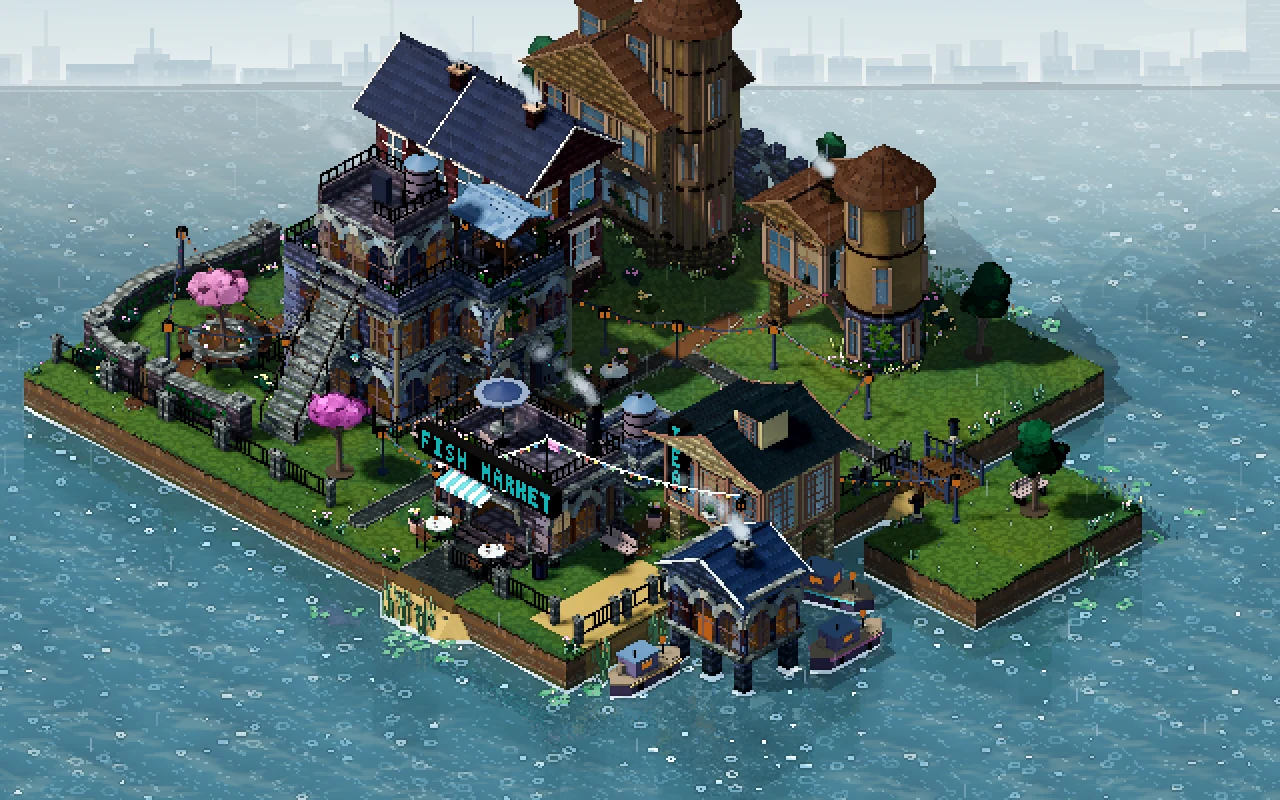
The art review noticed that several of the Harbour’s trees stood where the default camera could not see them. This part was told to stop at a mock-up and leave the shipped scene alone until the creator had seen it. In the mock, five hidden trees move to the garden’s far corner, the front-left corner outside the garden wall, the front lawn by the stairs, the right-hand lawn and the east bank, two conifers stand behind the gate tower, and the hidden shrubs gather into two groups of three. The share of lawn covered by plants rose from about 7 per cent to 19 to 27 per cent on the three lawns measured. A second option added a beacon tower on a paved pier.
The creator approved the replanting on 9 October, and it is now the default Harbour. One tree moved again: on the east bank it hid the bank’s lantern post, so it now stands between the post and the bench, and the post shows by day and at night. The old Harbour is one switch away. The replanted scene costs about 0.12 milliseconds of median frame at the Harbour and 24 to 26 more draw calls, close to what the mock predicted.
Two side effects were found and left as they are. Trees build their growth stages one per frame, so after a fresh load six of the new plants, four trees and two conifers, appear over about 7 frames; in the app the start-up screen covers that, but opening the Harbour from the menu shows them pop in. And in the recorded Harbour drag, the step that scrubs a size slider got slower, from a median of 10.9 to 17.5 milliseconds, probably because shrubs and trees now stand beside the house the script resizes; that was not traced. The drag recording was taken again as the new baseline.
A beacon you can place
A round tower with a flat roof can now carry a beacon: a lamp room on the roof, with a stone drum, an iron gallery and rail, lit glass, a cap and a finial, and a beam of two soft cones, each 15 metres long, added to the light and banded in four steps. Under Full motion the beam turns once every 16 seconds; Reduced and Off hold it still, and the lamp never blinks. It shows at night, at 05:45 and 20:45 and in heavy rain by day, and not at golden hour or on an ordinary day. In captures with the clock fixed, the water under the beam changed no more than between two captures with the beam on, so it is not mirrored. The beacon’s lamp is one more of the 16 lights the engine draws at once; in the test view it took the place of the tree house’s pink light.
The creator asked for the beacon to be an option, not part of any shipped scene. A selected flat-roofed tower and the tower tool now show a Beacon row under Roof, with None or Lamp room and beam. Choosing it is one undo step and is saved with the scene in the same format, and older builds simply ignore it. Tests check that none of the 12 shipped scenes and starters carries a beacon. With 24 extra lanterns on screen the beacon’s lamp got no light at all, and its beam was still drawn. The beacon’s cost stayed within noise.
Quay swags and grey rainy days
Two tunings from the art review were built switched off and shown as mock-ups first, because one changes many scenes at once and the other reverses an old rule. The first breaks strings of lights that run along a quay into separate swags: each lamp keeps at most one string along the water, and no lamp gains a new partner. Strings across lawns, plazas, stairs and water are untouched. In the quarter that takes 28 strings to 24; the Harbour has no string along its water and is unchanged. Two quay lamps end up with no string at all, which was accepted as one of the dark gaps between swags.
The second makes a rainy day read as overcast. Daylight in the game had ignored the rain. Now, in proportion to the rain and the daylight, the key light dims by up to 40 per cent, the ambient light rises by up to 25 per cent, shadows soften up to three times and the sky greys more. Nights and dry days are exactly as before, and the lighting data itself stays free of rain; the rule is now written down in the code. On the Harbour in heavy rain by day the town’s median brightness went from 105.7 to 101.4 and the sky band from 202.8 to 198.4. A stronger version was also shown; the creator approved the round as a whole, and that answer was taken to mean the milder one. The water still mirrors the hour’s bright sky under the overcast. Neither tuning changed frame times measurably.
Roof specks, measured and left alone
The polish list had a guard against single dark pixels in the outline, to be built only if the slate roofs still showed the lattice of specks the art review found. They do not. In four captures the Harbour’s slate roof by day had no isolated dark art pixel, against 2.4 per cent in the review’s capture; a fix in the defect sweep had removed it. The guard was not built and no code changed.
Two smaller leftovers went to the creator. The Harbour’s shingle cones show six or seven slightly dark shingles that the defect sweep had brought to none; they came back somewhere before the first motion group closed, and no one traced when. And at the lane zoom the shaded slope of the canal slate now shows scattered single dark pixels where it used to show joint lines between courses: the guard’s own trigger finds 21 cells there against 2 at the time of the review. That also appeared by the first motion group close, and the stage that brought it was not traced.
Bigger pixels in a bigger window
In a large or fullscreen window the interface grows, but the art pixel stayed the same size, so the town got finer the bigger the window. Each art pixel is now drawn at the pixel size times the window’s factor, which is the interface scale rounded: 1 for every window up to 2560 by 1440, 2 at 2880 by 1800 and at 4K, and 3 at 5K. Fullscreen then shows the town with the same art-pixel density as a 1440 by 900 window. It is a preference with a switch in the Scenery panel, Pixel size follows window size, kept out of the scene file. It is on by default.
At 1440 by 900 and 1600 by 1000 nothing changed, byte for byte. At 2880 by 1800 the frame is made of whole four-by-four blocks, the Glade’s fine look goes from one window pixel per art pixel to two, and the lens blur covers the same share of the frame as in a small window. Thin railings, cords and cable lines thin out or drop, as they do in a 1440 by 900 window. The median frame at that size was 18.5 per cent faster on the dense scene and 33.3 per cent on the Harbour. In a live editor none of 7.4 million checked window pixels picked the wrong art pixel. A real macOS fullscreen space was not tried, only a window of nearly the same size. The suite passed with 47 suites and 25,008 checks.
Three questions went to the creator with the third round’s sheet: whether to keep it on, whether to leave the Glade’s fine look out of it so the miniature stays fine in fullscreen, and whether the factor should follow the interface scale or a simpler ratio of the window to 1440 by 900, which would already double the pixels at 2560 by 1440. The creator approved the sheet as a whole on 9 October, and that answer was taken to mean the change stays as built: on by default, with the Glade included and the factor following the interface scale.
A pixel font: the options
The polish list also proposed a pixel font for the interface text and whole-number interface scales, so the text stays crisp. This part only measured and laid out options. No font was downloaded or added and the interface did not change, because a download needs the creator’s permission and a named file, source and size first. The body text used the system font, Arial on the Mac. The only font then in the project, Silkscreen, has no lowercase letters. At 8 pixels it is crisp but unreadable at normal size, and at 16 it is legible but twice as wide, so in the mock, labels in the Scenery panel were cut off.
Under the interface rule of 25 September, the interface scale was exactly 1 up to 1920 by 1080. It turned fractional above that, 1.28 at 2560 by 1440 and 1.53 in this Mac’s fullscreen, and there the pixel title text lost its whole-pixel steps. Rounding the scale would make fullscreen text 31 per cent larger, flooring it 35 per cent smaller, and the engine’s own whole-number mode was not mocked. Three free pixel fonts were listed with their licences for the creator to choose from. The creator picked Pixelify Sans, which is under the Open Font Licence, and rounding to whole numbers, and gave permission to download exactly that font file and its licence.
Turning the answers on
After the creator approved the second round, one more part switched on the replanting, the quay swags and the milder overcast, and added the beacon row to the editor, each behind its own switch with tests that follow it. The suite passed with 47 suites and 26,356 checks; part of the rise is a creature test that loops over the Harbour’s parts. In captures of the journey’s six views the Harbour views gained 17 to 24 draw calls and the quarter and styles views none. A rainy day now looks a little dimmer and greyer, and the quarter at night a little darker where strings came down. Against the code before it, the Harbour’s median frame was 0.12 milliseconds slower at 13:00 and at 01:00, slower in all five rounds, while the dense scene and the quarter were level. The dense scene’s slowest frames stayed under the plan’s limit.
The third round measured together
The third round’s closing checks ran on the evening of 9 October, on the code with the speck measurement, the window-sized pixels, the font options and the switched-on answers, before the font itself was added. The suite passed with 47 suites and 26,356 checks, and the integration check at 2880 by 1800 passed. On the journey’s six views the counts changed exactly as the part that switched on the answers had declared: the Harbour gained 24 draw calls by day and at night and 17 at the lane zoom, and the quarter and styles views were identical.
Of 112 capture views, 47 changed beyond the spread between captures of one build. The changes that held in every pairing were the replanted Harbour, 2.4 to 5.2 per cent of the frame, heavy rain under the new overcast, 6.9 to 9.1 per cent, and the quarter at night, 3.1 per cent, where the quay strings came down and cloud edges moved. The neon cores, the Glade’s night sky and the approved tree grove held.
Timed against the code from the second round’s close, the Harbour’s median frame was 0.02 to 0.16 milliseconds slower in every round, and the dense scene stayed inside the plan’s limit. Other programs kept the machine busier than at the earlier close, so absolute times sat about 2.5 milliseconds higher on the dense scene and 1.4 on the Harbour; both sides ran under the same load, but those times cannot be compared with earlier closes. The window-sized pixels were checked in a 2880 by 1800 window, not a real fullscreen space, and the shift in night cloud edges between the two versions of the code was not traced. The creator’s answer to the round’s twelve-page sheet was “All approved.”
Pixelify Sans in the interface
The part that built the answer downloaded only those two files from the Google Fonts repository, the font at the expected 79,160 bytes and its licence. The interface’s body text is now Pixelify Sans at 11 pixels, drawn with every pixel either on or off, and Silkscreen stays for headings. No size had been chosen, so the part used the one the face is drawn for, where a capital H is 5 by 7 pixels and a lowercase x 5 by 5. The interface scale is rounded to a whole number. It stays 1 up to 1920 by 1080; at 2560 by 1440 it goes from 1.28 down to 1, which makes the whole interface 22 per cent smaller there, and in this Mac’s fullscreen it goes from 1.53 up to 2. The font and the rounding each have their own switch back to the old behaviour.
Looking at the first captures turned up two problems. Fractional letter widths carried over from one letter to the next, so letters stood 1 or 2 pixels apart and some gaps between words closed up; each advance is now rounded on its own, which puts letters 1 pixel apart and words 3. At scale 2 the window drew the font at 22 pixels with stems 3 pixels thick. It now draws the 11-pixel text and doubles it, and every window the editor opens is scaled without smoothing, so pop-up menus no longer blur.
Checking the new text
Measured on the panel text, the share of partly covered pixels went from 0.52 to 0.61 down to none at 1440 by 900, 1920 by 1080, 2560 by 1440 and 2880 by 1800, and in pop-up menus from 0.56 and 0.63 to none. The Scenery labels and the hint in the top corner, which the options’ 16-pixel mock had cut off, are whole, checked at 1100 by 700 and 1600 by 1000. In a live editor none of about 25.5 million window pixels picked the wrong art pixel. Frame times stayed within noise: at 2880 by 1800 the median frame was 1.1 per cent slower on the dense scene and 1.5 per cent on the Harbour, and at 1600 by 1000 it was 0.5 per cent slower and 1.1 per cent faster. The suite ran 47 suites and 26,430 checks with one failure, a known intermittent check that passed when run again.
Work on the boats in the next chapter was editing some of the same files that night, so every measurement here was taken on a copy of the code with only the font change in it. No separate review verdict is recorded for this part, and the cost of setting the unsmoothed scaling each time an interface element is added was not measured.
Left open: the smaller body text and the smaller interface at 2560 by 1440 are look calls for the creator. Tooltips were not captured. The help dialog’s long lines run off a 1600-pixel-wide window, as they did before. Pixelify Sans lacks ten of the eleven small signs on the terrain cards and the arrow in the recovery message, so those fall back to the system font. Sizes from 4K up were worked out but not captured, and font rendering on Windows was not checked.
Where the stage stands
The second round closed on 9 October with 47 suites and 24,844 checks passing. Only the cables changed the shipped look at that point: the journey views gained 2 to 6 draw calls for the cable lines, 88 of 106 capture views changed beyond the spread between captures, mostly the lines and the capture clock, and the protected looks held. The median frame moved by no more than 0.03 milliseconds, except the dense scene at 19:30, which was 0.14 faster. The creator then approved everything on the round’s twelve-page sheet.
The third round closed the same evening and the creator approved it, the window-sized pixels included. The font was built overnight on the creator’s choices, which completes the polish stage. With the creator: the smaller body text and the smaller interface at 2560 by 1440. Still open from the stage, none of them traced to a cause: the dark shingle specks on the cones and the pepper on the shaded slate at the lane zoom, the slower slider step in the Harbour drag, an extra light update in the replanted Harbour, the shift in night cloud edges between code versions and the Harbour’s night dashes from the first round. The six plants that pop in when the Harbour opens from the menu were left as they are, and the pale cords and the night cable colour were approved as built. Windows was not run.
From the project notebook
This chapter draws on the project’s records as they stood on 10 October 2026.
- docs/visual-handoff.md · Beautify cables as one-pixel lines entry, with its review fix, 9 October
- docs/visual-handoff.md · Beautify Harbour replanting entry, with the beacon mock-up, 9 October
- docs/visual-handoff.md · Beautify beacon as a tower parameter entry, 9 October
- docs/visual-handoff.md · Beautify quay string lights and rainy overcast entry, built off as a mock-up, 9 October
- docs/visual-handoff.md · Second polish round close: suite, journey, protected looks, whole-round benchmark and summary sheet, 9 October
- docs/visual-handoff.md · Beautify speck guard entry (measured, not built), with its review fix, 9 October
- docs/visual-handoff.md · Beautify art-pixel density follows the interface scale entry, 9 October
- docs/visual-handoff.md · Beautify pixel body font and whole-number interface scale entry (options only), 9 October
- docs/visual-handoff.md · Beautify entry applying the second round’s approvals (replanting, swags, overcast, placeable beacon), 9 October
- docs/visual-handoff.md · Third polish round close: suite, journey, protected looks, whole-round benchmark and summary sheet, 9 October
- docs/visual-handoff.md · Beautify Pixelify Sans body font and rounded interface scale entry, 9 and 10 October
- artifacts/beautify/owner-decisions.md · The limits on the polish parts, the second and third rounds’ closes, the creator’s approval of both, and the font and scaling choice, 8 to 10 October
- artifacts/beautify/28-P10/, 28-P10-II/ and 28-P10-III/ · Per-part captures, sheets, metrics, benchmarks and suites, and the second and third rounds’ closing captures and sheets