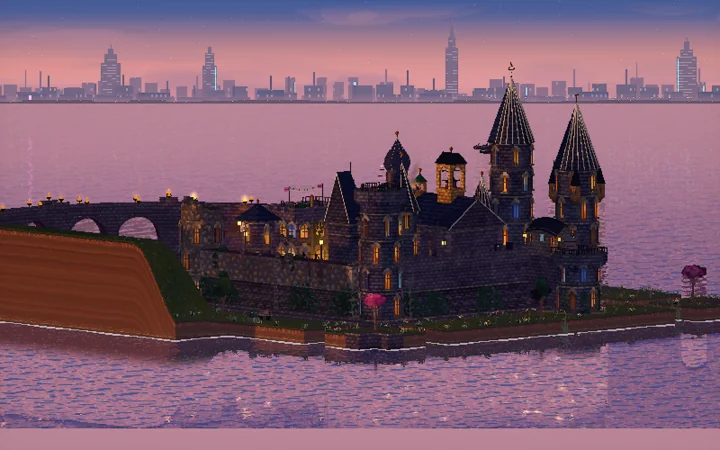
In this chapter
In this chapter
A tray that sorts itself
Before the stages that add cards, the part tray was reorganised. Each card now belongs to a group, and the Details and Garden trays draw a small header over each one: Lighting, Signs, Rooftop, Services and Waterside in Details; Trees, Beds and pots, Furniture, and Climbers and ironwork in Garden. With the tray open, typing filters every card in every category by its title, and the status line reads “Find: lan · Esc clears”. A row of the last six kinds placed sits in the tray’s title line and is remembered between sessions. At 1600 by 1000 the Details tray grew from 248 pixels with a scroll bar to 370 pixels showing all 21 cards.
The plan wanted every letter to start the filter apart from V, R, G and D. That would have turned P, the photo-mode key, into a filter letter and broken five checks from the controls fixes. A ruling kept the letters that do something: V, R, G, D, P and F always act, and H and L act only while a part is selected. Any other letter starts the filter, and once it is live every letter joins it. The match is by title, so “lan” finds Lantern, Wall lantern and Stone island, where the plan had expected the flower box. The review found nothing that had to be fixed. The suite passed with 48 suites and 27,200 checks.
Iron gates
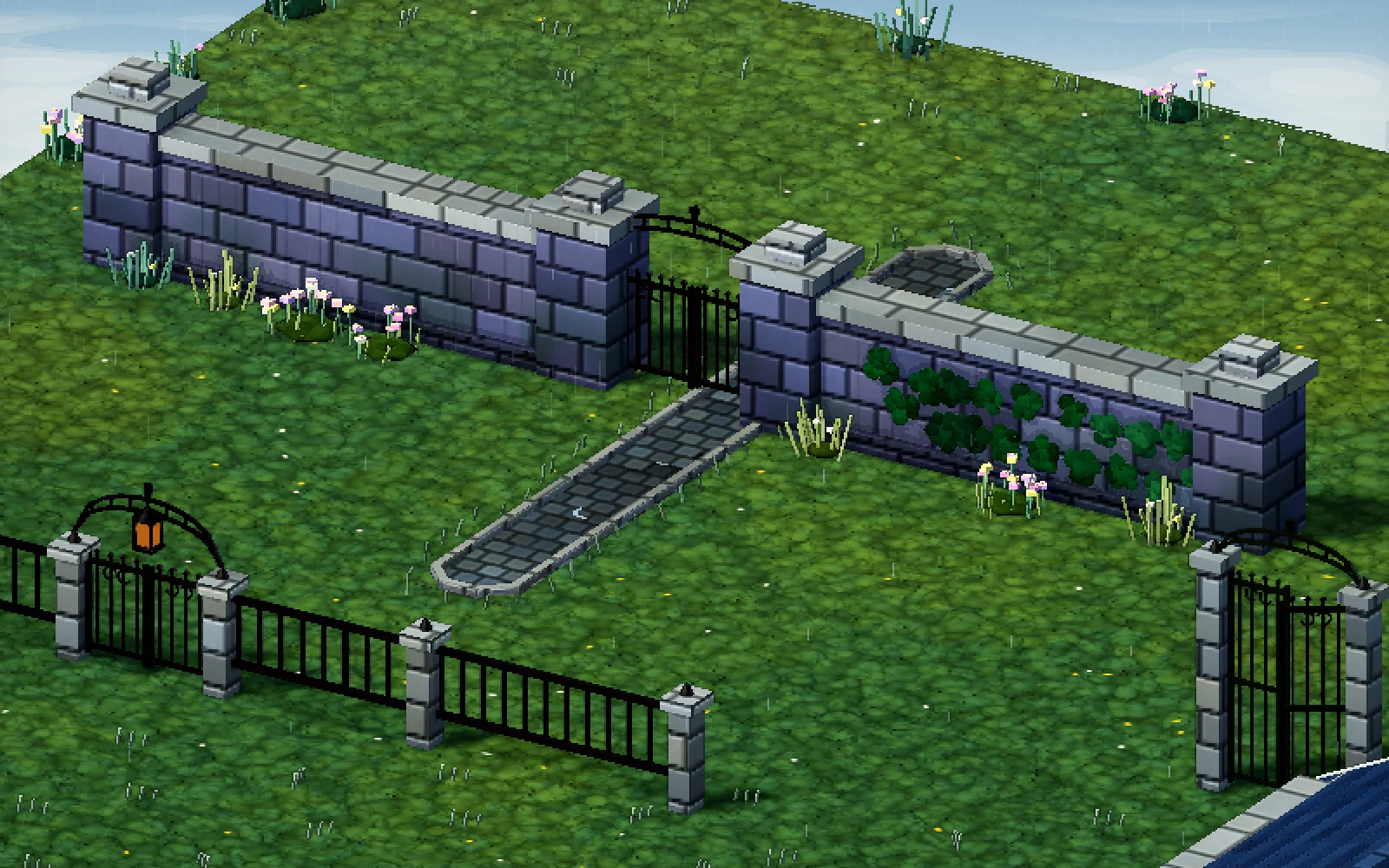
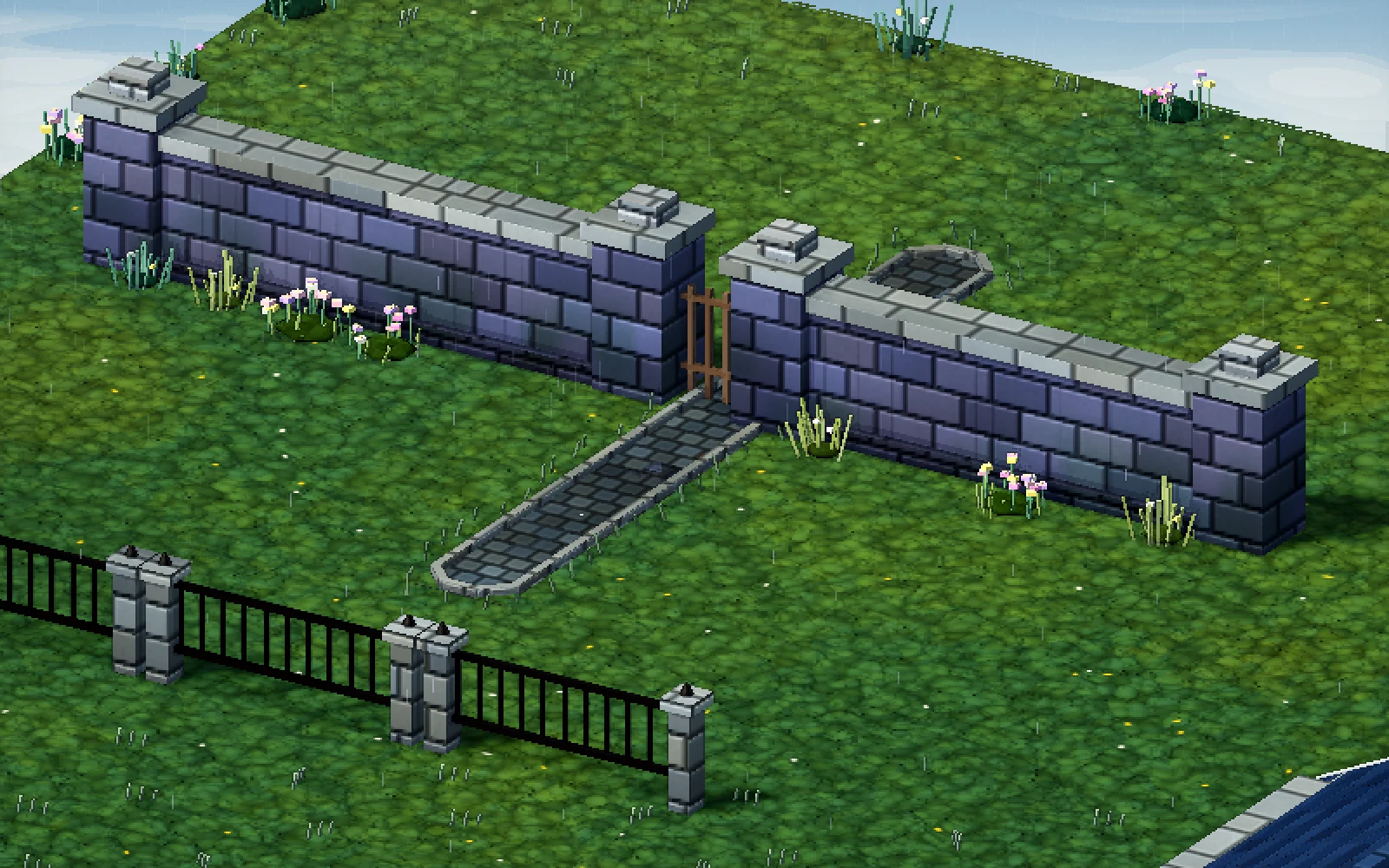
The ironwork stage began with a new card, the iron gate. It is 1 to 3 metres wide, low or tall, with a flat top, an arch or an arch with a lantern; it can stand ajar and comes in three paints. Set on a quayside railing, in the road gap of a freehand wall or on a house’s fence, it takes over that stretch: the railing or fence makes room for it and the wall’s plain timber gate goes. The takeover is worked out from the scene each time and never saved.
Three reviews found things to fix. The first fix stopped a gate on a house fence from taking more than the crossing it overlaps, or the nearest one, and from doubling posts at the joints. The second dealt with cost. Releasing a gate slid along a wall had cost 4.86 milliseconds more than before and along a fence 26.64 more, against a budget of 2; after the fix the figures were 0.16 on a railing, 1.92 on a wall and 1.09 on a fence. The last fix, a one-line bound so that curved walls are not skipped, was applied without another review round, with tests written first and the review’s probe run again. One cost was accepted: the first time a gate lands on a house’s fence, the house rebuilds once, about 206 milliseconds against 179. The suite passed with 27,318 checks.
Railings, a sign and a weathervane
A railing now has a length, from 1 to 15 metres. The plan said 12, but the Harbour’s own railings cover a 15-metre and a 6-metre stretch, and a ruling raised the limit so the quay could be railed in two placements instead of seven. Where two railings meet within 0.3 metres they share a post, and a railing comes in three styles: bars, hoops and a sagging chain. The quay magnet sets its water-side face 0.2 metres back from the quay’s lip. As built, releasing a railing cost 2.09 to 2.30 milliseconds more than before, over the budget of 2; the fix reused the drag arrows instead of rebuilding them and brought it to 1.30. Joined runs add 16 draw calls to the Harbour views and 8 to the courtyard. The suite passed with 27,502 checks.
The last ironwork part added four pieces for a house and garden. The rose arch spans 1.2 to 3 metres, and a vine climbs it when one grows beside it. The hanging basket comes in three flower mixes. The hanging sign swings on a scroll bracket with a small lamp and carries up to 12 letters in the neon signs’ lettering, or a tankard, a fish or a key when it has no words. The weathervane turns to the shared wind as a cockerel, an arrow or a gilded cockerel, and stands still with motion off. Ten such pieces in one scene cost 0.17 milliseconds and 44 draw calls, and their motion costs nothing measurable. A vane on a canal tower’s cap takes the place of the tower’s coloured pennant; asked at the part’s close, the creator kept that. The review found nothing that had to be fixed. The suite passed with 27,642 checks.
The ironwork stage was measured as a whole that afternoon. The suite passed with 49 suites and 27,642 checks. On the journey’s views the only count change was the railing part’s 16 draw calls on the Harbour; the gate part and the arrows part changed no starter. On the dense scene the slowest 5 per cent of frames moved by 0.002 milliseconds and the Harbour’s median by 0.078. Twenty smaller notes were carried forward. At about 15:49 the creator answered the stage’s sheet: “iron work looks great thanks”.
Bicycles that lean
The street stage began with bicycles. The bike card now has three styles, a city bike, a cargo bike and a bike with a child seat, and a bike within half a metre of a wall, a railing or a gate lies along it and leans 12 degrees against it. The lean is worked out each time and never saved, and Ctrl places a bike as drawn. A bike rack holds one to six bikes and draws them as one group: six bikes in a rack add 6 draw calls on a test plate, against 24 for the same bikes loose. Amsterdam’s document did not change, but nine of its ten bikes now lean on the house fronts. The tenth stands, because a piece of the front sticks out further than the bike stands from it.
Three reviews and three fixes followed. A bike now leans only when it was set down within 20 degrees of its support’s line, the lean stops at a front’s sills, window boxes and steps, and the search for a support is bounded. The last fix, made without another review round, measures a house again when an iron gate takes over its fence. Working out where a bike leans costs time the first time a scene is drawn: Amsterdam’s first sync took about 79 milliseconds longer, and a dense test scene with 30 bikes 389. That cost was accepted for now, with a switch that draws every bike standing and pays nothing. Releasing a dragged bike costs 1.13 milliseconds against the budget of 2. The suite passed with 27,867 checks.
A market and a street
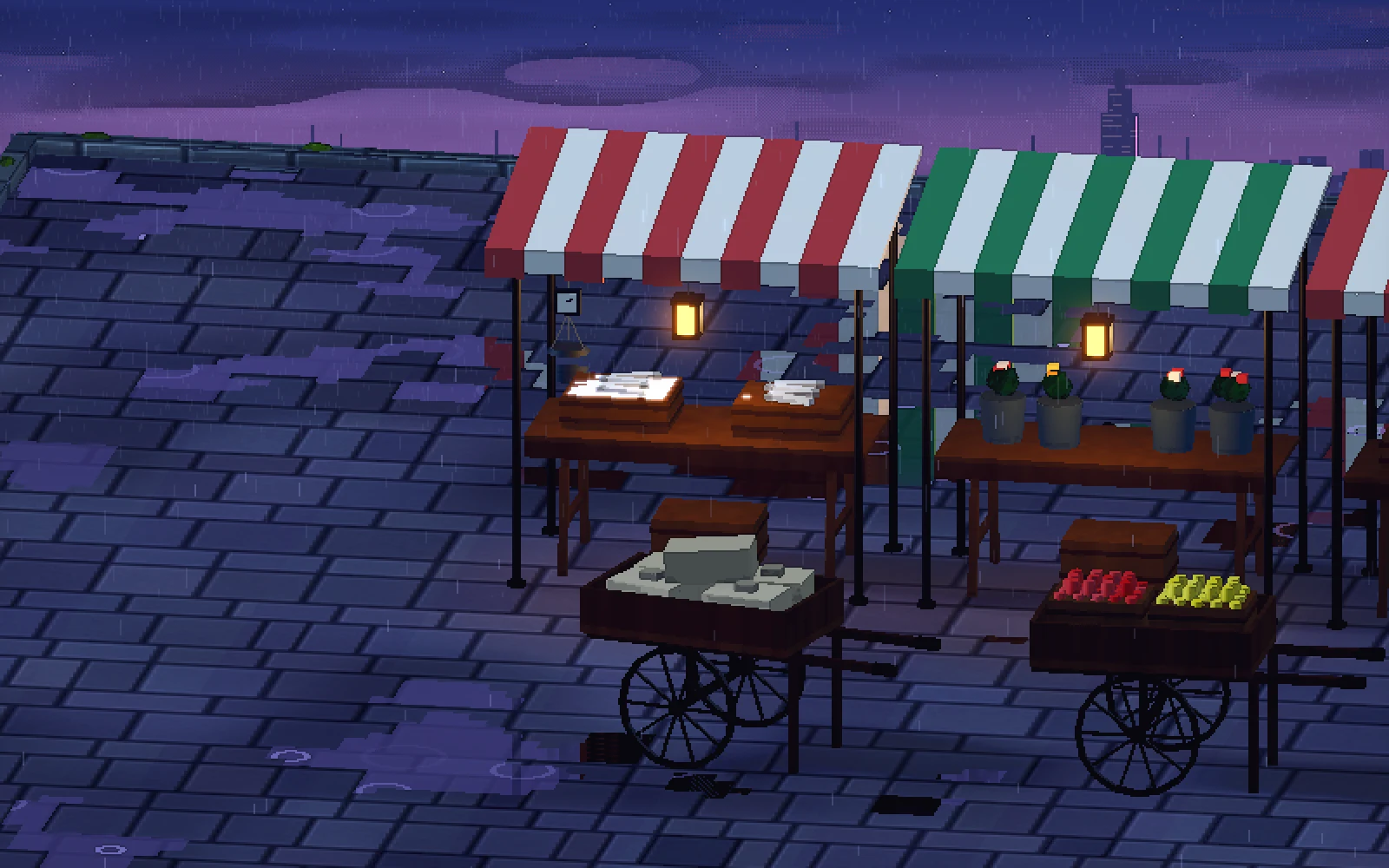
The market stall is 1.5 to 4 metres wide, under a striped canopy whose front valance moves in the wind like the flags, with a lantern and goods of fish, flowers, fruit or bread. The handcart carries sacks, crates or flowers. At the island zoom the stripes are 1.92 art pixels wide. A stall costs 14 draw calls. The review found nothing to fix, though it noted that the Harbour market’s camera saw the stall from behind, so the stage’s sheet added a red and a green stall facing the camera, lit at night. The suite passed with 28,062 checks.
The street furniture part added a post box, a fingerpost with one to three arms of up to 10 letters each, an A-board with two chalk lines of up to 8 letters, and a street clock whose hands show the scene’s time and move once a game minute. The words read only close up, not at the lane zoom, and the clock has marks but no numerals. The review found nothing to fix. The suite passed with 28,269 checks.
The street stage closed that evening. The suite passed with 49 suites and 28,269 checks, the journey’s counts were identical, and on the dense scene the slowest 5 per cent of frames rose by 0.158 milliseconds. Amsterdam’s first sync was 71.7 milliseconds longer, the cost of the bikes’ lean again. The stage was also the plan’s second milestone: a Mac zip of 66,599,908 bytes and a Windows zip of 43,482,400 bytes. The Mac app opened the Harbour at night, a street scene at night and the stalls at night and quit cleanly each time. The Windows build was exported, not run, and its checklist of 23 rows waits for a PC. The question for the creator was whether Amsterdam’s bikes should lean.
Bikes that look like bikes
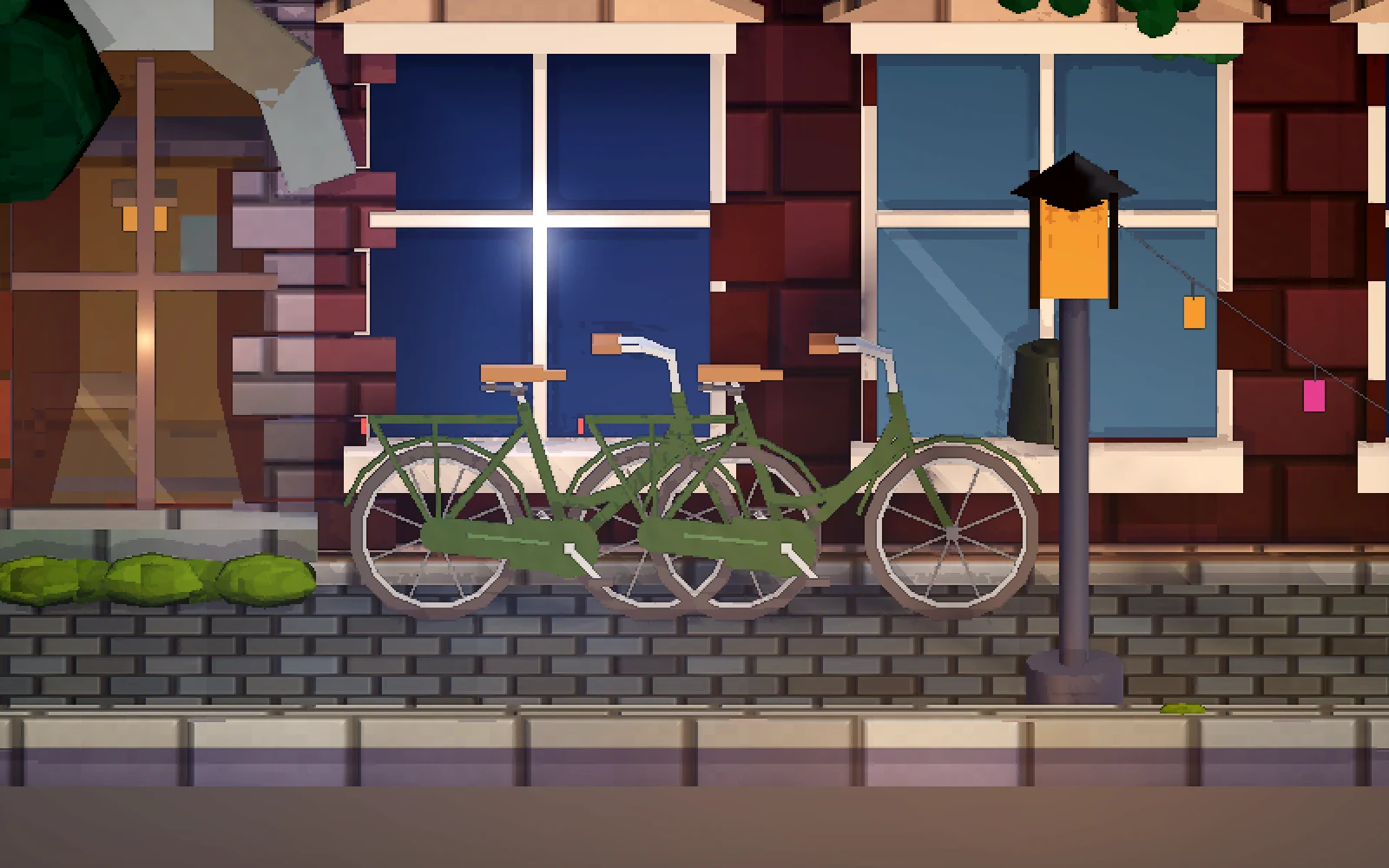
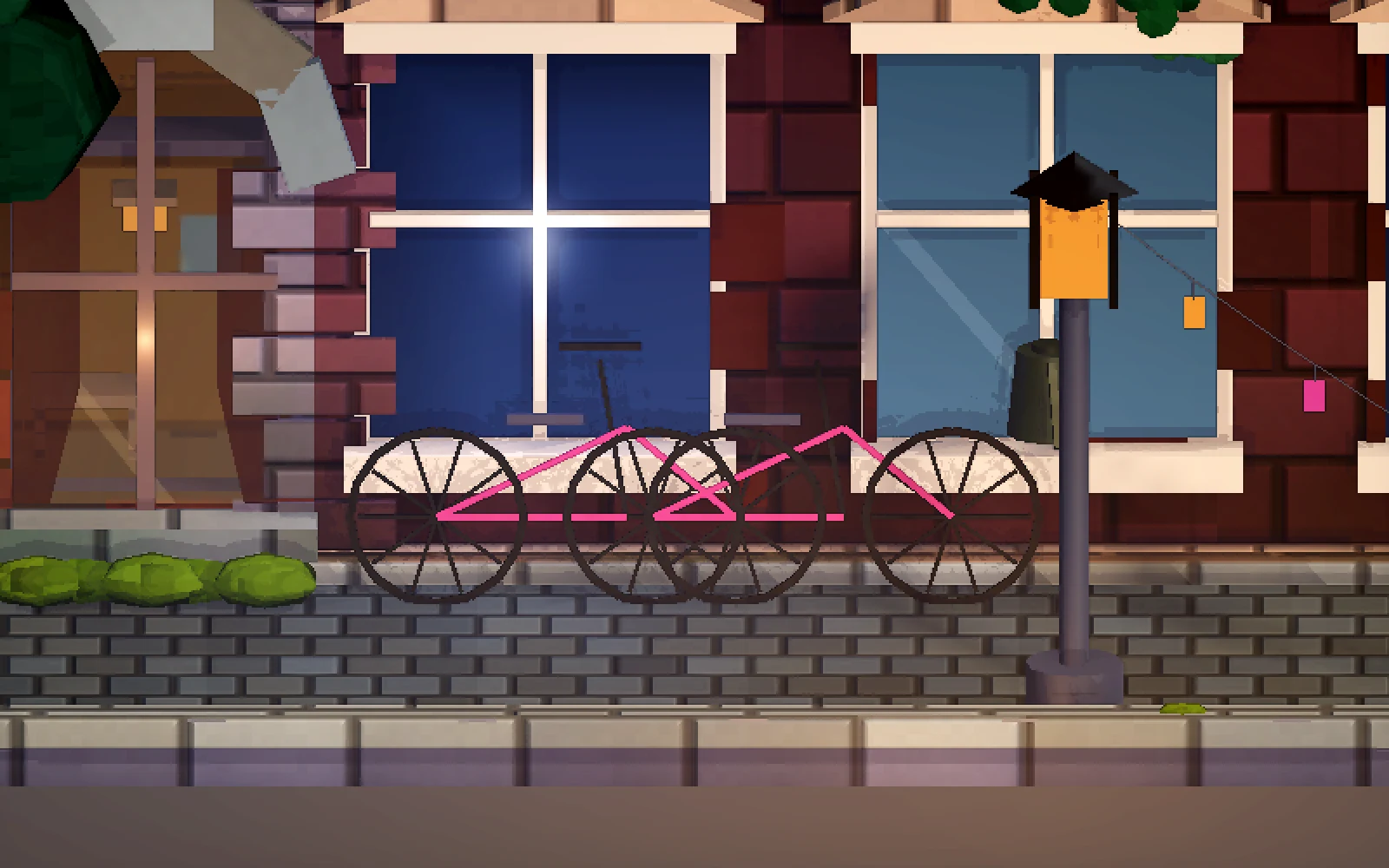
The creator looked at the street sheet on the morning of 14 October and did not decide on the lean: the bikes “don’t really look like bikes”, they said, and they sent pictures of a Dutch step-through city bike, a BMX and a road bike. That afternoon, between two castle parts, a fix part reshaped the bikes in the Dutch style: a step-through frame, mudguards, a chain guard, a rack with a red reflector, a brown sprung saddle and tall swept-back bars, on dark tyres and light rims, painted dark green by default. It added the BMX and the road bike as styles. The old default paint, Rose, became Green, and the other two paints were muted. At the default Amsterdam camera a bike is about 15 pixels long and its wheels, saddle and bars read; before, it was a pink zigzag.
Two fix passes followed the review. The first made a leaning bike touch a railing or a gate exactly. The second brought the lean search back inside its targets: a railing with six bikes costs 1.60 milliseconds more a preview frame than before the redesign (2.20 in all), a cold scene with 30 bikes takes 29.8 milliseconds longer to draw first against a limit of 30, and a railing release costs 1.78. Amsterdam drops from 488 to 472 draw calls at its bench camera. A scene with a BMX or a road bike does not open in a build from before this part, so the street stage’s builds cannot read one. The suite passed with 50 suites and 30,015 checks. Shown the new bikes at about 16:52, the creator answered “Keep the lean”, and of the paint, “Green is fine”.
A bridge that lifts
The waterside stage opened on the evening of 13 October with a seventh bridge style, the bascule, a lifting bridge of the Dutch kind. Its white counterweight frame is 3.2 metres tall and grows 0.3 metres for every metre of span, up to 5.6. A lantern hangs from a bracket outside each post, and strings of lights run from them to the quay’s lanterns. It is 1 to 4 metres wide and can be drawn raised, its leaf open at 60 degrees; a raised deck carries nothing. The review found that a bascule with landings at different heights was drawn as a plain walkway with no frame, while strings of lights still hung from where its posts would have been. The ruling followed the plan’s own test, and such a bridge is now refused at placement and at load with its own message: “A lift bridge needs both landings at one height.” The suite passed with 28,542 checks.
Buoys, pots and quay steps
The second waterside part added a buoy that floats and bobs by 3.5 art pixels, a lifebuoy for a wall or a post, a stack of one to six lobster pots, a net frame whose net moves like cloth, and a flight of quay steps with a ring that boats moor to. Its review found three faults. Sculpting the ground lifted floating things off the water; now sculpting never moves a floating or plinth prop, which also fixed the same old fault in the floating lantern. The magnet could bury quay steps; it now places a flight only where it lies over water along its whole length. And a lifebuoy pointed at a railing could stand on a plinth in the canal or, beside a moored boat, through its hull; now it stands on a post on the land side, and over water it keeps the side it was pointed from. The suite passed with 28,837 checks.
On 9 October the creator had answered the plan’s waterside question in their own words, as the plan records them: these pieces “can also organically show up where needed but be removeable and if removed dont come back”. The third part does that. A railed quay gets a lifebuoy on a post for every 8 metres, a fish stall or a fishing crate near the water gets lobster pots and a net frame, a boat moored with no line to a bollard gets a buoy off its bow, and a long quay standing well above the water gets one flight of steps near its middle. These pieces are worked out from the scene and never saved. Clicking one selects it and offers another look, keeping it, or removing it for good; G or D make it an ordinary placed part. A removal is written into the save as a short list of keys, the only new saved data in the stage, and the save format stays at version 2.
Review found removed pieces coming back. The key was the quay cell where a piece stood, so lengthening a railing, moving a boat or a crate, or cutting water beside the quay brought a removed piece back under a new key. A ruling turned a removal into a zone: a candidate is skipped while a removed piece of its kind lies within 4 metres, 3 for a buoy, or for steps within 10 metres along the same quay line. Derived steps had also turned up in odd places, in front of a railing, beside a bridge and facing each other across the castle’s moat, so a derived flight now needs a clear landing behind it, room along the lip from any crossing, 8 metres from any other flight and 5 metres of open water in front. On the starters the Harbour now draws 3 lifebuoys, the courtyard 5 lifebuoys and 3 flights of steps, Amsterdam and the canal quarter 2 flights each, and the castle none. The documents themselves did not change. The suite passed with 29,067 checks.
The waterside stage closed early on 14 October. The suite passed with 49 suites and 29,067 checks. The journey’s counts moved only by the derived pieces: 16 draw calls on the Harbour, 12 on its lane view and 6 on the canal quarter. On the dense scene the slowest 5 per cent of frames moved by 0.002 milliseconds, and the Harbour’s grip drag stayed at 53.23 milliseconds against its 53.7 baseline. The sheet’s first page asked the creator whether the pieces should appear by themselves at all, and it noted two flights that pass the rules but look tight, in an inner corner of the canal quarter and beside an Amsterdam houseboat’s bow. At about 10:01 the creator answered “Keep them on”, and agreed to push the finished work to the project’s repository.
Where the work stands
The tray part and the ten parts of the ironwork, street and waterside stages are built, reviewed and closed, and so is the bike redesign. All three stages were measured as a whole. The creator approved the ironwork sheet, kept a weathervane in place of a tower’s pennant, kept the bikes’ lean and the green paint, and kept the waterside pieces that appear by themselves. The street stage’s Windows build was exported, not run, and its checklist, like the boat stage’s, is still waiting for a PC. Those builds predate the bike redesign, so they draw the old bikes and cannot open a scene with a BMX or a road bike. Many smaller notes from the three stages were carried forward, among them the cold cost of the bikes’ lean. The castle parts, which began on the morning of 14 October, are the next chapter.
From the project notebook
This chapter draws on the project’s records as they stood on 14 October 2026.
- docs/visual-handoff.md · Decor tray groups, type-to-filter and recents entry, with its review, 13 October
- docs/visual-handoff.md · Decor iron gate, railing length and garden ironwork entries, with their reviews and fix passes, and the ironwork stage close, 13 October
- docs/visual-handoff.md · Decor bike family and rack, market stall and handcart, and street furniture entries, with their reviews and fix passes, and the street stage close and second milestone, 13 October
- docs/visual-handoff.md · Decor bike look fix entry, with its review, recheck and two fix passes, 14 October
- docs/visual-handoff.md · Decor bascule bridge, water clutter and organic waterside entries, with their reviews and fix passes, and the waterside stage close, 13 and 14 October
- artifacts/decor/owner-decisions.md · The rulings from each review and the creator’s answers of 13 October (the weathervane, the ironwork sheet) and 14 October (the waterside pieces, the push, the bikes and their paint)
- docs/decor-orchestration-handoff.md · State of the work, 13 and 14 October
- artifacts/decor/m-r2/windows-checklist.md · The street stage’s Windows checklist, 13 October
- artifacts/decor/34-R6/, 30-R2/, 31-R3/ and 32-R4/ · Per-part tests, captures, sheets, benchmarks and drag records, and each stage’s closing captures and sheets