In this chapter
In this chapter
Marks instead of ladders
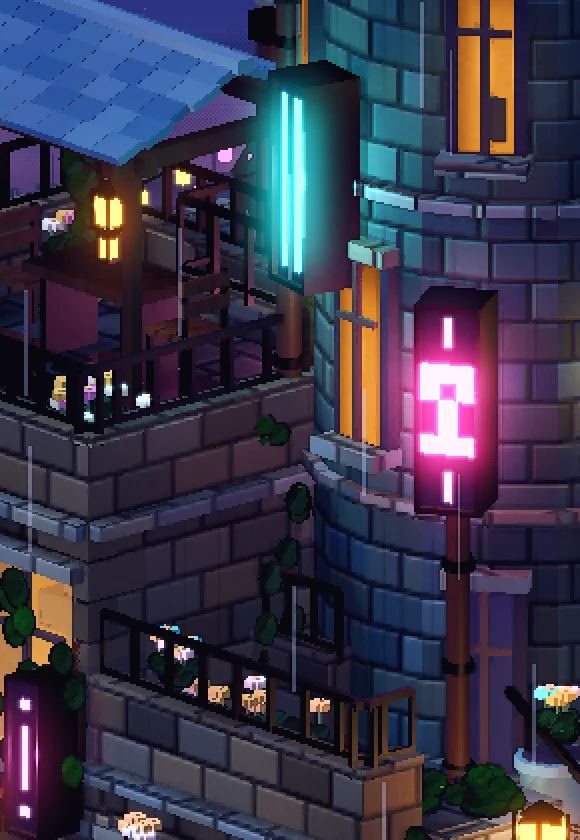
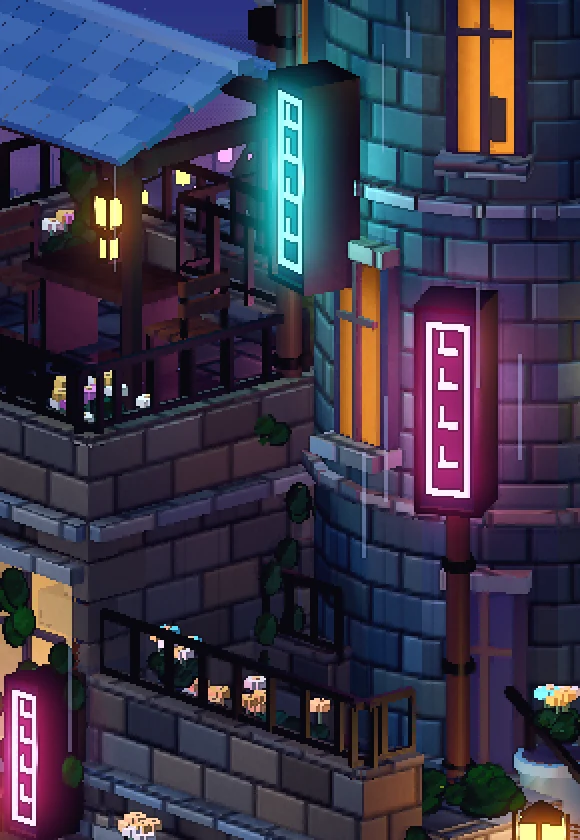
A neon sign with no lettering used to draw a ladder of four tube rungs, and 13 of the canal quarter’s 14 blade signs showed it. Each unlettered sign now draws one of twelve sets, chosen from its seed. Eight are bold marks drawn on a three-by-five grid: a cup, a fish, a star, a moon, an arrow, a heart, a cross and a note. The other four are plain tube patterns. A blade’s mark fills the width of its face with a short tube above and below; a bar sign’s mark fills its height with tubes on either side. On the smallest blade a mark’s cell is about 11 centimetres, just under the size the lettering keeps to, and on the smallest bar about 9. The creator had decided before the stage that marked blades drop their frame tubes and that the mark is not something a player picks. Cabinets, lights and the save format are unchanged.
The first capture after the change showed only four of the twelve sets in the whole town. The game draws repeated decorations from shared meshes grouped by the seed modulo four, so every unlettered sign in a group showed the same set. The set now joins that grouping. The quarter’s 13 unlettered blades show six different marks, and five of the blades carry tube patterns. That adds 35 draw calls to the quarter, 969 to 1,004, and costs it about 0.9 per cent of frame time, 6.93 to 6.99 milliseconds at night; the dense scene and the Harbour did not change. The cup and the arrow were redrawn after the first sheet, where the arrow read as a second cross. At the quarter’s zoom the cup still reads as an I, and the tube patterns put a little less light on a blade than the ladder did.
Glints under the lamps
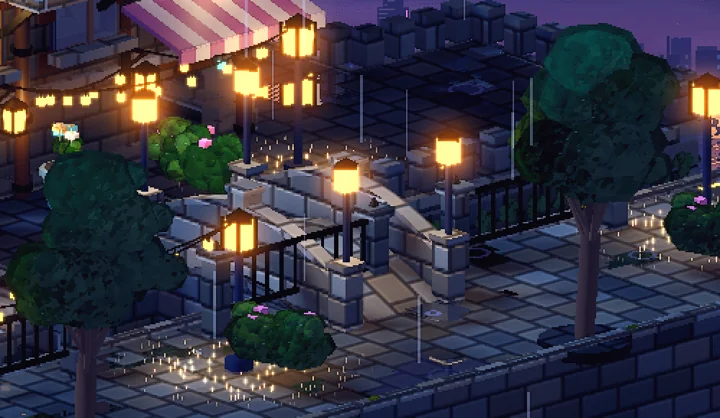
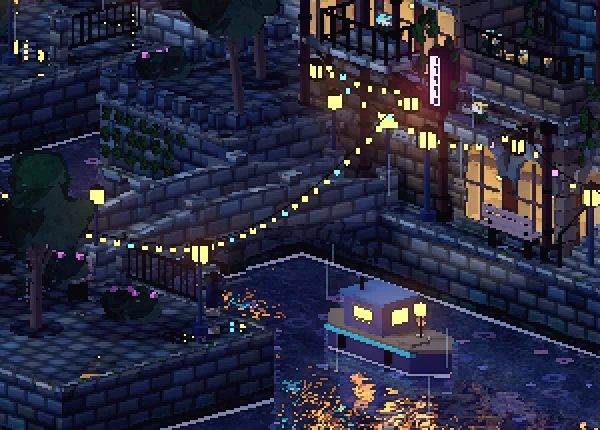
On a rainy night the paving under each lamp now glints. Inside a lamp’s pool of light, on flat ground only, small cells light a dash one pixel wide and two to four tall. About three in ten are lit at any moment, each re-rolls every 1.2 seconds on its own timing, and the glints grow with the rain and fade in with the lamps, so there are none by day. Dry scenes are unchanged, and so is the Glade at its default of no rain. The plaza’s lamps are standing lanterns that had a light but no pool on the ground, so each now carries a 3.4-metre pool that adds nothing when the ground is dry.
Review found pools hanging past edges. A lantern within about 1.7 metres of a quay or terrace edge threw its pool out over the drop, and in the rain its sheen and dashes floated over the quay wall below; 17 of the quarter’s 24 standing lanterns stood over a drop of more than a quarter of a metre or over water. The fix reads the depth behind each wet pool pixel, rebuilds the height of the surface there and fades the glints where it lies more than 0.14 to 0.22 metres below the pool. A first try at 0.08 to 0.16 metres faded the pools on flat roof terraces as well. The pools now stop at the coping line. A few dashes remain on flat cornice tops just below a pool that overhangs a terrace, and glints also fall on lawns inside a pool, since the shader cannot tell paving from grass.
The plan wanted the plaza 3 luma brighter on average. The first version reached 3.16, but only because of the sheen floating over the quay walls; after the fix it is 2.65. That shortfall was accepted overnight, and the creator kept it after seeing the sheet. Glints make up 5.8 per cent of the pool pixels on the quarter at night, under the plan’s 10. The new pools add four draw calls to the Harbour and quarter views and one to the styles showcase. After the fix the dense scene ran 0.06 milliseconds slower in the rain, and the Harbour’s slowest frames rose from 7.30 to 7.96 milliseconds, both in all three rounds.
Window cores and warmer arches
Lit windows changed in three ways. The middle of a lit pane is now a little brighter than its edge. Each lit room takes its tone from its position in the world, so tower slots and cluster bays, which used to share a single tone, vary from window to window; it also means that moving a house recolours its rooms on the next rebuild. And the large arched and cross-mullioned windows of the canal houses, which are recessed rooms behind tinted glass, lean toward amber, while the light they cast keeps the room’s own colour.
The arched windows used to read buff beside the deeper orange of the other panes. In the quarter their lit pixels moved from a hue of 30.6 at 50 per cent saturation to 28.5 at 63 per cent, inside the plan’s 26 to 31 and above its floor of 36, and they are 6 to 12 luma darker for it. The brighter cores missed their line. The plan wanted the centres of some panes to pass full brightness in red only, so that the final image pass would ring them in orange, but at the plan’s strength one pane in ten crosses it in the quarter and none of 55 in the Harbour, and no halo shows. Doubling the boost would still leave the Harbour at none and would risk the neon sign cores, so the line was waived overnight, and the creator later kept that. Frame time did not change.
The island clears the dock
In the editor the town used to sit in the middle of the whole window, with the dock along the bottom taking part of the view. The camera now lowers its eye by half the height the dock covers, so the town sits in the middle of the free area: 56 window pixels higher, or 28 art pixels, at 1600 by 1000. It moves in whole art pixels, eases into place, and eases back to the middle in photo mode. Opening the parts tray does not move the view, which is the plan’s default. Clicks still land where they should: ground picks at four points come back within a centimetre with the offset, also in the middle of the ease.
With the dock alone the Harbour’s fish market, boathouse and boats are clear, and the boats now sit about 110 pixels above the dock instead of 55. With the Landscape tray open, the fish market front is still free, but the boats stay under the tray, and a two-row tray covers part of the boathouse as well. Fixing that would mean reframing for the tray, which the plan’s default declined; it went to the creator as a question. The three floating labels, the hint, the status line and the part count, also lost their dark backing slab for a three-pixel ink outline. That reads on night water and on the pale Harbour sky, but it is harder to read than the slab on bright day water in the quarter and looks heavy against the Harbour’s day sky. Frame time did not change.
A pixel ring instead of bloom
The final image pass used to blur the brightest pixels with a seven-by-seven bloom, 49 samples for every pixel. It now draws a stepped halo one art pixel at a time: the four neighbours the outline already reads, plus a second ring of eight samples two pixels out. Each sample throws the colour of whatever stands above a brightness threshold, and each ring keeps the brightest. At night the threshold is low and the lanterns get an orange ring one to two pixels wide. One pixel out from a lantern in the quarter the brightness went from 30 to 79, two pixels out it rose by 10, and three out nothing changed. Lantern glass clips to yellow, which first made an olive ring, so a warm shift turns it orange. By day the threshold sits just above full white and nothing rings. The Glade look skips all of it.
The neon letters kept their brightness, but the dark one-pixel outline beside them became a coloured rim, so they read bolder and softer: the step from a BAR letter to the pixel beside it fell from 196 to 131. Review found the switch from day to evening too sudden. Between the 16:45 and 17:00 stops of the time slider every pixel beside sunlit white jumped from no ring to a full one, and the pink awning stripes lightened. The fix makes the ring grow from nothing as the threshold drops below white, so the late afternoon changes gradually, and at golden hour the rings are now about half as strong as before the fix.
A second, independent review found no fault in the code but corrected the record. The golden-hour ring figures had been measured with an outdated threshold. At the real one, the rings at golden hour sit on clipped white trim, awnings and bargeboards rather than on the lamps, and the pale sunlit bargeboards on the Harbour house lose their dark outline. It also found a change nobody had declared: the old bloom had lifted the whole day picture slightly, and without it the brightest daytime pixels are about 3 luma darker, with about a quarter fewer clipped to white. Frame time went down. On the dense scene the halo saved 0.33 milliseconds at night and 0.52 at 13:00, and on the Harbour 0.17 and 0.43; the canal quarter stayed within noise.
A hotter sun
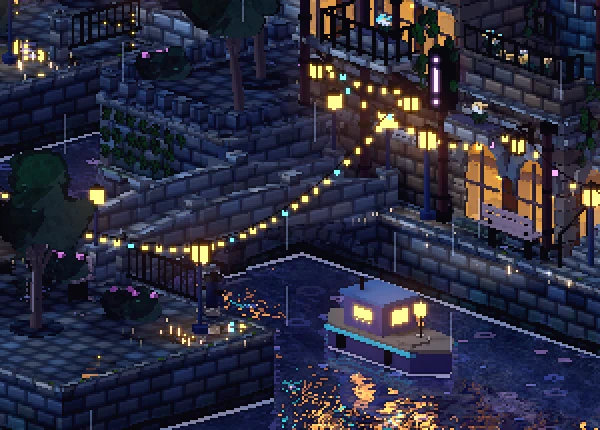
The sun’s disc used to be drawn at 1.18 times the sun’s colour, and the moon’s the same way. At golden hour the plan wanted the disc bright enough for the engine’s glow to give it a soft corona. The first version raised the whole colour, which turned the canal’s golden disc cream-white, its saturation at 06:45 falling from 27 to 3 per cent, and turned the Glade’s disc grey, because the Glade has the engine glow off and extra brightness only washed out its colour. The fix raises only the sun colour’s brightest channel, red in every look, by 1.6 plus up to 1.2 more as the sun gets low, and leaves the others at 1.18. The Glade keeps its old disc, as it stays out of the city glow, and measures identical. The moon takes 1.3 in place of 1.18.
In the canal look the golden disc’s core went from 208 to 217 on the quarter and from 194 to 205 on the Harbour, and keeps its colour at 38 and 41 per cent saturation. A corona about 9 to 10 luma brighter surrounds it, modest next to the first version’s. The glow also lays a warm orange-red rim on dark shapes right beside the disc: at 06:45 a facade next to it gained 23 luma and turned orange, and clouds and smoke in front of the disc read fainter. The moon is slightly whiter. The plan set no benchmark for this change, and draw calls are identical.
The stage measured as a whole
The checks that closed the stage ran on the final code on 1 October. The full suite passed with 40 suites and 21,367 checks and no failures, and the integration check at 2880 by 1800 passed on the first try. On the journey views the counts changed only as the parts had declared: the quarter from 969 to 1,008 draw calls, the Harbour from 889 to 893, the lane from 733 to 737 and the styles showcase from 469 to 470. At night those views show the orange rings, the glints on wet paving and the new sign marks; the day views are nearly unchanged.
Most protected looks held. The canal’s mirrored columns are the same streaks, and the Glade, the 05:45 and 20:45 zeniths and the approved tree style measure the same. Two changed as the parts said they would: the neon letters keep their brightness but take the coloured rim, and the 20:45 horizon is 1.1 to 1.4 luma darker now that the bloom’s lift is gone, which does not show. With the glints and the rings together, the quarter’s plaza at night is 4.7 to 4.8 luma brighter.
The stage made the game faster. Timed against the build from before it, with vsync off at 1920 by 1080, rain at 0.45 and mains power, over three interleaved rounds at night, 13:00 and 19:30, the final code was faster in all 18 paired rounds. The dense test scene went from 13.24 to 12.87 milliseconds at night, 13.21 to 12.49 at 13:00 and 15.15 to 14.78 at 19:30; the Harbour went from 6.77 to 6.46, 6.70 to 6.10 and 6.51 to 6.15. The halo’s twelve samples in place of the bloom’s 49 more than pay for the extra signs and pools. The rise in the Harbour’s slowest frames that the glints had shown is gone at stage level, although at 13:00 those frames were slower in two of three rounds, inside a spread of up to 1.3 milliseconds between rounds.
Before the stage was closed, a check of the written records against the saved files corrected twelve statements in the notes on its parts. Among them, a framing check for the halo captures had been reported as clean when six of its thirteen views had shifted between sets, the machine load during the halo benchmark had not been recorded after all, one noise figure belonged to an earlier round, and the dock’s replay matched the plain run at only one step instead of from that step on.
Where the stage stands
The stage is closed. Its nine-page summary sheet asked the creator about the plaza’s glints at 2.65 instead of 3, the window cores that do not ring, whether to reframe the view when the tray is open, how strong the golden-hour rings should be and whether the neon letters should keep a dark outline, the warm rim beside the sun’s disc, and glints on lawns and cornice tops. Making the sheet turned up four more things, left unchanged: the fish market and bar signs read bolder but less crisp; a small box sign on the quarter’s right block is almost unlit at night, because a tree hides most of its new mark and its soft glow is gone; the moon’s cloud dither is fainter; and an orange-red rim sits beside the 06:45 disc. On 2 October the creator approved all of it as built, which signed the stage off. The plaza stays at 2.65 with the glints on lawns and cornices, the window cores keep the plan’s strength, the view does not reframe for the tray, so the boats still sit under the open Landscape tray, and the halo rings keep their strength, with a coloured rim in place of the neon letters’ dark outline. The disc keeps its gains, its warm rim and the fainter moon dither, and the cup that reads as an I, the dimmer tube patterns and the dim box sign stay too.
A seventh planned change, hills in place of the grey city behind the Glade, was dropped by the creator on 1 October. The milestone build exported that day was made from the code before this stage and does not contain it, and no build was planned after it. Everything ran on a Mac; Windows was not run.
From the project notebook
This chapter draws on the project’s records as they stood on 2 October 2026.
- docs/visual-handoff.md · Beautify bold neon marks entry, with its review, 1 October
- docs/visual-handoff.md · Beautify wet glints in the lamp pools entry, with the review fix and recheck, 1 October
- docs/visual-handoff.md · Beautify window cores, styled glass and arched interiors entry, 1 October
- docs/visual-handoff.md · Beautify island visible with the tray open and outlined labels entry, 1 October
- docs/visual-handoff.md · Beautify pixel halo ring entry, with two fixes and two reviews, 1 October
- docs/visual-handoff.md · Beautify sun and moon disc gain entry, with its review fix, 1 October
- docs/visual-handoff.md · Small-items stage close: suite, journey, protected looks, whole-stage benchmark, summary sheet and handoff-check corrections, 1 October
- artifacts/beautify/owner-decisions.md · Rulings made while the creator was away and the dropped Glade hills, 1 October
- artifacts/beautify/owner-decisions.md · The creator’s approval of the stage’s summary sheet, 2 October (added 5 October)
- artifacts/beautify/23-P5/ · Per-part captures, metrics, benchmarks and suites, and the stage-close captures and sheet