In this chapter
In this chapter
A new plan
With the polish stage done, the next plan turns to things to put in the town and to how the editor handles. It lists resizable boats, iron gates and railings, bikes and street life, and pieces for the waterside, followed by control and interface work: an input map, grips for every prop, the camera, tray groups, the save dialog, preferences and key rebinding. The creator answered its fourteen questions on 9 October and said yes to all of them. That added a jetty, a waterside set whose pieces may also turn up on their own where a scene suits them and stay gone once removed, selecting several parts at once, gamepad controls and groundwork for translation. The creator also asked for each milestone’s build to be run on a Windows PC from a checklist. No part in this chapter has been run on Windows yet.
Fixes before features
The first part fixed two faults that a read-through of the code had predicted, and both showed up in tests written before any change. In photo mode the editing keys still reached the hidden selection. Backspace deleted the selected house, and other keys changed the scene, the brush or a pending move behind the camera. Photo mode now swallows every key that is not its own. Undo and redo, save, Esc, P and F12 still pass through, and the free camera still flies. F is swallowed as well, because it would move the camera onto a part that cannot be seen; that was a ruling made after the review, and the creator can reverse it.
The second fault was that pressing Esc during a grip drag kept the drag. Esc now puts the part back as it was when the drag began, adds no undo step and leaves the part selected, and one function does this for every kind of grip. The review wrote its own scratch tests for the grips the part’s tests skipped, among them building height, roof ridge, neon size and tree spread, and found each one restored byte for byte.
Two small additions came with the fixes. Shift+R turns a part the other way, and the comma and full stop keys turn the selection by 15 degrees, one undo step a press. The help dialog and the README now describe arrows where they used to describe boxes and knobs, and list double-click to move and the photo-mode keys. The suite passed with 47 suites and 26,396 checks. The photo bar’s hint still does not list undo and save; that was left for the interface work later in the plan.
Boats of any length
A boat can now be anything from 2.4 to 14 metres long. A boat without a length is 3.6 metres and is drawn exactly as before. An arrow at the bow and one at the stern stretch it: the end you hold follows the pointer while the other end stays put, and Shift steps by half a metre. The curved arrow the buildings use turns it, in 15-degree steps with Shift. The bow and stern are fixed pieces and the middle stretches. From 3.6 metres up the cabin keeps its size near the stern and the mast and lamp keep theirs near the bow; on a shorter boat the fittings close up. A boat that starts on the water stops growing where its new length would run onto land. Reeds and lily pads keep clear of a long hull, and a 14-metre boat heaves 0.35 times as much as a short one.
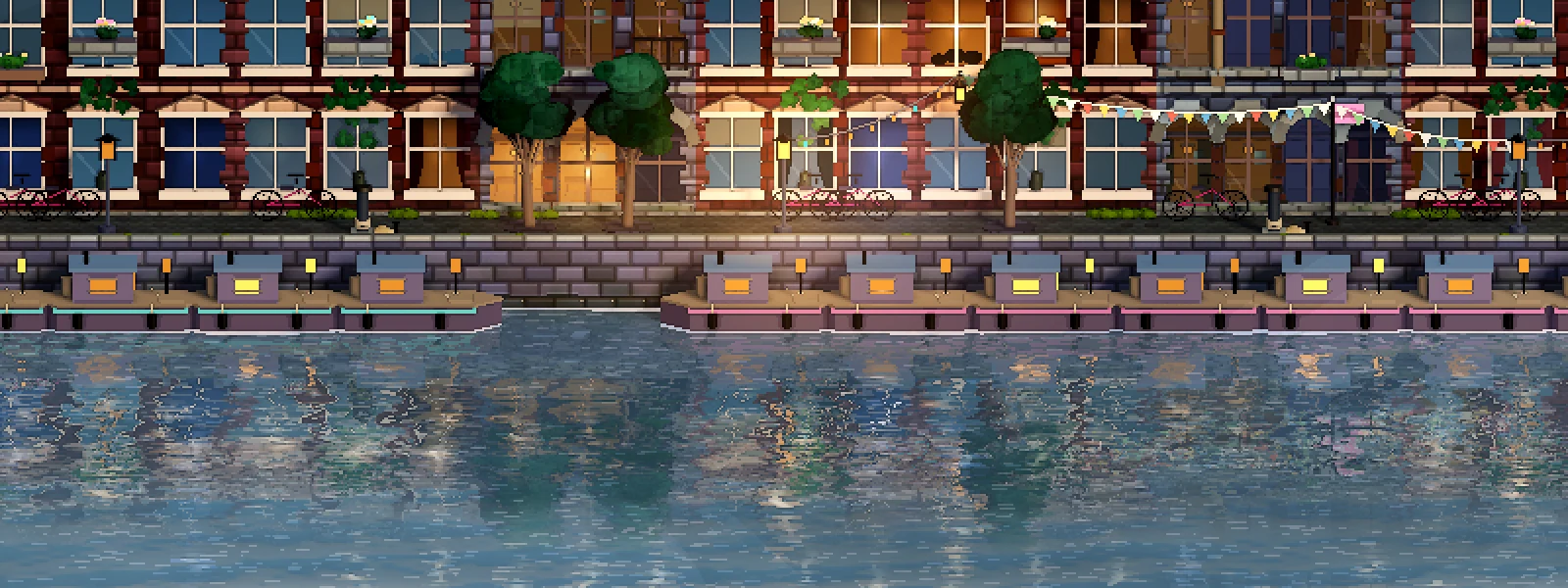
Stretching a boat on the Harbour took 22.6 milliseconds at the slowest 5 per cent of steps, against 53.7 milliseconds for the grips in the Harbour’s recorded drag test. In Amsterdam the part joined each row of small moored boats into one long boat of 14, 14 and 9.5 metres. With only the old cabin on board they read as empty barges with one small wheelhouse each, so a ruling after the review kept the Amsterdam starter on its sixteen small boats until the boat styles were ready. The review’s one must-fix was a pair of tests that ruling changed. The fix pass also stopped a beached long boat from tipping like a short one, which had moved a 14-metre hull’s ends by about 0.84 metres; the tip now shrinks with length. The suite passed with 48 suites and 26,554 checks.
Two gaps were handed on. The turn arrow and the inspector’s Length row could still swing or stretch a hull over a quay, and at normal zoom a long boat’s smaller heave rounded to nothing, so it sat still.
Six kinds of boat
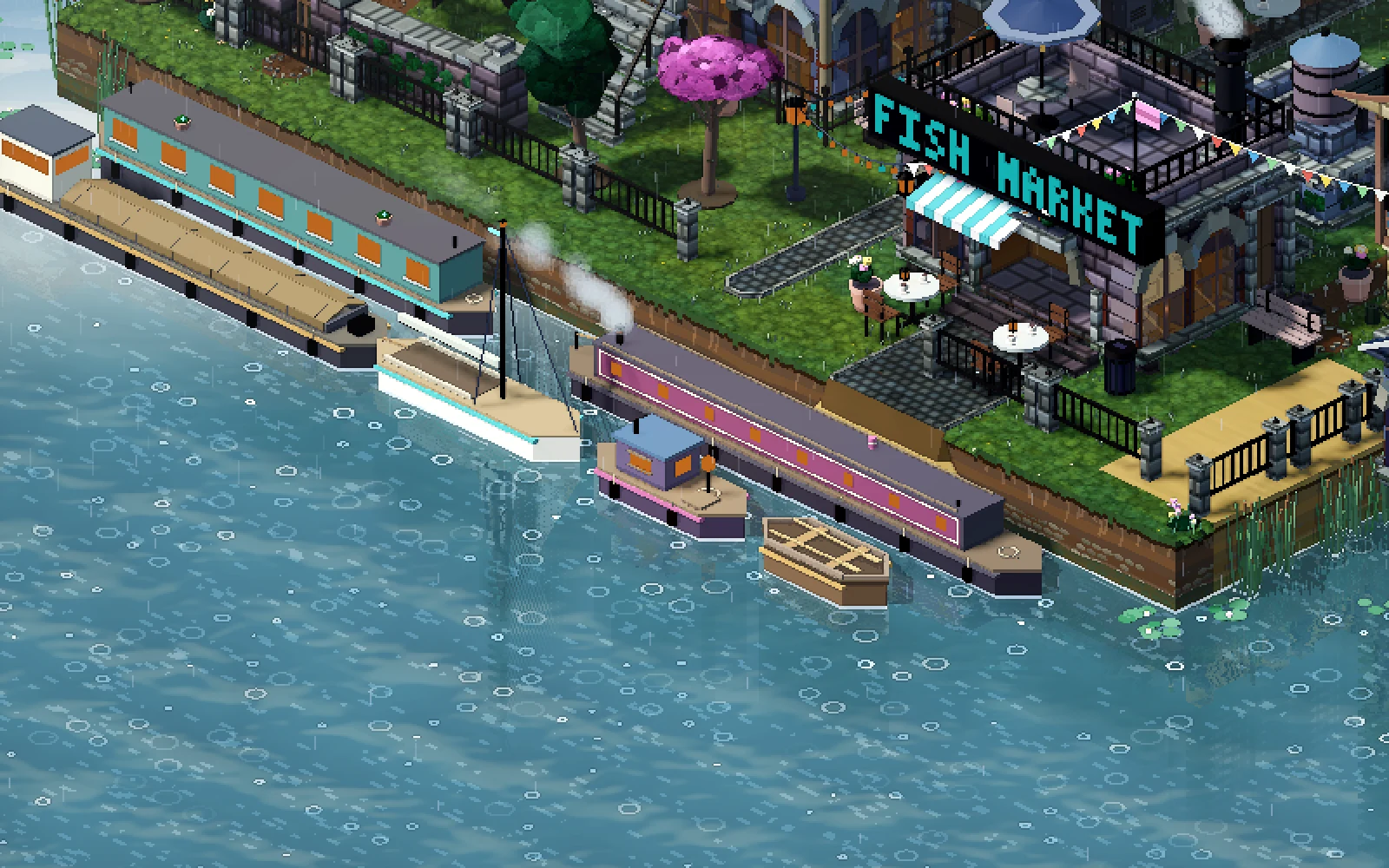
The creator asked for all six boat styles the plan proposed, up to 14 metres. The cabin boat is the old boat, unchanged byte for byte at every length. The narrowboat is a low painted cabin with cream lines, square windows and a stove chimney that smokes. The barge has a wheelhouse at the stern and a hold under a ridged tarpaulin. The rowing boat is an open hull with thwarts and shipped oars. The sail boat has a pale hull, a mast with stays, a furled sail, a pennant and a riding light that comes on with the lamplighter’s round. The houseboat has a full-length flat-roofed cabin with big windows, pots on the roof and a post at each end for strings of lights.
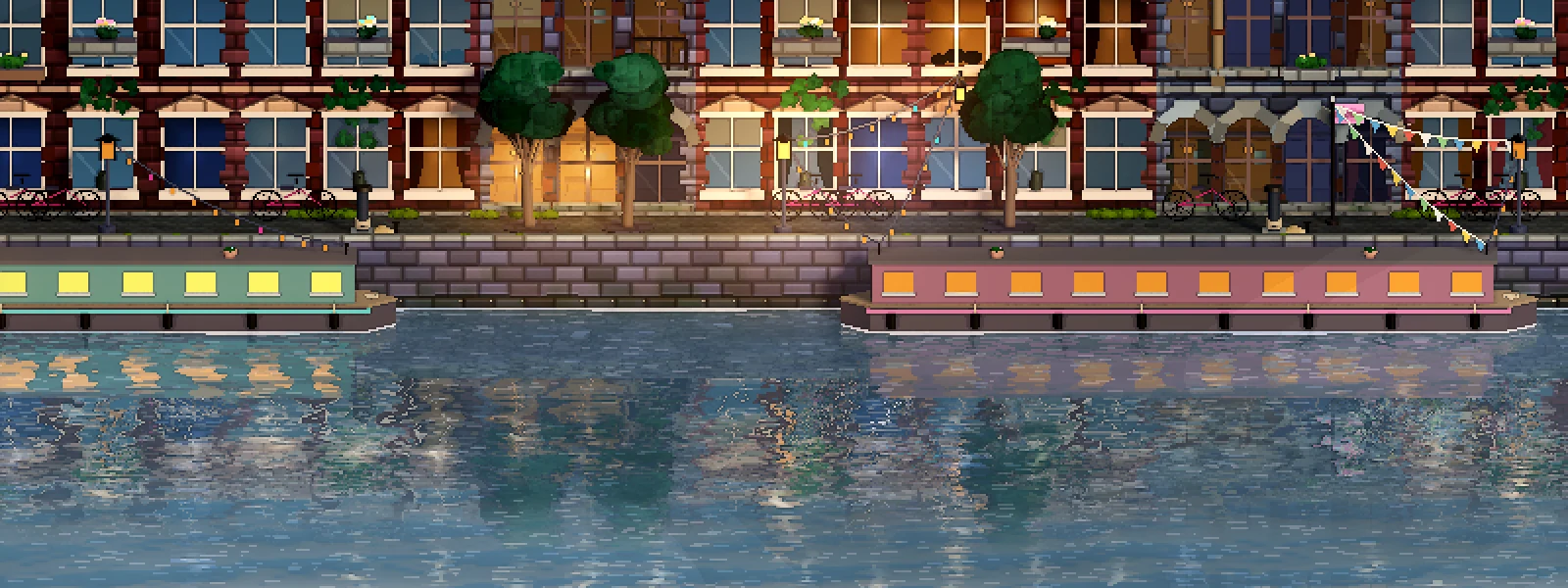
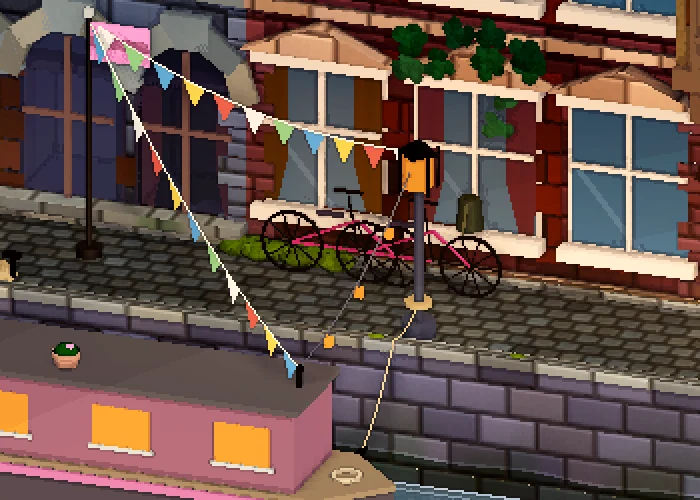
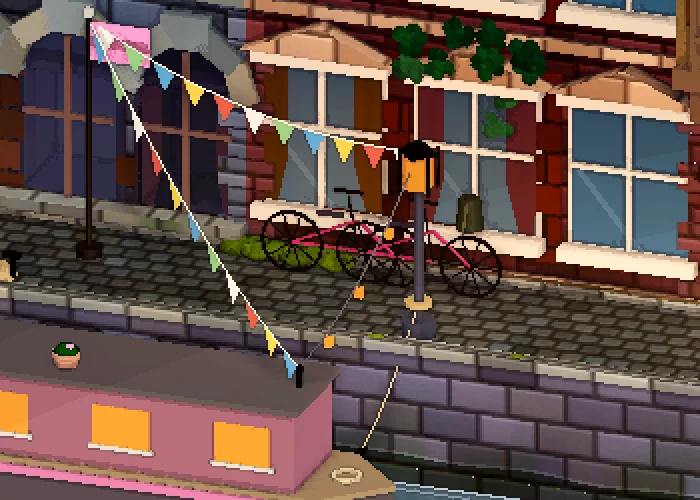
Each style has its own length range, from 2.4 to 4.5 metres for the rowing boat up to 6 to 14 for the narrowboat and the houseboat. Outside its range a style is drawn as the cabin boat and the inspector says so, so a scene never becomes invalid. One boat of each style at its longest uses 16 lights at night, the most the engine draws at once. A barge’s wheelhouse roof is a perch for sparrows and a houseboat’s roof is a place for the cat to nap. In Amsterdam the three long boats are now houseboats and ship that way, and a lantern’s string of lights runs to one houseboat’s post and a flag’s bunting to another’s.
Long hulls now heave as well. Where a short boat bobs by one art pixel and a long hull’s smaller heave would round to nothing, the long hull moves one pixel on a slower swell, about 10.5 seconds for a 14-metre boat. Timed on a test Harbour with one boat of each style, at 1920 by 1080 in rain at 21:00, the median frame was 7.27 milliseconds against 7.22 with every boat drawn as a cabin boat, inside the spread of the old code’s rounds. A second set run in the other order flipped the sign, and with the order taken out the difference was about 0.003 milliseconds. The review found nothing that had to be fixed. The suite passed with 48 suites and 26,754 checks.
The sail and the tarpaulin follow the flags’ wind rule, so they stand still with motion off and never move more under Reduced than under Full. The plan had asked for them to rest under Reduced; asked about it, the creator chose on 12 October to keep the flags’ rule. Not done: the houseboat’s windows do not show the lit rooms the houses have at night, washing is never strung to a houseboat, and the cat, the string ends and the chimney smoke sit at the boat’s resting height instead of following its one-pixel bob.
Tying up at the quay
With snapping on, a boat let go within 1.5 metres of a quay turns parallel to it and lies 0.35 metres off; holding Ctrl places it as drawn. The quay finder reads only the terrain, so it works on any quay and leaves buildings, bridges and every other part alone. A moored boat then gets mooring lines to the nearest bollard, mooring rope, lantern post or houseboat post, a boat alone on open water gets a red and cream buoy, and fenders hang only on the quay side. The creator had chosen for these lines to be worked out from the scene each time, so none of it is saved or goes into undo. The turn arrow and the Length row now stop where the hull would leave clear water, with a short message that says so. On a houseboat’s post a line ties at the foot while strings of lights hang from the top.
In the shipped scenes the Harbour gains a buoy for one boat and one-sided fenders on another, the rainy canal courtyard gains one line to a bollard, and Amsterdam’s houseboats tie up to a bollard, lantern posts and a mooring rope. The Harbour views gain 3 draw calls.
Review found the lines going through the quay wall. Each line was one straight, sagging rope from the boat’s cleat to a post on top of the quay, and where it crossed the edge it ran under the stone: five of six lines in Amsterdam, with up to 1.73 metres of rope inside the masonry, the courtyard’s line and every quay line in the test scene. A line could also run back along its own hull, 3.35 and 9.74 metres of it in two probe cases. A ruling followed: no spring lines for now, so a bow line ties to something beside the front half of the boat and a stern line to something beside the back half. The creator was asked and on 12 October chose to keep it: no spring lines, and a long boat whose reachable posts all stand beside its front half keeps a single line.
The fix bends each rope at the quay’s lip. It rises from the cleat to a point just past the coping, then crosses the quay top to the post, with each span’s sag limited so it stays above the ground; a line that cannot be drawn that way moves on to the next anchor. Afterwards no rope ran under the ground or over a hull in any of the scenes checked, and the lowest rope over land was 11 centimetres above it. Amsterdam went from six lines to four: its two 14-metre houseboats keep only a bow line, because every post within reach stands beside their front half. A recheck over 813 generated lines found no rope under the ground. On low quays a rope can still dip onto the coping in a V, in 21 of the 303 generated lines on the Harbour and in none of the shipped scenes, and at a glancing angle the first span can clip the coping by up to 13 centimetres.
Dragging a boat along the Harbour quay with the magnet, the slowest 5 per cent of steps took 21.5 milliseconds against 21.0 before, inside the spread between runs. The first time the magnet engages in a drag costs one frame of about 66 milliseconds, probably its guide being prepared on first draw; that was noted for the next part. The suite passed with 48 suites and 26,888 checks. Not done: cleats appear only where a line ties, the buoy does not bob, and the lines tie at the boat’s resting height without following its heave.
A jetty that floats
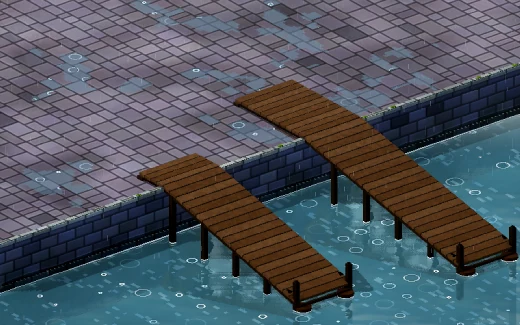
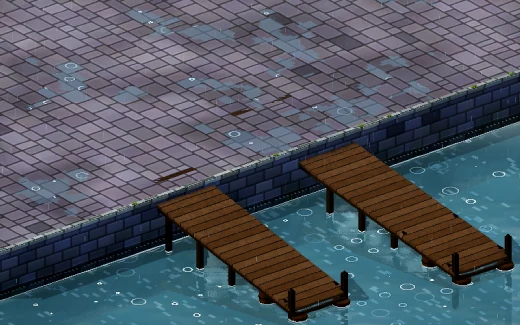
The creator had asked for a jetty, and it is a sixth bridge style: timber planks on barrel floats running from a quay out over open water, 1 to 2 metres wide, with its water end 30 centimetres above the water. It is the one bridge that may end on water. A jetty from the quay to the water is valid, drawing one with both ends on water is refused, and every rule that changed applies to the jetty style only, so a stone or timber bridge with the same ends still needs two landings. Where the deck is low over the water it rests on pairs of hooped barrels every 1.5 metres, and where it is higher on piles. It has cleats every 2 metres wherever the deck is no more than 0.6 metres over the water, boats berth beside it and moor to them, and a lantern can stand on the deck. Carve away the quay under its land end and the jetty floats whole at deck height and stays valid; paint the quay back and the land end sits down on it again.
The part also took on the moorings’ leftovers. A rope now runs straight wherever a straight sagging rope clears the coping and bends at the lip only where it would not, so low quays lose their V, and at glancing angles the bend moves to the coping’s face. The rope test now checks a buoy line against its own boat, and the drag recorder fails loudly when a drag is cancelled. One leftover was not met: warming up the magnet guide’s material at load did nothing for the 66-millisecond frame the first time the magnet engages. The game’s full shader warm-up removes it, so it is a first-draw compile, but which piece of it was not found, and it was handed on to a later part that redraws the grips and guides.
Review found three things to fix. A jetty whose land end sat back from the quay’s edge buried its deck in the quay, up to 0.43 metres under the paving with the land end 6 metres in, and the tests’ own example did this. A buoy could sit under a jetty’s deck. And a steep straight rope could slip through the coping between two samples taken 5 centimetres apart. The rulings were that a deck must never sit under the ground and that a buoy and its line must keep clear of a deck. The first fix runs the deck level over the land and then down a gangway from just past the quay’s edge to the floats. The level stretch stands 0.18 metres above the paving, not at its height as the ruling first put it, because planks laid at ground height flickered through the paving and the coping cut across them; that change was accepted as a ruling too. A jetty whose gangway would be too steep is refused, a boat that would put its buoy near a deck gets no buoy, and ropes near a quay side or a deck edge are now checked every centimetre.
A recheck found that ground rising under the level stretch could still bury it, by 0.42 metres on a quay that rose 0.6 metres toward its edge. The second fix sets the stretch 0.18 metres above the highest ground beneath it and adds short posts where it stands higher than 0.3 metres over the ground. Raising the terrain under a jetty lifts the deck with it, and a raise that would make the gangway too steep is refused. The same recheck found that clicks missed the raised stretch at low camera angles, 33 of 60 test rays at 20 degrees; after the fix none missed, and a final recheck closed every finding. The finer rope checks roughly triple the time it takes to work out all the moorings in the quay scenes, from about 1.0 to 3.2 milliseconds in Amsterdam, paid only on a full update and never during a drag. The suite passed with 48 suites and 27,109 checks. No journey scene has a jetty, and the Harbour’s counts did not change.
Not done: painting land, as opposed to raising it, under a gangway can leave a jetty too steep and refused until it is moved, though never buried. Jetties at some angles to the quay have piles inside it. The jetty does not bob with the water, boats tie only to cleats on its lower part, and there is no film of placing one.
The boat stage as a whole
Just after midnight on 13 October the boat stage was measured as a whole, on its final code and against a copy of the game from before its first boat part. No game code changed. The full test suite was not run again, because nothing had changed since the jetty’s last fix pass, which passed with 48 suites and 27,109 checks. On the six views the journey records at every stage, the only change that belongs to the boats is the one the moorings part declared: 3 more draw calls on the three Harbour views, for one buoy with its line and a one-sided fender. The pixel font, built on 9 October inside the same window, accounts for the rest. The looks protected since the polish stage stayed inside the noise between sittings, apart from a faint band of cloud dither at the top of the Harbour’s night sky. A third copy of the game, with only the font part added, showed that band coming from the font part.
Timed at night on the dense test scene, the stage added 0.023 milliseconds at the slowest 5 per cent of frames, against a stop line of about half a millisecond. On the Harbour the median frame went from 6.886 to 6.862 milliseconds. The bench ran only at the 01:00 setting. Dragging a boat along the Harbour quay with the magnet, the slowest 5 per cent of steps took 19.68 milliseconds and the release a median 35.87, both under the 53.7 milliseconds of the Harbour’s recorded drag test. The slowest single step in each run, 153 to 158 milliseconds, came the first time the magnet engaged, as the moorings part had measured it in the same script, and it was handed to the next part.
The closing sheet for the creator has eight pages: the boats at every length by day and night, the inspector’s rows, the six styles, the moorings, the quay magnet, the jetty, Amsterdam before and after, and the existing scenes. It notes one small fault: the inspector describes every boat as a narrow canal boat with a lit cabin, whatever its style. The move and resize arrows are on no page, because the automated captures hide them. The records still list this sheet as waiting for the creator; no answer to it is recorded.
The stage was also the plan’s first milestone: a Mac and a Windows build of the game as it stood, and a checklist for running the Windows one. Both exported at 01:09 with no error in either log. The Mac zip is 66,483,580 bytes and the Windows zip 43,362,571 bytes. On the Mac the exported app opened the Harbour at night and a jetty scene at night and quit cleanly, and the jetty frame was looked at. The Windows build was exported, not run. Its checklist has 24 rows for the creator or a session on a PC: unzipping and launching, the two starters, placing a boat and using each arrow, the six styles, the magnet and Ctrl, the mooring lines, a jetty with a boat and a lantern, undo and redo, saving and reopening, the pixel font at three window sizes, photo mode, a capture and quitting. It is still waiting for a PC. As the creator had asked on 12 October, the close also moved 70 captures the journal would not use, 56.5 MB, to the macOS Trash.
Arrows that stay sharp
On 12 October the creator asked for the move and resize arrows to be easier to read, because at some zoom levels they were hard to make out. The arrows were 3D shapes drawn in the game’s low-resolution art frame and scaled up with it, so at larger pixel sizes their outlines turned into steps, and a size limit made them shrink or swell past certain zooms. Of the fixes offered, the creator chose to keep the same 3D arrows and draw them at the window’s full resolution. The part waited for the creator’s own confirmation, which came at 06:43 on 13 October, and ran that morning, after the tray and gate parts that open the next chapter.
The arrows now draw in a layer of their own at the window’s resolution, smoothed at the edges, and that layer is laid over the finished frame after the tilt-shift blur and before the interface. The size limit was widened so far that an arrow keeps the same size on screen at every zoom. A new set of 53 checks confirmed that the size held within 0.001 from a 10-metre to a 95-metre view, and that over 120 window layouts the layer never sat more than a hundredth of a pixel off the art frame. On the comparison sheets the arrows had stepped at pixel size 2 and broken up at 3 and 4; afterwards every pixel size showed the same smooth arrow. At near zoom the old limit had drawn them 1.7 times larger. The suite passed with 49 suites and 27,371 checks.
Drawn outside the art frame, the arrows lost the frame’s one-pixel ink edge and looked a little paler, with a thinner dark rim. The creator saw the sheets at about 10:28 and gave two answers: keep the steady size, and thicken the rim. A measurement review found that the layer cost 0.78 to 0.79 milliseconds a frame at 2880 by 1800 while arrows showed, more than the part’s own 0.58 but under the 1-millisecond stop line, and a ruling accepted it. The review also found that the layer kept its full-size target in video memory after a deselect, and it pinned the slow first-magnet frame from the moorings part on the first draw of the magnet’s guide line.
One fix pass dealt with all three. The rim is now the old rim plus one art pixel at every zoom; grown that far, the outline broke into shards until the arrow shapes were given smoothed normals. Measured at 1600 by 1000, the rim went from 1 window pixel at every pixel size to 2, 3, 4 and 5 at sizes 1 to 4, and the thicker rim costs nothing measurable. The layer’s target now shrinks to 2 by 2 pixels while no arrow shows, so after a deselect the video memory falls back to about 90 MB at 2880 by 1724, where it had held 279. The guide-line stall came from the warm-up at start-up: it drew the right material, then freed it with the start-up screen and took the compiled shader with it. Keeping those materials alive brought the first magnet frame, 88 to 90 milliseconds in this sitting, to a median of 48, the level of a second drag. The suite passed with 49 suites and 27,388 checks.
Still open: with only the start-up half of the warm-up, a separate first-drag frame of about 88 milliseconds remains, which the full warm-up removes. Arrows appear one frame after a selection, the rim falls further short of its design width the larger the pixels, and at pixel size 4 the hole in the turn arrow fills in, though it still reads. These were accepted and handed to the later part that gives every prop its grips. The arrows were not checked on Windows.
Where the work stands
The controls fixes and the four boat parts are built, reviewed and closed, and so is the boat stage as a whole, with its Mac and Windows builds. The arrows part is built, reviewed, fixed and closed, and it carries the creator’s two answers about size and rim. The creator kept both choices put to them on 12 October: boat cloth moves like the flags, and there are no spring lines. The stage’s closing sheet and the Windows checklist are still waiting for the creator. The Windows build was exported, not run, and no part in this chapter has been run on Windows. A set of castle exteriors was planned on 12 October and queued after the waterside pieces. The next chapter covers the tray and the ironwork, street and waterside stages.
From the project notebook
This chapter draws on the project’s records as they stood on 13 October 2026.
- docs/visual-handoff.md · Decor controls fixes and document sync entry, with its review, 9 October
- docs/visual-handoff.md · Decor boat length grip and parametric hull entry, with its review, fix pass and recheck, 10 October
- docs/visual-handoff.md · Decor boat styles entry, with its review and benchmark review, 12 October
- docs/visual-handoff.md · Decor moorings and quay-edge magnet entry, with its review, fix pass, recheck and drag review, 12 October
- docs/visual-handoff.md · Decor jetty entry, with its review, two fix passes and rechecks, 12 and 13 October
- docs/visual-handoff.md · Decor water craft stage close and first milestone entry, 13 October
- docs/visual-handoff.md · Decor crisp grips entry, with its three reviews and fix pass, 13 October
- artifacts/decor/owner-decisions.md · The creator’s answers to the plan’s fourteen questions on 9 October, the creator’s answers of 12 October, the overnight approval, the arrows request, its confirmation and the creator’s answers on it, and the rulings from each review, 9 to 13 October
- docs/decor-orchestration-handoff.md · State of the work, 12 and 13 October
- docs/decor-controls-ui-plan.md and docs/castle-elements-plan.md · The plans, intent only, 9 and 12 October
- artifacts/decor/m-r1/windows-checklist.md · The boat stage’s Windows checklist, 13 October
- artifacts/decor/33-R5/ and 29-R1/ · Per-part tests, captures, sheets, benchmarks and drag records, the stage close and the arrows part