In this chapter
In this chapter
Keep the good bits
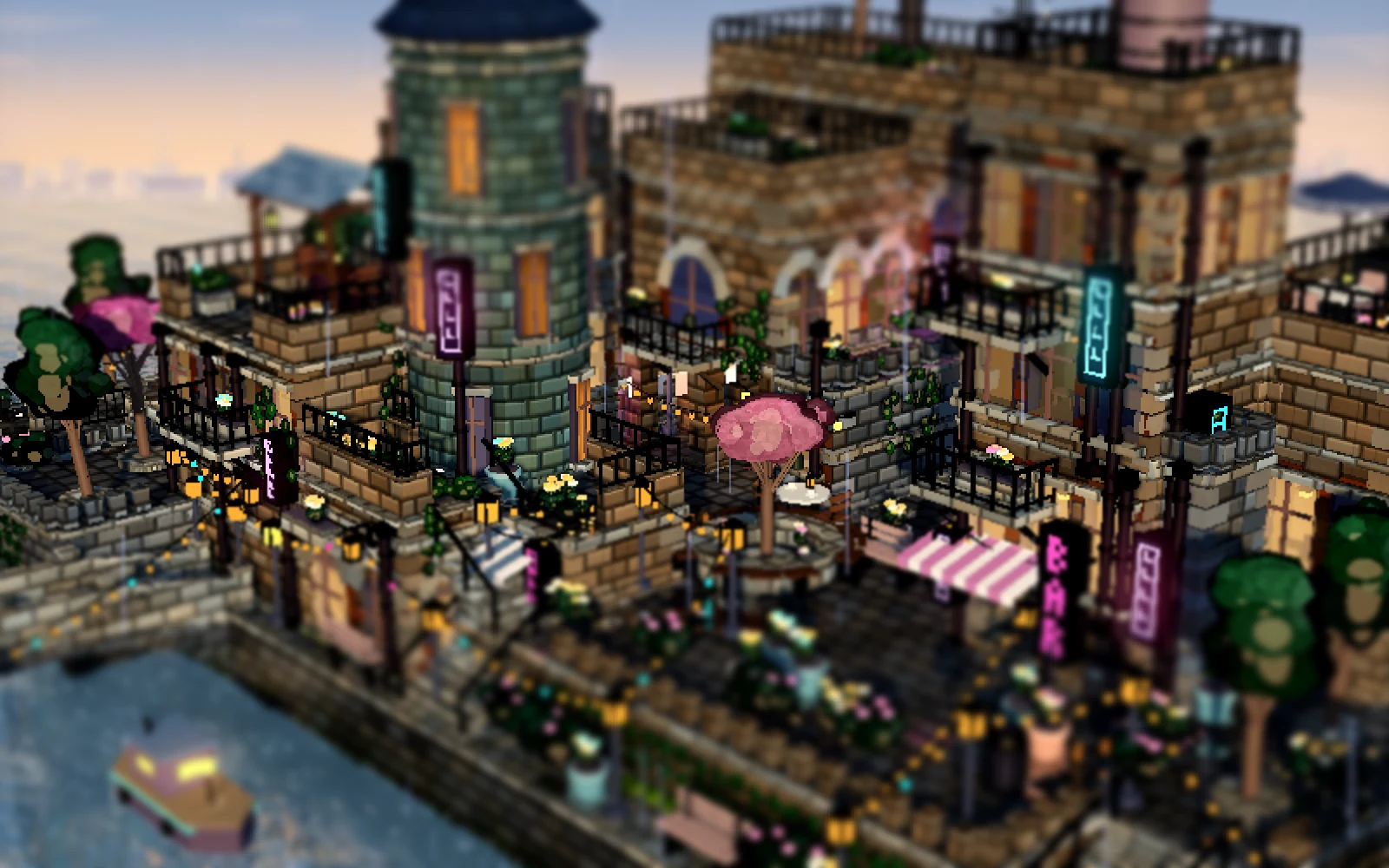
The warm windows, cool stone and white-hot neon already give the Canal look a recognisable mood. Reflections break into little coloured rows beneath the quay. Blue hour and sunset have their own skies. The plan begins by protecting those details, along with the new tree silhouettes and the softer, separate Glade look.
Thirteen captures across different scenes, weather and lighting supplied the starting point. The close photo view above is one of them. It shows the attraction of the town, but also the pale discs across the wet trees and the heavy black railings. Looking closely turns a vague wish for a prettier game into particular things to fix.
Start with the awkward bits
The rainy crown patches come from a hard gloss threshold in the foliage shader. Once the leaf normals began pointing together, the little highlights joined into plates. The proposed replacement scatters small, leaf-tinted glints across cells. Its acceptance test compares against gloss disabled at the same rainfall, so removing the rain cannot accidentally count as fixing the gloss.
The shoreline foam has a simpler fault. The texture feeding it tops out at about 0.667, while the shader only starts revealing foam at 0.72. It could never appear. A threshold correction is the short-term fix; a later water-edge pass would replace it.
Other early repairs address the bright, flat cut sides of islands, black dots between roof tiles, the lawn’s regular grid and stars showing through rain. The canal reflection also runs out of search steps and meets its sky fallback in a hard seam. That needs a softer transition and a longer reach near the end of the search.
Seeing the town at night
The review measured about forty-six per cent of the night image below a luminance of 0.1. The target is roughly twenty-eight to thirty-three per cent, while ironwork and ink lines stay dark. That is a proposed image balance, not a result already achieved.
The plan combines a modest ambient lift with indigo-violet sky and water, then adjusts the darkest tones without flattening the neon reflections. A temporary twilight fill should also keep the town readable while the sun and moon hand over. At present the town can go very dark beneath some of its best skies.
Quay faces need their own treatment: a little light bounced from the water, brighter stone and a tide mark near the surface. Painted railings and pipes would use less metallic shading so they stop reading as black cut-outs in daylight. Each change has to survive a night comparison too.
Where the island meets the water
The larger shoreline pass would read the depth beneath the water to draw a narrow illuminated rim, a broken wash line and shallows that change with the lighting. Boats would gain submerged geometry where needed so the water can find their hulls. Rain rings would reach the open bay as well as the canal.
On land, the flat cut face would become a small cross-section through the ground: a grass lip above soil layers, roots, rock and an algae line. Sand needs its own edge. Glade would keep a calmer version with fewer marks.
The bands have to remain readable at the game’s actual pixel size. Too much tiny detail would disappear or crawl as the camera moves. The planned checks include day, night and golden-hour views, plus a short orbit.
Beyond the last roof
The distant city would get more distinct layers, occasional landmark roofs and restrained neon. A violet cloud deck would pick up light from below. Long broken columns across the bay would come from a separate reading of those distant lights, with the sun and moon kept out of that stretching effect.
Golden hour has a directional problem to solve too. The proposed sky should know whether the camera faces toward the sun or away from it, with a warmer sunward glow and pinker bands on the opposite side. Fog and lawn values would be adjusted alongside it. The established blue-hour and sunset views remain comparison points.
Light under the leaves
A lantern below a tree should colour its lower leaves. The current scene-wide foliage batches and engine light limits make that unreliable, and the bent crown normals can turn the underside away from the lamp altogether.
The proposal builds a separate list of up to thirty-two nearby emitters, sorts them into a spatial grid and lets each foliage fragment consider at most four. Windows contribute more softly than lamps, while neon keeps its own colour. The calculation would use the leaf colour before underside darkening so the light has something left to illuminate.
This is one of the riskier performance changes. The plan calls for forest and dense-scene measurements and an actual Windows run. Cooler shadow colours and more clustered crown shading also need visual review because they would change the tree style just introduced.
Small signs of life
Lit windows would vary by room: a curtain edge, a plant silhouette, a dim interior or a cooler room among the warm ones. The visual pattern has to agree with the light emitted into the street. Window glass also needs separating from balcony glass, otherwise a room shader could put curtains on a railing.
Roofs would acquire details from their available space, with a mast or tank on a suitable high point and smaller pieces packed within the roof edges. Ivy could spill over parapets; window boxes and downpipes would follow the facade layout. These details would be derived again after edits, rather than becoming a second set of objects to maintain.
There is little room to hide the cost. The earlier Harbour animated release took 26.7 milliseconds against a twenty-five-millisecond target. New roof and plant detail needs a measured release-time budget before it spreads across every building.
Judge it moving
The motion pass proposes an Ambient motion preference before adding breathing lights, occasional faulty neon, clearer rain and a shared wind. Flags, foliage and smoke should respond to the same weather. Boats could bob in whole art pixels, with small dust or splash puffs when a part is placed.
Reduced and Off settings need explicit choices about existing motion as well as new effects. Recordings will matter here: a still cannot show a tree crown tearing between pixel positions or a neon pulse that becomes annoying after ten seconds.
The final pixel pass would add restrained depth-based ink and lit edges, then move presentation work to the smaller art-resolution image. The proposed camera treatment snaps rendering to the pixel grid and scrolls the finished image by the leftover offset. Its purpose is to keep fine details steady during a pan. It needs a live camera check before being called finished.
The order of work
The work starts with defects and night values, then settles choices such as leaded windows, fog defaults and contact shading. Water edges come before the expanded skyline. Smaller changes to signs, glow and the interface lead into lantern-lit foliage and the room and roof details. Motion follows, with the final ink and pixel-stability pass judged against the resulting scene.
The interface work in the previous chapter already makes the tray smaller and lets it hide. The beautify plan still has a separate question to answer: how to frame the island while that tray is open. Those are different parts of the same obstruction problem.
Later polish, including new paving, Harbour replanting and further photo-mode work, is optional. The plan budgets roughly 140 hours of development and machine time for the core, or about 160 with contingency, excluding time spent waiting for visual decisions. Those are planning estimates, not a release date.
Each stage calls for matched captures and performance checks, including comparisons that protect the canal mirror, neon cores and the two distinct looks. A Windows performance kit is part of the plan. Until it has been run, the Windows build remains an export with no recorded Windows result.
From the project notebook
This chapter draws on the project’s records as they stood on 25 September 2026.
- docs/beautify-plan.md · Stage order, milestones, estimates and unresolved choices
- artifacts/beautify-0925/report.md · Art-direction findings and proposed acceptance targets
- artifacts/beautify-0925/cap/ · Current-build review captures
- docs/visual-handoff.md · Implemented trees and interface baseline