In this chapter
In this chapter
An ink line and a lit rim, left off
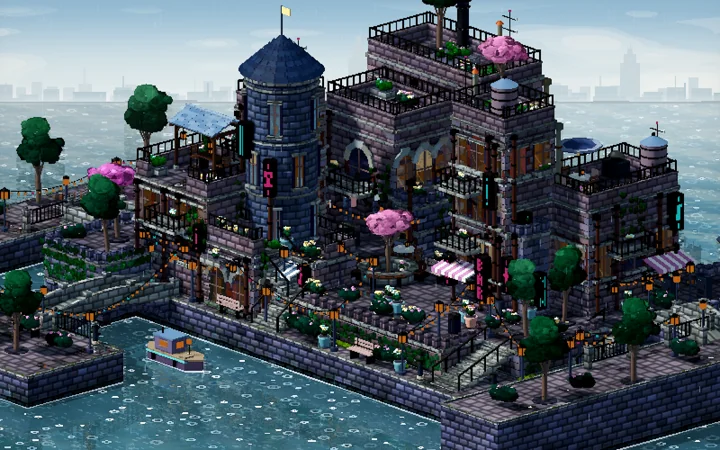
The art review proposed outlining the town the way a pixel artist would. A new full-screen pass reads the depth of each art pixel and its four neighbours. Where the depth jumps, at a silhouette, it draws a dark violet-black ink line. Where a surface folds outward over a short distance, at copings, sills, quay lips, stair nosings and ridges, it draws a lit rim in the hour’s key light lifted 30 per cent toward white. From the start it was built switched off, so that the creator could decide after seeing it.
Probes changed the design in two places. The review’s plan put the ink on the near side of an edge, and that inked every festoon bulb and lamp head solid, so the ink now goes on the far side, the pixel behind the edge, and on the near side only against sky or water. A gap or sliver one pixel wide is not inked either; without that rule every railing panel on the terraces came out solid black. Measured on a mask that colours ink red and rim green, brickwork and roof-tile laps took no outline and the sky and water took none. Every coping, sill and quay lip carried its rim, but on edges that run two pixels across for one down the rim broke into dashes. Single rim pixels sat inside tree crowns, on 1.2 to 3.3 per cent of their area, and the shingle cones picked up rim lines along their facets. With the pass on, the dense scene’s median frame was 0.059 milliseconds slower.
A second part moved the strengths into the lighting profile, with a value for every hour that defaults to zero, a weaker setting for the Glade and a proposed set of values for the creator to look at. It also tuned the pass. The pass now draws below the glass, the lamp halos and the raindrops, ink and rim fade with the distance fog, the rim follows the key light as it hands over at dawn and dusk, railing openings are no longer ringed, and a rule drops lone rim pixels. In the quarter at night the share of rim pixels in clumps of one or two went from 44.2 to 32.7 per cent, and on the Harbour from 23.4 to 10.1. The crowns keep some specks, the cones keep short rim ticks by day and the dashes stayed. At night the proposed ink strength gave a line of 0.07 to 0.10 on a 0 to 1 scale against a target of 0.05. A strength of 0.9 reached the target but read as a solid black outline.
The speck rule reads a five-by-five block of depths and cost about 0.35 milliseconds on its own. Review flagged that, with the pass on, the dense scene was now 0.47 to 0.62 milliseconds slower against a limit of 0.4. A cheaper ordering of the same test brought it to 0.41 on average over six rounds, three of them above the line, which is inside the benchmark’s own noise. With the defaults at zero the pass draws nothing and costs nothing. The suite passed with 45 suites and 23,759 checks.
On 8 October the creator chose to keep ink and rim off by default. No outline level was picked, and the dashes, the cone ticks, the crown specks and the night ink strength were not pursued. The pass and its proposed values stay in the code for tests and later use.
Finishing the picture once per art pixel
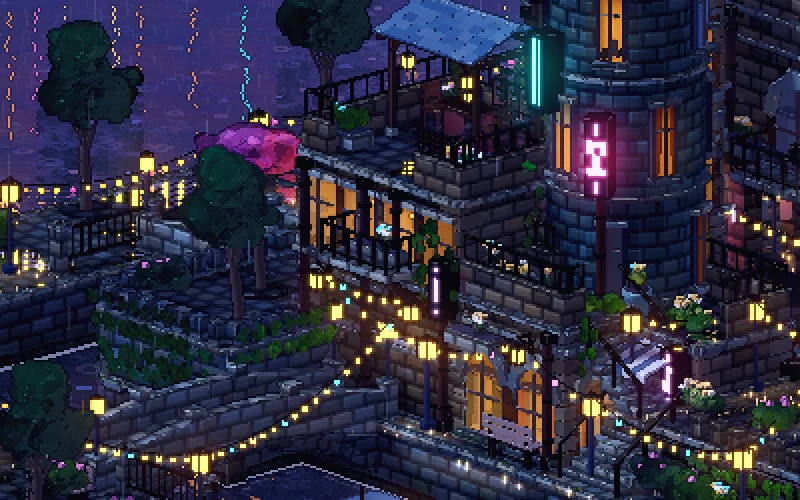
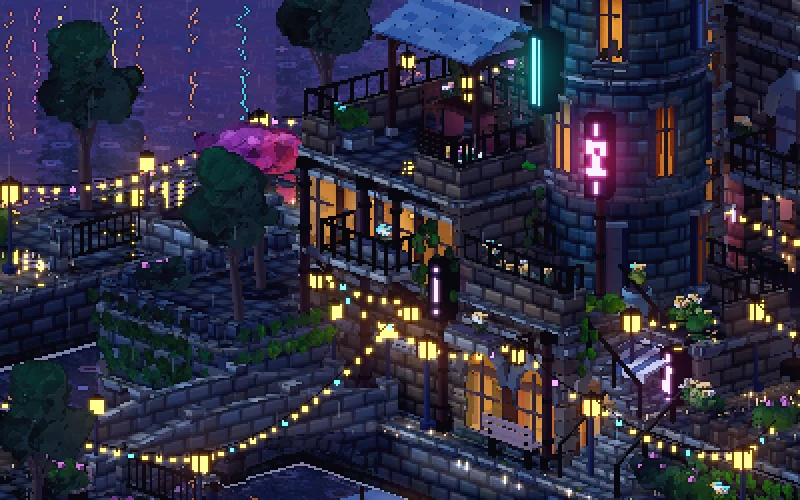
The last pass over the picture, which draws the outline, applies the night grade, adds the pixel halo round lights and darkens the corners, ran once for every pixel of the window. At the usual pixel size of 2 that repeated each art pixel’s 17 texture reads four times. It now runs once per art pixel in a small view of its own, and the window simply scales that up. The only change meant to show is the corner vignette, which is now taken at the centre of each art pixel. On the views that do not change between captures, 1.11 to 2.02 per cent of the pixels moved, every one of them by exactly one level, and at pixel size 1 nothing moved.
Timed at night with the halo working, the Harbour’s median frame was 0.14 to 0.19 milliseconds faster in a 1600 by 1000 window and about 0.53 faster at 2880 by 1800, about 5.4 per cent. The dense scene was 0.19 to 0.28 faster. Every view has one more draw call, the small view’s rectangle. On its first try the integration check stalled once, while the creator was using the laptop. Four standalone runs passed after that, three of them on the new code, and the stall was recorded as a one-off. The suite passed with 46 suites and 23,801 checks.
A camera that steps in whole pixels
When the camera slides by a fraction of an art pixel, every edge in the town lands on the pixel grid a little differently, so lamp heads and tables change shape from frame to frame. The orthographic camera now looks at the nearest point that sits on a whole art pixel and keeps the remainder for the next part to use. The perspective lens and photo mode’s free camera are never snapped. In this part the snap stayed off in the editor, because without the next part a pan would move a whole pixel at a time.
In 24-frame pan recordings the picture moved by exactly the whole-pixel shift the game predicted in 23 of 23 frame pairs, in all four recordings. Frames where the grid did not step were identical in the quarter. Without the snap, the median frame pair changed 33.6 to 60.9 per cent of its pixels. The shading did not fully hold, though. On a pair where the grid steps one pixel, 8 to 49 per cent of the pixels match neither the shifted previous frame nor the unshifted one: a diamond moiré on lit surfaces for sideways steps and banding along brick courses for vertical ones. Odd steps changed 28 to 31 per cent of the pixels and even steps about 5. Probing pointed at the contact shade and the surface bumps, whose maths depends on which way the graphics card groups pixels in twos; that reading was not proven. A two-pixel grid cut sideways steps by day to 0.10 per cent of pixels changing by more than 8 levels, left the night at 1.1 to 3.2 per cent, and doubled the step.
A ruling the same morning accepted the shading gap as recorded and kept the one-pixel grid, so the creator could judge it in a live session. Review found one fault, the near rain box not following the snapped point when the foliage was rebuilt, which was fixed. The suite passed with 46 suites and 23,873 checks.
Smooth panning on a fixed grid
With the camera snapped, the finished picture now slides by the leftover fraction. The 3D view is drawn one art pixel larger on every side, and the window shows it at exactly the pixel size, moved by the remainder in whole window pixels. So the pixels stay fixed to the world while a pan moves at the window’s own resolution. In the pan recordings the drawn target stayed within 0.40 to 0.47 of a window pixel of the true pan and moved at most one window pixel per frame, where the snap alone was off by 0.80 to 0.95 with jumps of two.
The same layout fixed an old fault. At window sizes the pixel size does not divide, one row or column of art pixels was drawn twice as wide. Every art pixel is now exactly the pixel size: in captures at pixel size 3, one or two doubled lines became none. Picking goes through the same sums. In a live editor at three window sizes and two pixel sizes, none of 1.9 to 7.4 million checked pixels pointed at the wrong art pixel, no ground pick fell outside the pixel under the pointer, and all 10 grips and all 136 part centres picked as before.
The snap is now on in a person’s editor. Automated runs, captures and benchmarks keep the old camera, so they stay comparable, and turning the snap off is one line. With the margin the editor frames two more rows than a capture of the same camera. The margin’s cost was not measured. The suite passed with 46 suites and 23,994 checks.
The stage measured as a whole
The closing checks ran on the evening of 8 October. The suite passed with 46 suites and 23,994 checks, and the integration check at 2880 by 1800 passed. Every journey view gained one draw call, the finishing pass’s small view. In 10 of 101 views the frames changed by more than the spread between captures of one build, all of it rain rings, glints, cloud dither and smoke caught at another moment; the new build’s captures came 22 to 83 milliseconds earlier because the finishing pass is cheaper. The canal’s light columns, the neon cores, the twilight skies, the Glade and the approved tree style held.
Against the build from before the stage, over three interleaved rounds, the dense scene’s median frame was 0.39 milliseconds faster at 01:00 and 0.22 at 19:30, and about level at 13:00, when the halo is skipped. The Harbour was 0.18 and 0.24 faster at night and in the evening. Its slowest frames at 01:00 spread between 7.4 and 8.4 milliseconds in both builds. The ink pass is off, so its cost is not in these figures.
The close was asked to repeat the integration check five times on each build to look for stalls, and did not. It was done afterwards: ten runs, no stalls. Eight passed, and one pair failed on both builds with the same value in the check that holds the raise brush, so it does not come from this stage; it looks like a timing effect of load on the machine and was not investigated. Mac and Windows builds of this code were exported that day and not launched.
Where the stage stands
The stage is complete. The creator ran the final build in the live editor on the Mac, panning with the snap and the smooth scroll on, and said it all looked good. That keeps the one-pixel grid with its shading shimmer on each step, and the margin. The two-pixel grid and a fix for the shading maths stay as options. Picking and odd window sizes were not tried separately in that session and rest on the automated probes. The creator kept the ink and rim off.
Still open: the shimmer on grid steps, the margin’s cost and the vignette moving with the scroll, which were not measured, the perspective lens, photo mode and the Reduced and Off settings, which were not captured at the close, and the integration check at 1440 by 900, which was not run because of a stall inherited from earlier work. Windows was not run.
From the project notebook
This chapter draws on the project’s records as they stood on 8 October 2026.
- docs/visual-handoff.md · Beautify edge ink and rim pass entry, 8 October
- docs/visual-handoff.md · Beautify ink in the profile, Glade scaling and tuning entry, with its review fix and the open cost question, 8 October
- docs/visual-handoff.md · Beautify presentation post at art resolution entry, 8 October
- docs/visual-handoff.md · Beautify camera snap to the art-pixel grid entry, with its review fix and the ruling on shading, 8 October
- docs/visual-handoff.md · Beautify smooth scroll by the residual and integer-exact rect entry, 8 October
- docs/visual-handoff.md · Edges and pixels stage close: suite, journey, protected looks, whole-stage benchmark, the repeated integration check, the live pan session and the exports, 8 October
- artifacts/beautify/owner-decisions.md · Notes and rulings after each part, the live pan session and the decision to keep ink and rim off, 8 October
- artifacts/beautify/27-P9/ · Per-part captures, pan recordings, metrics, benchmarks and suites, and the stage-close captures and sheet