In this chapter
In this chapter
A highlight, arrows and a double-click
On 8 October the creator asked for this part directly: they were still seeing boxes round objects. A part should just be highlighted when the pointer is over it, a selected part should show only its movement arrows, and with the arrow tool a double-click on any piece should pick it up to move it. Hover is now a soft lift of the part under the pointer, at 0.6 of the old selection lift, fading in and out in about 0.07 seconds. A selected part shows its arrows and nothing else, which replaces the selection lift added on 25 September. No wire box is drawn round anything in any tool. Placing a part shows only the translucent preview of it, the markers for wall paths and bridge landings are a flat ring on the ground, and parts left hanging in the air breathe the lift instead of a wire frame. A double-click with the Select tool starts the Move command on that piece, and the next click is one undo step.
Before the change every hover, placement and floating frame had one wire mesh on screen, and afterwards none of 27 frames had any. Hovering a building by day changed about 11.5 per cent of the frame, brightening the changed pixels by about 15 luma; with nothing hovered the frames stayed within the spread between captures. Hovering one building cost nothing measurable.
A second review found four problems, all handled. A double-click on the middle of a small building’s wall or roof started a resize, because the first click selected the building and its arrows appeared under the pointer before the second; whether the pointer is on an arrow is now decided by the first click. The first benchmark’s hover column had in fact measured nothing hovered, and was run again. Some quoted figures could not be reproduced from the pictures on disk, because the capture script let the light and creature clocks run; the captures were taken again with them held. Follow-up fixes the next morning made double-click work only with the Select tool, released the lift when the pointer moves onto the interface and fixed two smaller bookkeeping cases. The suite passed with 46 suites and 24,096 checks.
Left as known behaviour: the lift follows the part’s box, so anything standing inside that box lifts with it, such as the bench under a tree or a sliver of roof behind a building. A small glow in one tower window by day varies from run to run in both builds, and its cause was not found. A real double-click on macOS was not tried by hand, only the engine’s double-click events.
Stone toward violet-grey
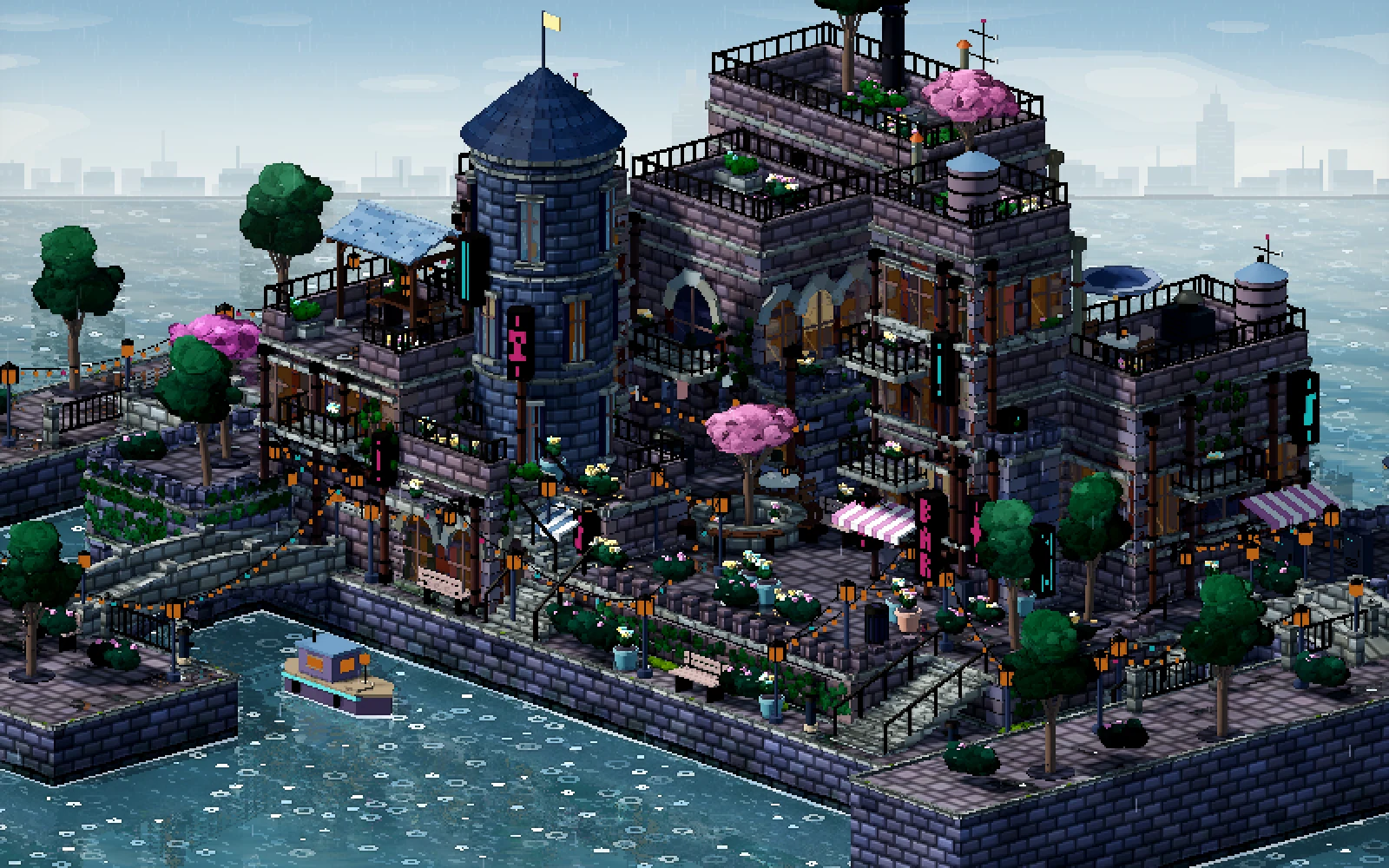
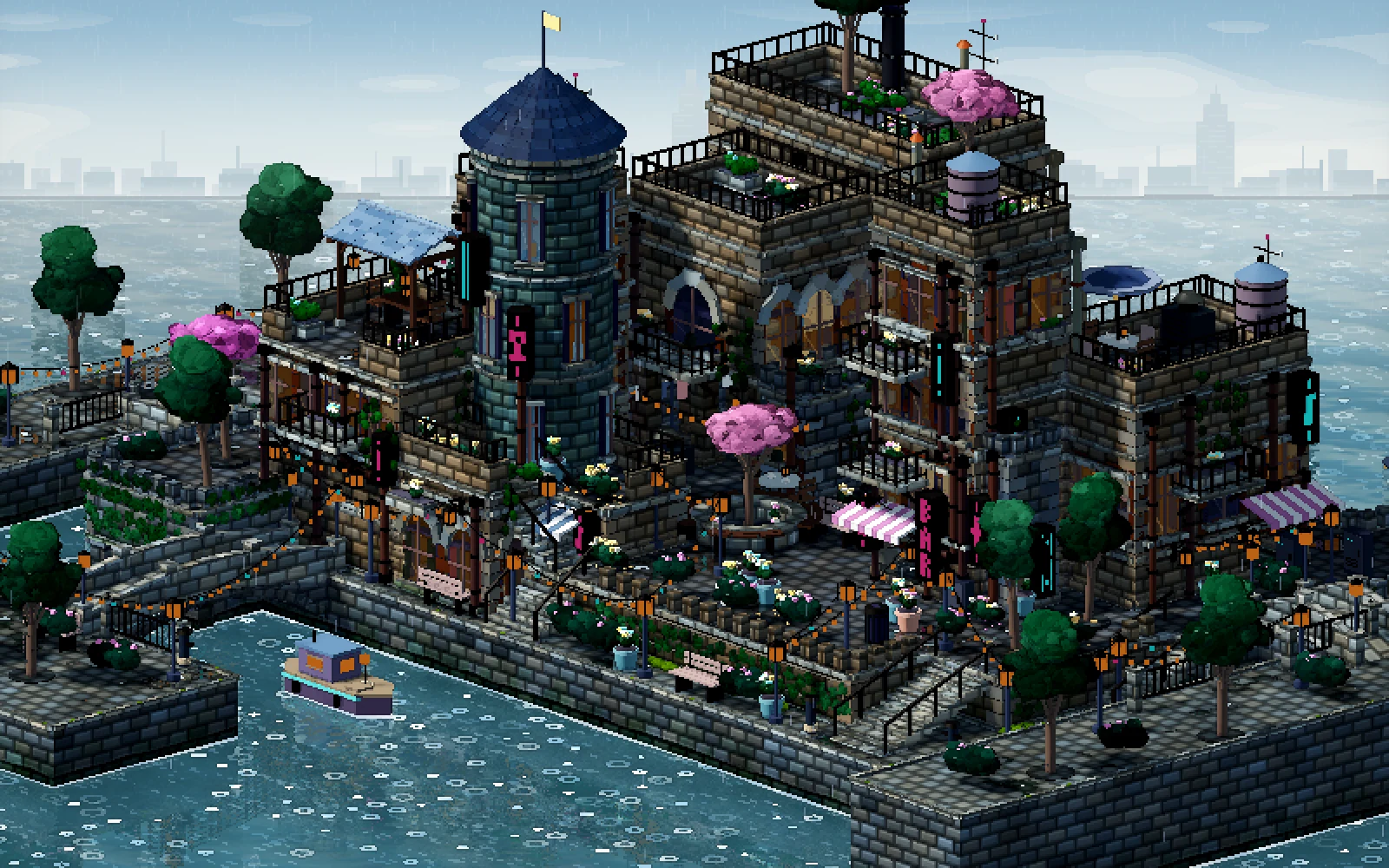
The canal stone moves from grey with tan and teal variants to violet-grey, mauve-grey and blue-grey, and the warm and cool tints between blocks are halved. From 2.5 to 4.5 metres above a wall’s own ground the masonry also calms down: odd dark blocks drop from 12 to 5 per cent, the blocks vary less and the mortar is lighter. Street-level walls, paving and setts keep their full texture. In the quarter by day the wall colour’s hue moved from 144 to 232 degrees, and at night from 228 to 236 degrees, which is blue-indigo, not purple. Golden hour now reads rose-mauve on the stone, the round tower is blue-grey and the Glade’s stone house a pale mauve.
Review found two problems with brightness. The art review’s colours matched the old stone in screen terms but were 3.2 to 5.4 per cent darker in the linear light the renderer works in, so walls the calming did not reach came out 4 to 7 per cent darker. The three colours were lifted to hold the old value. That uncovered a second problem: the calming made upper walls up to 7.7 per cent lighter, because it assumed a fixed share of mortar while, from the playing distance, joints widen to a whole art pixel and cover far more of the face. The share is now worked out for each pixel. The quarter’s walls now read 0.4 to 0.9 per cent brighter than before by day, at golden hour and at night, and the other wall crops are within about 2 per cent. One crop of about ten bricks on the round tower’s lower wall still reads 3.4 to 3.7 per cent lighter, while the tower as a whole is unchanged; it comes down to which few blocks the calming changes in a small sample.
The tighter tints apply to every masonry surface, and the calming also applies to the Victorian stone walls. Timed against the previous code, frame times stayed within noise and draw calls did not change. The suite passed with 46 suites and 24,151 checks.
Lawns in three tones
On the canal lawns the meadow’s smooth, airbrushed drifts become three hard-edged tones, lush, middle and sunny, and its dry straw comes in three steps. The borders between tones are dithered on a 25-centimetre pattern fixed to the ground. A turf of 30-centimetre clumps now holds when the camera is zoomed out, where the finer clumps had already faded. The Glade, the river banks, earth and sand are untouched.
On the Harbour by day the lawn’s tones went from two broad peaks to six sharp ones, and the median bright tuft grew from 2 to 3 art pixels, with runs of two pixels or more rising from 56 to 68 per cent. In small orbits the tufts held together about as well as an unchanged slate roof beside them, so the pattern does not crawl. The lawn kept its overall brightness within 1 per cent by day and at golden hour; at night it is 2.1 per cent brighter in linear terms. Frame times stayed within noise.
Two looks went to the creator with the sheet. At the tree grove’s zoom the new turf reads as a fine, slightly regular scale pattern. And the bands reach the approved grove, where 78 per cent of the lawn pixels changed by more than 8 luma, and darken the Harbour’s lawn at golden hour, where the dark band now covers more of it. The suite passed with 46 suites and 24,203 checks.
Paving in long slabs
The flagstones on the plaza, the roof terraces and the stair treads were a regular grid that read as a diamond checker. They are now laid as random ashlar: courses 37.5 and 62.5 centimetres deep in pairs, slabs 50 to 87.5 centimetres long starting at a random point in each course, and about 15 per cent of slabs split near the middle. Every joint stays on the eighth-metre grid the puddles use, so a puddle still fills whole stones. The plaza colour is lighter and faintly mauve, about 12.5 per cent lighter in linear terms, and the quay walk is a little lighter too.
Measured on the plaza, the old checker’s repeat dropped from a correlation of about 0.54 to 0.18 at night and from 0.73 to 0.25 by day. The plaza’s brightness relative to the walls rose from 0.86 to 1.04 at night, toward the art review’s 1.6 but well short of it. The pattern alone, with fewer joints, accounts for a small part of that and the colour for the rest. Frame times stayed within noise.
Review found that a claim of the Glade being unchanged hid one change: the Glade’s canal roof decks take the new mauve too, about 3 luma lighter on the deck pixels. The notes were corrected and a labelled strip added to the sheet. The creator was asked whether the Glade should keep its old greys and on the morning of 9 October chose to keep all of it new, the Glade decks included. The suite passed with 46 suites and 24,241 checks.
Shadows on the water, and paler streak cores
The water was drawn without shading, so every shadow stopped at the island’s cut edge. Now each water pixel steps through the depth of the scene toward the sun, and where its ray passes behind the town the water and the mirrored sky darken by 30 per cent and the sun’s glitter goes out. The mirrored town keeps its colour. With the sun down nothing is computed. In shadowed patches on the Harbour by day the water lost 23 to 26 per cent of its brightness in linear terms, and at golden hour 14 to 19 per cent. The Glade gets the shadow too, 17.5 per cent darker beside its island.
Review found that the Harbour’s slowest frames by day were 6.2 per cent slower, over the 5 per cent the plan allowed. The march was cut from 32 steps to 24 with longer strides, so it reaches about 36 metres instead of 46, and the shadows measured about the same. Over 12 rounds the slowest frames were then 2.8 per cent faster by day and 1.3 per cent slower at golden hour. The median frame stays about 0.2 milliseconds slower at the Harbour by day and 0.15 at golden hour.
The reflection streaks under lights now have a core: near the mirror point their middle pales toward a warm white and is brightened up to 1.6 times, so the centres bloom in their own colour while the edges keep their tint. On the night canal in the quarter, bright streak pixels went from about 6,500 to about 8,570 and became less saturated. The creator kept both changes, including the shadow’s crisp edge in the Glade next to its softer land shadows. A darker far bay at 20:45 was noted and left as it is. The suite passed with 46 suites and 24,270 checks.


Lens blur on the art-pixel grid
The tilt-shift lens and photo mode’s depth of field blurred the finished picture at window resolution, so the blurred parts showed streaks and gradients finer than an art pixel. At pixel size 2 and above both now work on the art-pixel grid. In the blurred bands the share of two-by-two blocks that are flat went from about 35 to 47 per cent to 100. In photo mode, bright highlights also spread into flat squares, a pixel version of a camera’s bokeh, so a string of bulbs in a blurred foreground becomes a row of yellow squares instead of dim smudges.
Review found that the bokeh filled in neon letters in lightly blurred rows, and that photo mode’s gentle default depth of field brought it into every photograph. The bokeh now fades in with the blur, from none up to 3 art pixels of blur to full at 6, so the default photograph gets none. It was also lowered to half strength after a first try made the squares too dominant. Bright flower heads and window glints become squares too, because brightness alone cannot tell them from lamps. Pixel size 1, the Glade’s default, is unchanged. The grid needs fewer reads: measured before the fade was added, photo mode’s median frame was 1.4 per cent faster and the tilt-shift’s 2.8 per cent. The suite passed with 46 suites and 24,306 checks.
The first round measured together
The round’s closing checks ran on the morning of 9 October. The suite passed with 46 suites and 24,306 checks, and the integration check at 2880 by 1800 passed. Every count on the six journey views, draw calls included, matched the previous stage. All 101 capture views changed beyond the spread between captures of one build, because canal stone is in every canal view. The neon letters, the twilight skies, the Glade at night and the approved tree colours held; the grove’s lawn changed, as the lawn part had reported.
Against the code from before the round, the median frame was about 0.2 milliseconds slower at the Harbour by day and at golden hour and 0.13 to 0.15 slower on the dense scene, almost all of it the water shadow, and nearly level at night. The dense scene’s slowest frames stayed well under the plan’s limit of about 0.5 milliseconds.
One question stays open. On the Harbour at night, cyan reflection dashes along the front lawn’s edge show in both captures from before the round and in neither from after. The dashes are redrawn one and a half times a second on their own clock, which probably explains it, but that was not proven.
Where the round stands
The creator kept the paving and the water changes early on 9 October, choosing to keep everything new, and after the round’s ten-page sheet kept the stone, the lawns, the hover and selection changes and the lens blur. The whole first round is approved as built.
Kept as known behaviour: the round tower’s small crop that reads lighter, the rose-mauve stone at golden hour, the regular-looking turf at the grove’s zoom and the darker golden lawn, the plaza still darker against the walls than the art review aimed for, the water shadow’s cost by day, flowers turning into bokeh squares, the box-shaped hover lift and the unexplained window glow, and the night dashes on the Harbour. No perspective, photo-mode, hover or reduced-motion view was in the closing captures; those parts are shown from their own captures. Windows was not run.
From the project notebook
This chapter draws on the project’s records as they stood on 9 October 2026.
- docs/visual-handoff.md · Beautify hover highlight, arrows only and double-click to move entry, with its second review, fix round and follow-ups, 8 and 9 October
- docs/visual-handoff.md · Beautify canal stone toward violet-grey entry, with both review fixes, 9 October
- docs/visual-handoff.md · Beautify lawn tone bands and turf octave entry, 9 October
- docs/visual-handoff.md · Beautify irregular paving and mauve plaza entry, with both fix passes, 9 October
- docs/visual-handoff.md · Beautify water sun shadow and streak core entry, with its review fix, 9 October
- docs/visual-handoff.md · Beautify tilt-shift and photo depth of field on the art-pixel grid entry, with its review fix, 9 October
- docs/visual-handoff.md · First polish round close: suite, journey, protected looks, whole-round benchmark and summary sheet, 9 October
- artifacts/beautify/owner-decisions.md · The creator’s request for the hover change, the overnight approval, and the creator’s answers on the paving, the water and the round’s sheet, 8 and 9 October
- artifacts/beautify/28-P10/ and 28-P10-I/ · Per-part captures, sheets, metrics, benchmarks and suites, and the round’s closing captures and sheet