In this chapter
In this chapter
What did the player probably mean?
The adaptation work changed the question from “is this exact placement valid?” to “is there a valid version close by?” A building drawn past the edge can slide back inside, a resize can clamp smoothly to a valid size, and the preview shows the adjusted result with a short hint explaining it.
Underneath, candidates are generated and scored. Each possible adaptation is data, so the editor can compare them and explain why one won. The player still gets an escape hatch: hold Ctrl or Cmd to place things as drawn, which turns off snapping and any adaptation that is safe to skip.
Existing scenes still have to mean what they meant before, and the preview has to match what gets committed. A clever adjustment that surprises the player after they let go is just a refusal in a nicer colour.
Paths that turn into things
The path-grammar work applies the same idea to terrain. A stroke across water can make stepping stones or a causeway, a path up a slope can become steps, and a path that runs into a wall can ask for a gate or an arch.
An early bug made paths react to the steepest gradient in the terrain, even when it ran across the path. That produced a sideways staircase on a lane that barely climbed in the direction you would walk it. The fix measures the gradient along the path’s run, since a cell can be steep without the walk through it being steep.
Shorelines raised a different ambiguity. One rule turned a canal-side road into a sandy beach, which was consistent but wrong for what was meant to be a quay. Follow-up work told a road running along the water apart from one running into it. The canal-side scene made the intended behaviour clear: a quay should stay a quay.
Draw the connection, let it find the structure
A connection picks a bridge, walkway, stairs or ladder depending on its rise and run. A bridge that rests entirely on land can become something closer to a path. Tower walls are real cut shells, so openings and attachments respond to the surface they sit on.
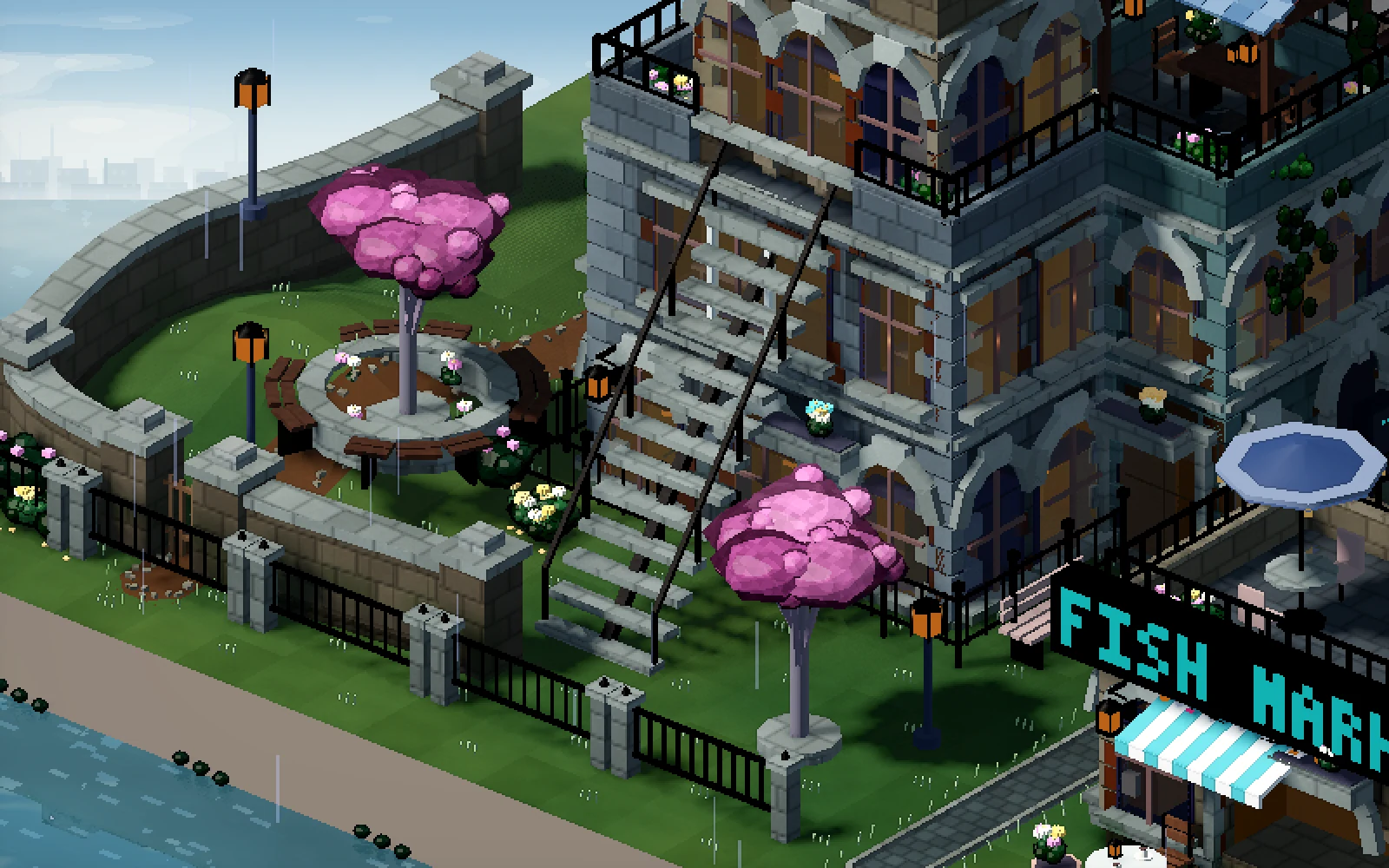
One request was very specific: a stair winding round a round tower. The follow-up work made the tower a proper neighbour for a helical stair, and supported, floating and banistered versions came after that. One connection gesture now has several possible outcomes.
Floating treads change the structure as well as the material. A straight run may need a spine, a flight beside a wall can key its treads into the wall, and a helix cantilevers out of the tower’s facets. Railings follow the walking line and the open edge.
What the stairs don’t do yet
The stair work still had gaps in September. Glazing on modern towers can stay behind the stair, some fittings under the band don’t move out of the way, and a detailed banister adds a lot of vertices with no level-of-detail system of its own yet.
A stair can have a valid path and treads that meet the wall while nearby fittings still get in its way. Checking the walking line alone misses those faults, as well as the cost of drawing all the detail.
This is how PixelPunk’s construction chemistry is meant to work in general. The player makes simple gestures, the world pays close attention to them, and there is enough control left to correct it when it guesses wrong.
From the project notebook
This chapter draws on the project’s records as they stood on 23 September 2026.
- docs/visual-handoff.md · Feel A3, B1, B2 and Q1
- docs/tiny-glade-feel-handoff.md · B1 outcome and owner follow-ups
- README.md · Stepping-stone save compatibility
- scripts/adapt.gd
- tests/test_chemistry.gd