In this chapter
In this chapter
- A stage of settled choices
- Mist the colour of the town
- Smoke that starts warm
- Why a thin veil darkened
- Lamps in the mist
- Checking the new look
- On by default
- The halo and the cost
- A crisp shade under the ledges
- The soft shade was doing something
- Soil and paving at the tree feet
- Leaded windows
- The speed fix for the tree undersides
- The stage measured as a whole
- The creator’s answers
- Where the stage stands
A stage of settled choices
Before this stage began, the creator answered the questions the plan could not settle by itself: whether windows should get leaded medieval panes, whether new scenes should open with fog and chimney smoke, whether the Canal look should draw a soft contact shade under ledges by day, and what should sit around the foot of a tree. The stage turns those answers into separate changes. All of them have now merged, together with a follow-up for trees on roofs and a speed fix the creator approved during the night stage.
Mist the colour of the town
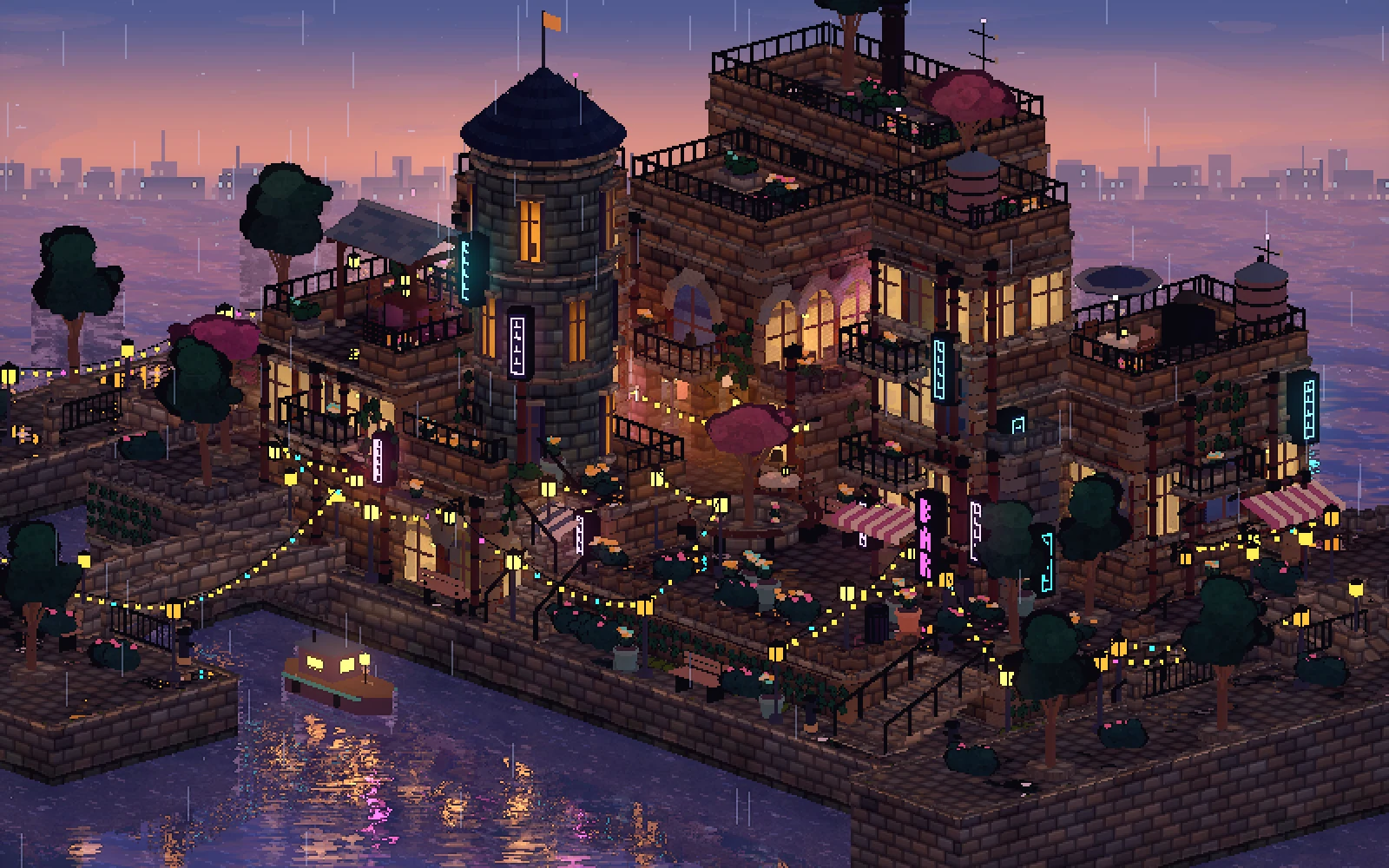
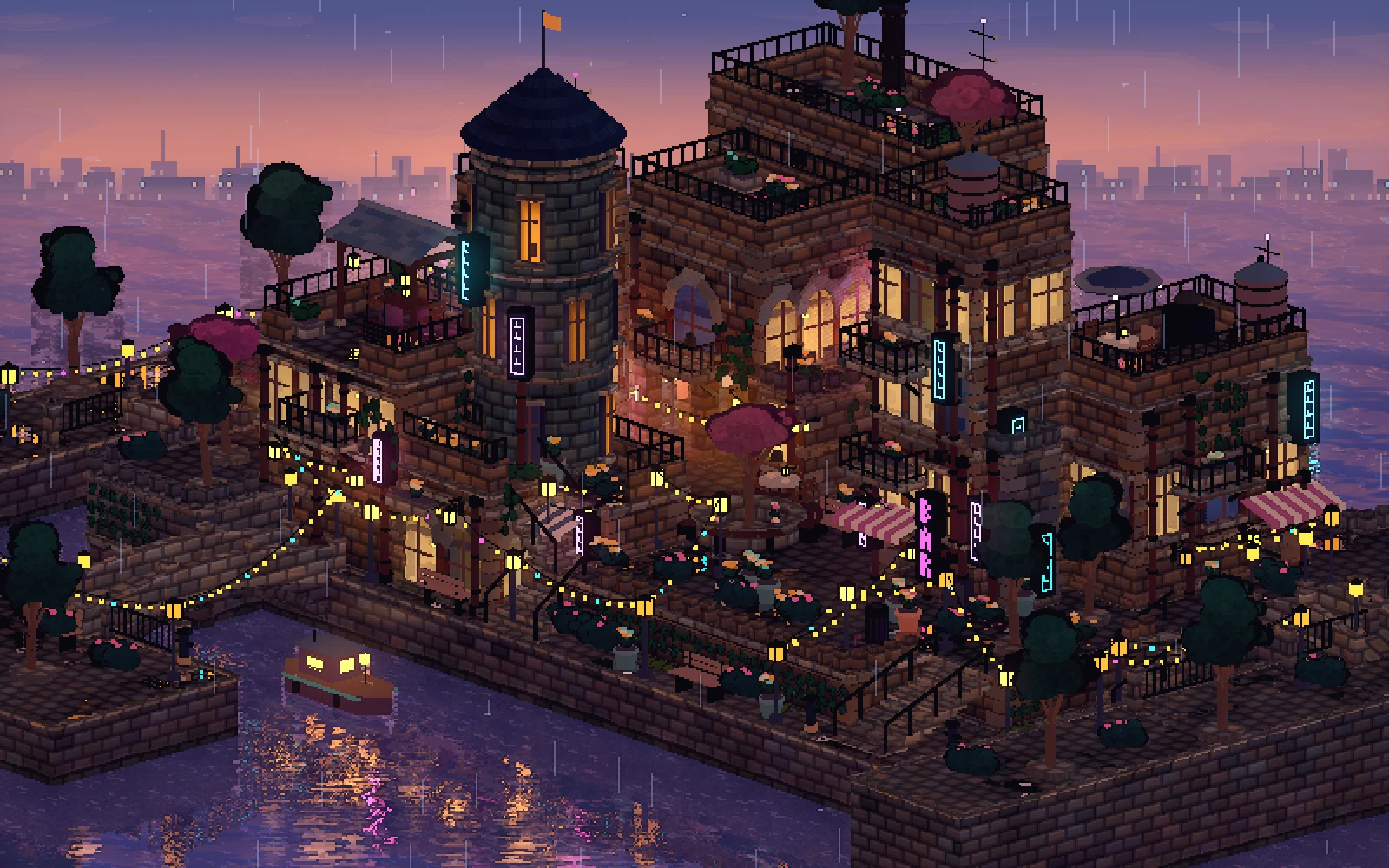
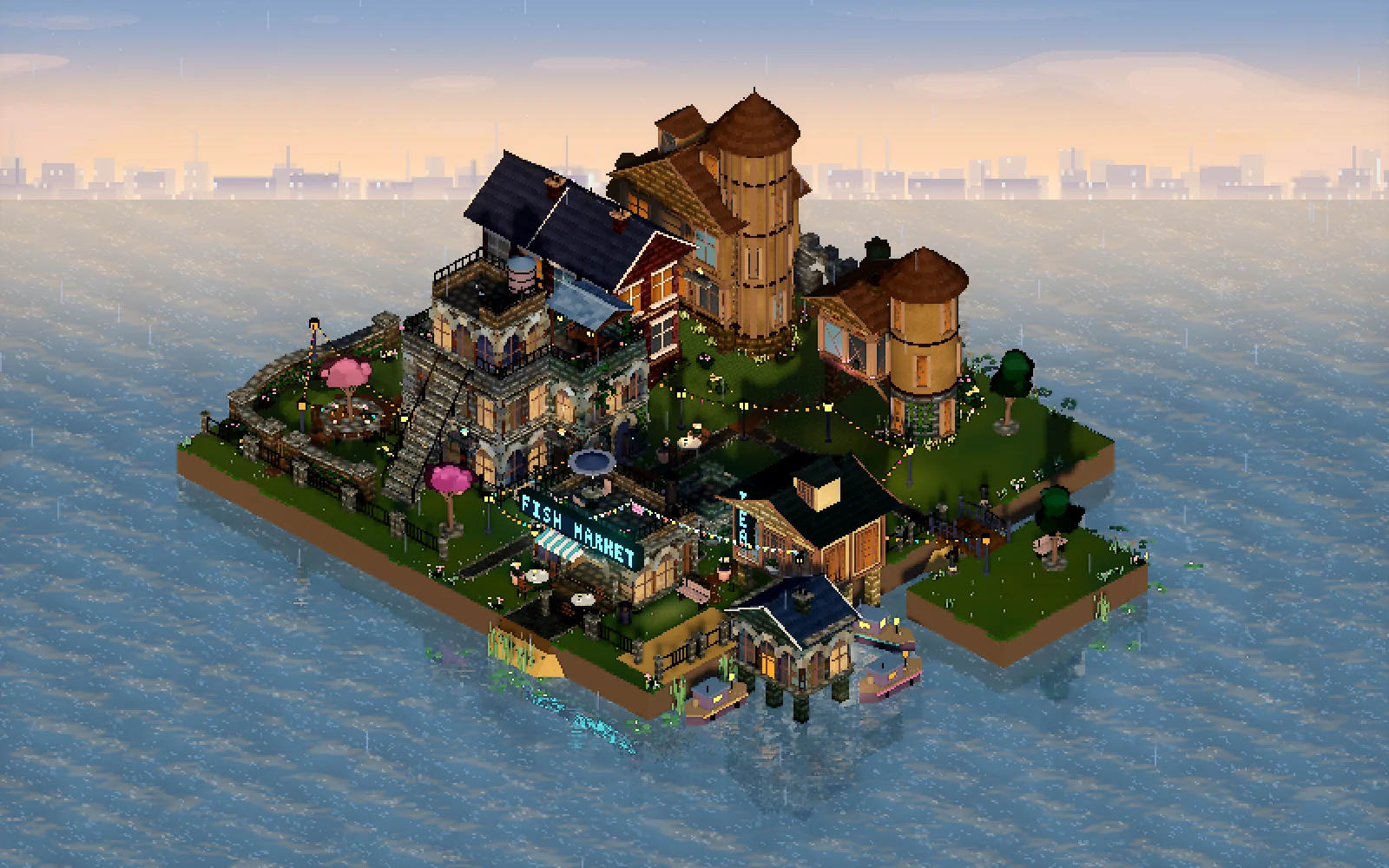
The height fog used to take the plain haze colour of the hour, so at night it was a dark veil that only dimmed what stood behind it. Its night colour now leans toward the horizon and is lifted a little by the town’s lit windows. The mist glows violet, and rose around 21:00.
How much fog is drawn now depends on the hour as well. By day and at golden hour the game draws 0.45 of the setting. From 20:45, through the night and until 05:45, it draws all of it, with steady ramps in between. The first tuning round waited for full night before drawing everything, and at 21:00 the mist came out no brighter than before, so the full amount now starts at twilight.
In the canal quarter at 21:00, the pixels the fog visibly touches make up about 18 per cent of the frame. In the final version their mean luma went from about 100 to 105, they were brighter by more than one luma on 76 to 81 per cent of them, and their colour moved slightly toward the horizon’s hue. Across the whole Harbour night frame, the fog used to take away 1.5 luma on average. It now adds 2.3.
Smoke that starts warm
At night every chimney plume now starts warm, close to the orange of lamplight, and cools into the dusky grey as it rises. At the plume bases in the Harbour lane view, the gap between red and blue went from 3 and 8 in the two captures before the change to 48 and 43 after it. The smoke’s colour by day and at golden hour did not change. In the Glade look the smoke is paler.
Every plume warms in the same way. The plan allowed that or a version that warmed only the plumes over lit houses, and the simpler one was chosen. The warmth is tied to the hour and is full from 20:45, while the houses go on switching their windows on until 22:00, so for a while a plume can glow over a house that is still dark.
Why a thin veil darkened
By day the thinner veil was meant to be a faint milky haze. Review found two problems with it. The first showed on the Harbour plaza at golden hour. The lamps’ glow in the fog is drawn by the same shader, so it had thinned along with the veil, and the plaza’s mean luma fell from about 90 to 60. The fix gives the glow its own strength, always the full setting, and only the veil follows the hour.
The second problem took a probe to explain. Measured at several fog amounts on the build before the change, the day veil did not behave in a straight line. A very thin veil changed almost nothing. Thicker ones, up to about 0.14, darkened the fogged area by as much as 3.4 luma, and only from about 0.2 did the veil lighten it. The cause is in the Compatibility renderer the game uses. In Godot 4.6 it converts a shader’s colour output to the stored colour through a curve that crushes very small values: an added colour of 0.02 stores nothing, 0.03 about one luma and 0.05 about ten. The fog’s added haze was small enough to fall into that dead zone, while its opacity still dimmed the frame underneath. Under that renderer the shader now works backwards: it writes the colour that the curve turns into a plain mix toward the haze.
After that fix the day veil lightened steadily as the amount rose and never darkened, but it came out about one and a half times as strong as the old veil at the same setting. A second fix scales its opacity down, so a setting never draws more than it used to. Against the old veil at the same setting, the day veil is now 0.33 as strong and the golden-hour veil 0.41, under the 0.45 the plan asked for. At 13:00, with the fog at 0.3, the fogged part of the frame, 43 per cent of it and mostly water, is about 2.9 luma lighter than with no fog at all. Before the change the same setting made it 9.2 lighter.
Lamps in the mist
The plaza ended a little brighter than before the change: 91.8 against 90.0 at golden hour, 84.9 against 83.2 in the Harbour at night, and 103.4 against 100.5 in the Glade at night. The review had asked for the old figures within capture noise. The lamp glow’s own share, measured by switching it off in a matching capture, is unchanged at 51.7 before and 51.8 after at golden hour. The rest comes from the veil, which used to darken the plaza slightly and no longer does. Matching the old totals would have meant trimming the glow by a different amount for each hour and look. The review accepted the unchanged glow share as the measure, and the creator can still overrule that.
Checking the new look
The final full suite passed with 40 suites and 19,227 checks and no failures, and the integration check at 2880 by 1800 passed. New tests pin the fog’s amount and colour at each hour, the smoke’s colour ramp and a model of the renderer’s colour conversion. The graphics path itself can’t be tested without a window, so the probe captures are its record. Draw calls were identical on every captured view. The plan set no benchmark for this change, which adds a few operations to one full-screen pass. The six standard journey views carry no fog or smoke and did not change.
The Harbour and the canal quarter were not timed for this change alone. They were timed with the next one, which switches fog and smoke on for new scenes.
On by default
Until this change, fog and chimney smoke were switches a scene had to turn on. Now every starter scene in the menu, including the four demonstration canvases and the blank canvas, opens with low fog at 0.3 and chimney smoke on. The Glade look starts its fog at 0.15. A blank canvas has no chimney, so at first it shows only the mist. Saved scenes that never had the settings still open without them and save back byte for byte, so older work looks as it did. Choosing a look in the editor now writes that look’s fog and smoke, which means switching an older scene to either look adds them, as one step that can be undone.
By day the veil is light. Across the starter scenes the frame brightens by 1.4 to 2.1 luma on average, and 1 to 3.4 per cent of it changes by more than 8. From golden hour on, the plumes rise warm and the fog’s lamp glow puts a warm halo around every lit door and lamp. On the courtyard, the Harbour, the canal quarter and Amsterdam, 7 to 15 per cent of the frame changes by more than 8 luma at golden hour and at night. On the small demonstration canvases the halo is the biggest change of all: in the bracketed room at golden hour a third of the frame changed by that much, with a mean lift of 8 luma. The castle and the bracketed room have no chimney, so they get fog only.
Note added 30 September. A check of the records at the end of the stage found no saved measurement behind the starter-scene figures in the paragraph above: the 1.4 to 2.1 luma, the 1 to 3.4 and 7 to 15 per cent, and the bracketed room’s third of the frame and 8 luma. They come from the change’s summary sheet and should be treated as unverified. The check did not question the Harbour figures in the next section.
The halo and the cost
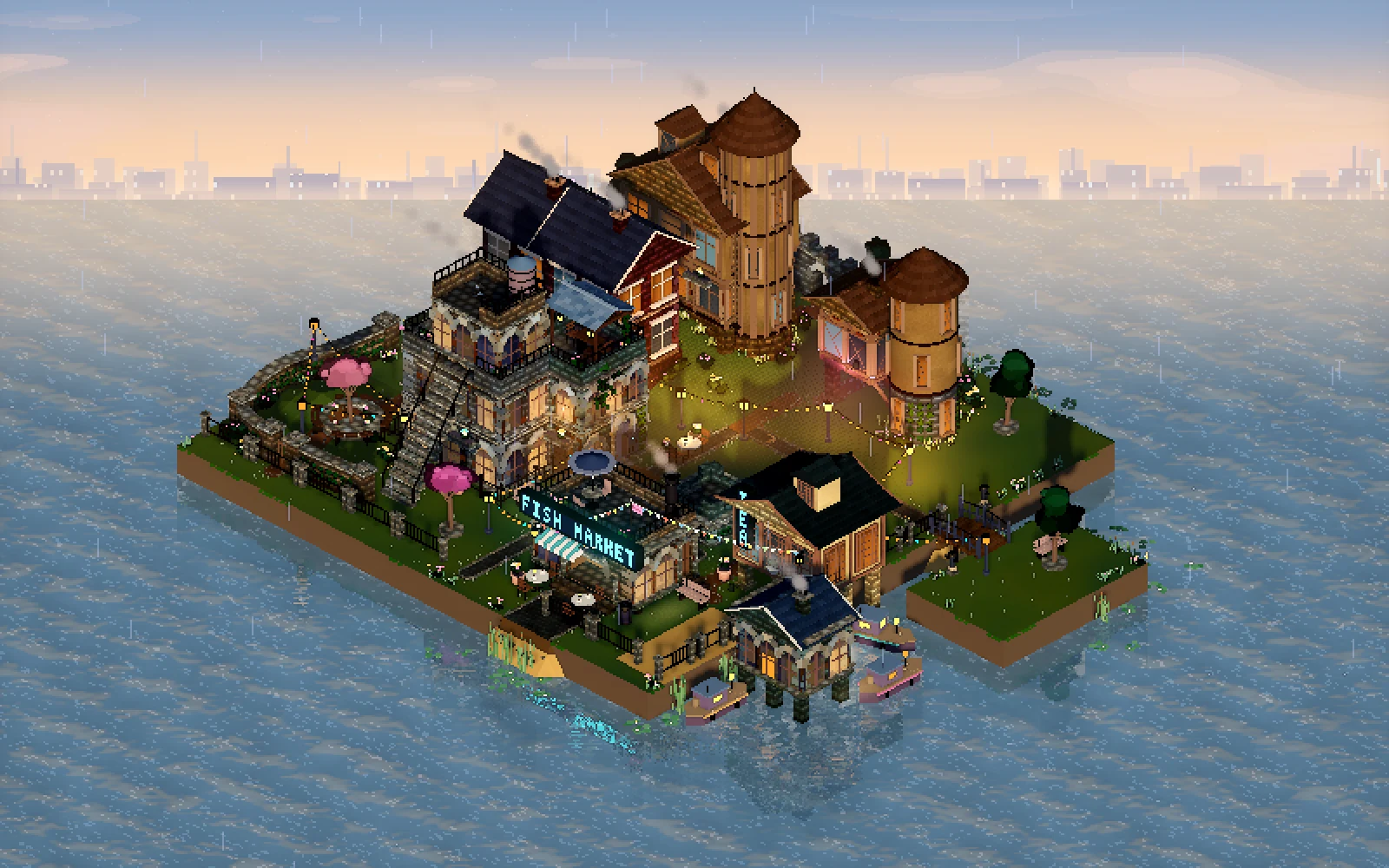
At night the Harbour, the scene the game opens with, became 2.3 luma brighter on average, with 8.3 per cent of the frame changing by more than 8. Compared with the old build with fog and smoke switched on by hand, the new Harbour views differ by less than two repeat captures of the same build do, so the defaults change nothing else. Views that load an older saved scene stayed within capture noise.
The warm halo is the open question. On grass at golden hour and at night the lamp glow in the fog reads as a halo around each lamp, and it is strongest in the small scenes. It comes from the previous change, which keeps the lamp glow at the full fog setting at every hour. Whether to keep it that strong was left for the end of the stage; the answer is further down.
Fog and smoke cost about a quarter of a millisecond a frame. Timed with vsync off at 1920 by 1080, rain at 0.45, over five interleaved rounds on mains power, the Harbour at night went from 6.56 to 6.82 milliseconds, 0.25 slower, and at 13:00 from 6.58 to 6.81, 0.23 slower, within the plan’s limit of 0.5. Timing the canal quarter with and without the settings in the same build puts about 0.2 of that on the full-screen fog, which leaves about 0.05 for the Harbour’s seven chimneys of smoke. Each adds one draw call. The smoke can’t be made to repeat exactly between captures in this version of Godot, even with a fixed seed, so plume differences between two captures count as noise in the measurements. The final full suite passed with 40 suites and 19,292 checks and no failures.
A crisp shade under the ledges
The Canal look’s contact shadow switch used to turn on only the engine’s ambient occlusion, a soft darkening in corners and creases. It now draws the game’s own contact shade pass, the one the Glade look already used, in a near-black violet with three steps of strength, at half strength at night. By day and at golden hour it puts a dark line one or two art pixels wide under sills and copings, along stair risers and at the feet of walls. The same switch still turns it off.
At the plan’s radius of 0.6 metres the pass drew soft bands up to 10 art pixels wide across whole parapet faces, so the radius came down to 0.15 metres, and the smallest step in height that gets a shade went from 0.22 to 0.06 metres. On the canal quarter by day the median shaded band is now one art pixel thick, and 88 per cent are at most two. The shaded cells cover about 7 per cent of that frame and are darkened by about 14 luma on average.
The soft shade was doing something
The plan assumed that the engine’s ambient occlusion did nothing visible in this renderer and could be switched off everywhere. Measurement showed otherwise. In the build before the change, switching it on darkened the frame by 0.3 to 0.5 luma on average, enclosed courtyards by about 3, and it cost 0.35 to 0.44 milliseconds on the dense test scene and about 0.13 on the Harbour. With it gone, the Glade views, which were meant to stay identical, changed on 1.2 to 1.4 per cent of the frame against 0.2 to 0.5 per cent between repeat captures. At night more than nine in ten of the Canal creases it used to shade came out lighter, by about 7 luma on average and nearer 10 under the Harbour fog.
The creator chose to keep the engine shade in the Glade look only, exactly as before, and to let the Canal look use the crisp pass alone. Canal gives up the soft night shade in the creases it used to darken, and the creator accepted that. The creases the new pass draws still hold at or below their old values at night. After the third fix pass the Glade views match the old build within capture noise, and the Canal views match the reviewed version.
In the Canal look the new pass costs about what the soft shade did. Timed the same way as the defaults, the final build ran 0.07 milliseconds faster than the build before the change on the dense test scene at night and 0.01 faster on the Harbour, so frame time is about neutral. Each Canal view gains one draw call. Keeping the engine shade as well would have added about a quarter of a millisecond on the dense scene. The final full suite passed with 40 suites and 19,379 checks and no failures, and the integration check at 2880 by 1800 passed.
Soil and paving at the tree feet
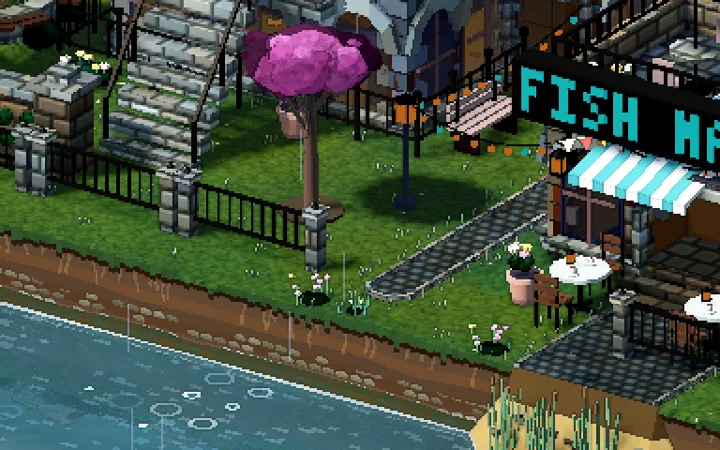
Every tree used to stand on a pale stone ring, even in the middle of a lawn, and the art review had listed it among the quick fixes. The ring is gone. On grass, earth and sand a tree now stands in a low collar of dark soil, 6 centimetres high at the default trunk size. On stone paving or a cobbled road it stands in a ring of darker stone sunk nearly flush with the slabs, which reads as a tree pit. Both use the old ring’s twelve-sided shape at the old radius, so the triangle counts are unchanged, and both are there from the moment a tree is planted, so the growth animation leaves them alone. Paint paving under a standing tree and it switches to the pit; undo brings the soil back, and the saved scene is byte for byte what it was.
The soil colour from the art review came out too light. In sunlight the collar’s top rendered at luma 118 against a lawn of about 100, a tan disc brighter than the grass, so it was darkened until the sunlit top sat at 74 to 76. The creator kept the darker colour. Measured against the green ground around it, the collar in the tree-style grove now has a median luma of 28 against the ground’s 59, where the old ring had 55. On the canal quarter’s paving by day the pit reads 48 against the paving’s 54; the old pale disc read 91.
Trees on roofs and terraces have no terrain under them, so at first they fell back to the soil collar and stood in a brown bed on the stone. The creator asked for the paved pit there too, and a follow-up gives it to any tree whose parent is a building. Trees afloat or on a plinth keep the soil. Earth and sand collars are covered by tests but were not captured, and the roof-tree follow-up was compared by eye by day only; its night captures were not looked at. Draw calls moved a little, because trees are grouped by their collar: the Harbour view lost 15, since trees on grass no longer need a stone surface, and the canal quarter ended where it started once the roof trees took the pit. After the roof-tree change the full suite passed with 40 suites and 19,494 checks.
Leaded windows
The small medieval houses, their merged pairs, the towers’ slot windows, placed windows and dormers used to draw an X of two thin diagonal beams across each pane. Every medieval window is now leaded instead, with a 5-centimetre bar down the middle and a crossbar a little above the centre, both standing 4 centimetres proud of the glass. The larger composed fronts already looked like this. The X survives only where it belongs, as timber bracing on the walls. The creator had turned down a variant that would have given small windows the crossbar alone.
A beam and a bar are both 36 vertices, so vertex counts did not move, and draw calls were identical on the Harbour and the styles showcase. A test probe counts no diagonal beams in any building type or scene it builds. One side effect can be heard: during the build animation the crossbars start appearing higher up the window than the beams did, so a medieval tower now plays its plank clicks in four groups instead of two. In the Harbour at night the vertical bar of the middle tower window barely shows in the glow, although the crossbar does. The full suite passed with 40 suites and 19,492 checks. No benchmark was planned for this change.
The speed fix for the tree undersides
The night stage added a floor that keeps the undersides of tree crowns from sinking to black at night. Its frame-time follow-up found that the floor’s shader work ran on every foliage pixel at every hour and cost about as much at noon as at night. That work now sits behind one switch that is on only where the floor has any weight, which means at night. By day and at golden hour none of it runs. At night it is the same code as before, with a few trims that give exactly the same result.
On the dense test scene the fix saves 0.19 milliseconds at 13:00 and 0.17 at night, and the fixed build was faster in all five rounds. That brings back about 85 per cent of what the floor cost. Against a copy of the same build with the floor taken out, 0.04 milliseconds remain, the same by day and at night, so they come from the switch itself. Removing that would need a second version of the shader swapped in at dusk, which was not tried. The Harbour result could not be read: the Mac was busy during that benchmark, and rounds spread by 0.35 to 0.74 milliseconds, far more than a saving of this size. The benchmark repeated the night stage follow-up’s settings, with vsync off and on mains power.
The crowns look the same. The median of the crown undersides in the canal quarter at night stayed at 24.9. Most captures sat within the spread of repeat captures, and the few views that read slightly above it show only rain, water, smoke and glints moving in their difference maps. After a review fix replaced a test that could never fail, the suite at the stage close passed with 40 suites and 19,510 checks.
The stage measured as a whole
At the end of the stage the final code was checked against a copy of the build from before it. The full suite passed with 40 suites and 19,510 checks and no failures, and the integration check at 2880 by 1800 passed. On the six standard journey views every change in the draw-call counts is one that a part declared. The Harbour went from 909 to 897: two more for fog and smoke, one for the contact shade and fifteen fewer tree surfaces.
Apart from the view of the tree-style grove, which comes up below, the looks the plan protects held. All of the Canal’s mirrored light columns are still there, the neon fish and bar signs are unchanged, and the 05:45 and 20:45 skies measure the same. The Glade and Canal night skies are still clearly apart. The only other protected spot that moved is the surround of the lane’s neon sign at night, where the lamp glow in the fog lifts the median from 132.7 to 139.6.
The stage was timed against the build from before it, with vsync off at 1920 by 1080, rain at 0.45 and mains power, over three interleaved rounds at night and at 13:00. The dense test scene got faster, from 13.47 to 13.19 milliseconds at night and from 13.55 to 13.16 at 13:00, and was faster in every round. The Harbour was 0.06 milliseconds slower at night (6.59 to 6.65) and 0.03 slower at 13:00, in all three rounds. That is less than fog and smoke cost on their own, about 0.25. The speed fix and the fewer tree draw calls would explain the difference, but this benchmark did not separate them. On the dense scene most of the gain is the speed fix, and the contact shade about paid for itself by replacing the engine’s soft shade.
The creator’s answers
The creator answered three of the stage’s questions on 29 September, before seeing its summary sheet: keep the warm lamp glow in the fog, keep the darker soil, and give the roof trees the paved pit. The lamp glow therefore stays as the earlier sections describe it.
The stage close raised three more questions, and on 30 September the creator answered all of them the same way: keep it as it is. The first was the lamp glow at lane zoom, where it turns the lawn and path olive-amber at night: the frame’s mean luma rises by 7.4, and 26 per cent of it changes by more than 8. The creator had kept the glow after seeing smaller crops, so it was asked again at this zoom. The second came out of the stage check. The approved view of the tree-style grove changed more than any part had reported: 10.8 per cent of the crown pixels and 7.4 per cent of the frame moved by more than 8 luma, against at most 0.14 per cent between repeat captures, and the lawn lost its hatched shading. Apart from the new tree feet, that comes from the contact-shade change, which removed the engine’s soft shade from the Canal look. The grove is a Canal scene, and that change never captured it. Restoring the old grove would have reopened the creator’s ruling on the soft shade, and that ruling stands. The third was small: the vertical bar of the middle Harbour tower window at night, which the creator accepted. Nothing was changed for any of them.
Where the stage stands
The stage is closed and all of its code is merged, and the creator has answered its questions. Two one-call changes, on the chemistry test scene and on the Harbour at 21:00, were not traced to a part, and the Harbour share of the speed fix is still unmeasured. The bank that should stand out from the water at night, owed since the night stage, moved on to the next stage, which rebuilt the island edges. Everything ran on a Mac; Windows was not run.
From the project notebook
This chapter draws on the project’s records as they stood on 30 September 2026.
- docs/visual-handoff.md · Beautify fog lit by the city and warm smoke entry, with both fix passes and the review fixes, 29 September
- artifacts/beautify/owner-decisions.md · Creator decisions before the stage and the review ruling on the lamp glow
- artifacts/beautify/20-P2/c/ · Captures, probes, metrics, sheets and suites
- docs/visual-handoff.md · Beautify fog and smoke on for new scenes and starters entry, 29 September
- docs/visual-handoff.md · Beautify canal contact shade entry, with its review, escalation and third fix pass, 29 September
- artifacts/beautify/owner-decisions.md · The creator’s ruling on the engine shade in the two looks, 29 September
- artifacts/beautify/20-P2/b/ and 20-P2/d/ · Captures, metrics, sheets, benchmarks and suites
- docs/visual-handoff.md · Beautify tree-foot collar, leaded windows, roof-tree pit and foliage night-floor speed fix entries, 29–30 September
- docs/visual-handoff.md · Fog and smoke stage close: suite, journey, protected looks, whole-stage benchmark, handoff check and open questions, 30 September
- artifacts/beautify/owner-decisions.md · The creator’s answers to the stage’s questions, 29 and 30 September
- artifacts/beautify/20-P2/a/, e/, e2/, p/ and close/ · Captures, sheets, metrics, benchmarks and suites