In this chapter
In this chapter
A line along the water
The water used to meet an island with no mark at all. The art review had found that the shoreline foam in the water shader never actually drew. The water now works out, from the camera projection alone, how deep the submerged face under each pixel is and how far the pixel lies from that face’s waterline. From that it draws a rim one or two render pixels wide that brightens and fades with a slow lap, a broken one-pixel swash line three to five pixels out, and shallows that turn a little turquoise by day and darker at night. In the Glade look the rim is a soft white line. All of it fades out within 0.2 metres of the face, so nothing is drawn over open sea, and the dead foam code is gone.
One snag came from the renderer. The game’s pixel viewport flips the sign of one entry in the projection matrix, and until the code took its absolute value the rim filled the whole submerged face.
On the views drawn at the usual pixel size, most rim runs are one or two render pixels long: 92 to 99 per cent on the canal quarter, the styles showcase and a new test scene with a beached boat, and 76 to 92 per cent on the Harbour views. The lowest is the Harbour lane view, whose repeat captures have as many long runs from rain streaks. Over open sea the rim count stays within the spread of repeat captures, and a three-frame orbit shows the same line along the same cut from each angle. The photo lens blurs it into a thin soft line. On a sandy beach slope it widens to two to four pixels, and the Glade’s white line is about three pixels wide; both were left as drawn. At the Harbour’s zoom the submerged face is only about three render pixels tall, so the swash fades out before it can draw there. Draw calls and every other count were unchanged.
Boats got a skirt in the hull colour that reaches 0.2 metres below the waterline, so their hulls take the rim as well. Beached boats are not lifted, as the creator decided before the stage; on a tipped hull the skirt closes the gap under the raised end, and nothing hangs below the sand. Review found that the plan’s captures with floating lanterns had not been taken. They were taken afterwards: the lanterns’ float discs draw no visible rim and no artefact, and why they draw none was not looked into. The full suite passed with 40 suites and 19,620 checks. At night the rim is a strong lavender line, and on 30 September the creator chose to keep it.
Rings in the rain
Rain used to throw small untextured splash squares, about a third of a metre wide, over the water from the processor, and some of them showed as ticks against the painted sky. The puddles already drew pixel rain rings, so that ring code moved into a shared file and the water now draws it too, on 0.8-metre cells, with more drops as the rain gets heavier and none when it is dry. The splash emitter is gone. Every rainy view with water has one draw call fewer, and no splash ticks appear over the sky.
On the Harbour’s open sea at night, with rain at 0.35, the groups of pixels shaped like rings went from 3 to 45 and 46 in two capture sets. By eye they are pale ellipses about five to eight pixels wide and two to four tall, and a fresh drop shows as a dot of one or two pixels. By day the pixels the ring detector picks out went from 7.4 to 11 per cent of that stretch of sea. At lane zoom the rings are faint. With no rain the water is unchanged, and the plaza puddles stayed within capture noise.
Review sent two problems back. Where the camera looks far across the water at a low angle, or is zoomed far out, one render pixel covers more water than a ring is wide, and the one-pixel line lit the whole drop as a bright square dash. The rings now fade out as the pixel grows past about 0.17 to 0.33 metres, and those views are back within 0.2 luma of the old water. The second problem was on the canal, where the rings were drawn but lost among the reflected walls, which vary by 33 luma against the Harbour’s 5. Where the town is reflected, a ring now shows at least the sky’s colour, at full strength. The share of canal pixels lifted by more than 16 luma in rain went from about 3 per cent to about 6, and pale ellipses now read over the reflected walls.
One plan line is only partly met. The rings ripple the water’s own reflection of the town, but the orange and neon light columns are drawn in a separate pass on top of the water, and the rings don’t show inside them. Changing that belongs to a later stage’s work on the neon bay. By day the rings over the reflected town near the Harbour island are paler and brighter than on open sea, and fresh drops there read as white dashes. The creator kept that too. The suite passed with 40 suites and 19,688 checks after the fix.
The waterline and the rings were timed together against the build from before the stage, with vsync off at 1920 by 1080, rain at 0.45 and mains power, over five interleaved rounds while the Mac was moderately busy. Each change stayed within about 0.06 milliseconds of nothing on every scene. The Harbour at 13:00, for example, measured 6.61 milliseconds before, 6.64 with the waterline and 6.61 with both. The benchmark was not repeated after the review fix, which adds a few operations per pixel and skips the ring where it has faded.
Banks cut like cake
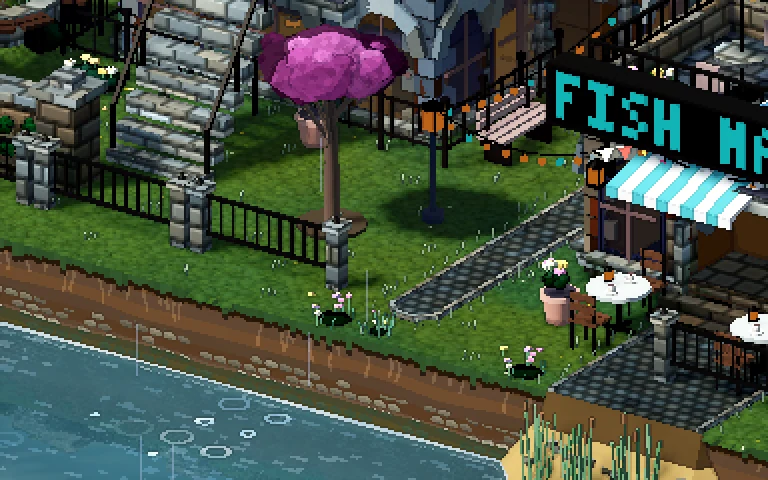
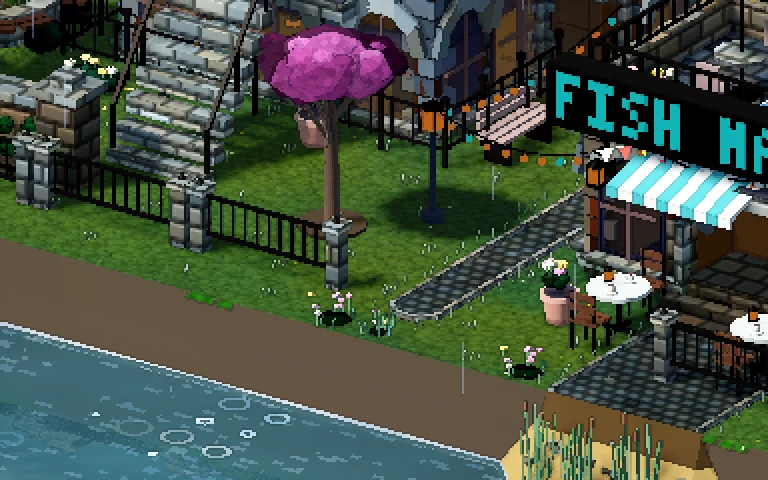
An island’s side used to be one flat brown face with a straight ruler edge along the grass. It is now drawn in the ground’s own material, grass, sand or earth, and shaded like a slice of cake. At the top is a lip in the ground’s colour; on a meadow it is 10 to 18 centimetres deep, ragged from column to column, with a drip hanging on about one column in eight. Below it runs a thin shadow line, then soil in layers 22 centimetres deep whose boundaries wander and whose tones alternate slightly warmer and cooler. The overhanging grass flaps from the defect sweep now take the lawn’s own colour, which ends the bright lime squares on the Glade’s banks that the creator had asked to have redone. Chunks whose flat surface held only the island side draw one call fewer: seven fewer on the Harbour view and 21 on the styles showcase.
At night the soil leans toward a cool grey of its own brightness and is lifted, so the bank stands clear of the water. The creator had asked for the night bank to sit at least 8 luma above the water, and it now does: 12.4 above open water and 10.2 above the water just below it, up from 3.6 and 4.5. By day the bank came down from 0.88 of the lawn’s brightness to 0.74, under the plan’s limit of 0.8.
The plan also wanted the bank under 0.8 of the lawn at night. That cannot hold together with the creator’s line, because 0.8 of the night lawn is 41.4, darker than the open water at 42.6. The creator’s line was kept, and the plan’s night limit was waived for the rest of the stage, by a ruling made under the creator’s instruction to settle choices overnight, which the creator can reverse. The bank sits at about 1.06 times the lawn. One constant would bring it nearer the lawn, with less margin over the water.
Roots, stones and a line of algae
The second half of the bank work filled in the layers. Pale roots one art pixel wide hang 10 to 42 centimetres through the top layers; there are fewer on earth and none in sand. Lower down, a band of stones in running rows rises from the water to a wandering top 30 centimetres above the tide mark. At the foot is the algae band and pale tide line the quays already have, reused from the quays’ own shader code, so where a bank runs into a quay the tide line carries on at the same height, 19 pixels below the rim on both sides of the join. Earth banks get their own red-brown soil, and sand banks are tan with a few pebbles. The Glade look calms the bank down: no drips or roots, fewer and smoother stones, and a less saturated brown.
As first submitted, this left a black line one or two pixels wide along the foot of every bank, and on earth at night a black honeycomb between the stones. The part’s report had claimed no black pixels, because its fixed measuring boxes missed the foot. The cause was the algae tint laid over already dark soil, which the tone curve’s dark end crushed to black. The fix keeps the algae band at no less than 0.95 of its soil’s brightness, and the packed soil between the stones at no less than the soil itself. The algae now reads by its green-teal colour, its gloss and the pale tide line. A recheck then found the Glade’s shadow line under the lip running on as an unbroken black line where the calm had removed the drips, so in the Glade that line was lightened to 0.93 of the soil. Counting pixels that turned black in both final captures and in neither before capture, a handful are left: eight on the styles showcase, two art pixels in all, and five art pixels where two roots start under an earth bank’s shadow line.
After both fixes the bank sits at about 0.76 of the lawn by day. At night it is 15.1 luma above open water and about 12 above the water below it. At golden hour it is 1.255 times the lawn against a limit of 1.5, and in the Glade by day 0.58 of the lifted lawn against a limit of 1.0. The Glade’s count of dark specks along the lip, which the shadow line had raised from 3 to 38, is back to 3. The quays’ night brightness, raised during the night stage, held at 0.72 to 0.73 of the paving against a floor of 0.55, so the new night shallows did not undo it. Draw calls were unchanged, and the suite passed with 40 suites and 19,830 checks.
The bank changes were timed on the lane, the tree grove and the styles showcase at 13:00, with rain at 0.45, vsync off and mains power, over five interleaved rounds while the Mac was under load. They moved frame time by 0.03 milliseconds at most either way. That benchmark ran before the review fixes and was not repeated.
The stage measured as a whole
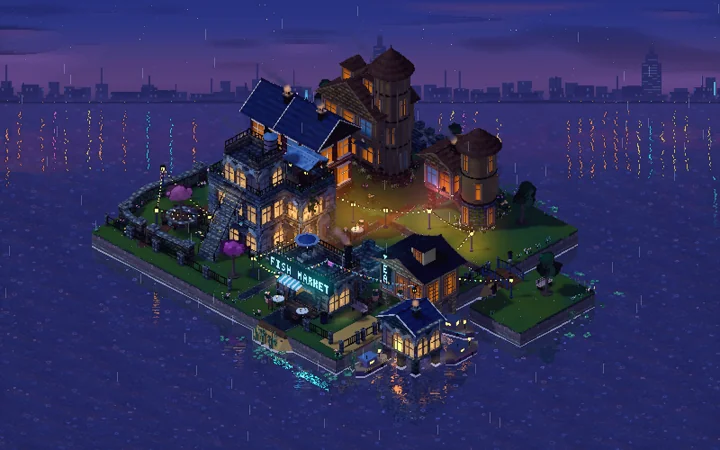
At the end of the stage the final code was checked against a copy of the build from before it. The full suite passed with 40 suites and 19,830 checks and no failures, the same count as after the last bank fix, and the integration check at 2880 by 1800 passed. On the six standard journey views every change in the draw-call counts is one a part had declared. The rain rings took one call off every rainy view with water, and the banks took seven more off the Harbour, four off the lane and 21 off the styles showcase, so the Harbour went from 897 to 889 and the styles showcase from 491 to 469. By eye the Harbour views gained the thin lit rim, lighter and textured bank sides that turn lavender at night, and rings on the open water. In the canal quarter the quays and the boat gained the rim, and the town itself did not change.
The looks the plan protects held. The canal’s mirrored light columns are all still there: in two capture sets 16 and 45 per cent of their pixels moved by more than 8 luma, against 14 and 39 per cent between repeat captures of one build, and the extra is the rain rings landing on them. The neon fish and bar signs and the lit tower windows stayed within capture noise, the 05:45 and 20:45 skies measured the same, and the Glade and Canal night skies are still apart. In the tree-style grove the crowns, conifers, tree feet and lawn did not change; the small change in that frame is along the bank.
The bank figures were taken once more on the final code. On the Harbour by day the bank sits at 0.77 of the lawn’s brightness, down from 0.88 before the stage. At night it stands 15.1 luma above open water and 12.0 above the water just below it, up from 3.6 and 4.5, and is 1.12 times as bright as the lawn; the plan’s night limit of 0.8 times stays waived. At golden hour it is 1.26 times the lawn, and in the Glade by day 0.58 of the lifted lawn.
The whole stage was timed against the build from before it, with vsync off at 1920 by 1080, rain at 0.45 and mains power, over three interleaved rounds at night and at 13:00. It cost nothing measurable. The dense test scene went from 13.46 to 13.44 milliseconds at night and from 13.45 to 13.41 at 13:00. The Harbour went from 7.85 to 7.63 at night and from 7.76 to 7.63 at 13:00, with eight fewer draw calls and no splashes left for the processor, but that gain is inside the spread between its rounds, up to 0.45 milliseconds. Other programs kept the Mac busy during the run, and the Harbour’s times sit about 1.2 milliseconds above the fog stage’s figures for the same starting code, so these numbers only compare with each other. The bank review had asked for views with a lot of ground. The stage close timed only the dense scene and the Harbour, so the ground-heavy views were last timed in the bank work’s own benchmark, before its review fixes.
Where the stage stands
The stage is closed. Its summary sheet has fourteen pages of before and after crops, in colour and, where values matter, in greyscale. Two things on it were flagged for the creator and left unchanged. At 05:45 and 20:45 the Harbour bank reads 1.57 and 1.50 times as bright as the dark lawn, up from 1.45 and 1.39 before the stage. In the lane view at night the bank is a pale lavender-blue block with light stone chips, lighter than the lawn. The sheet also showed that the rain rings still do not appear inside the reflected light columns, which was left for the next stage’s neon bay.
The creator signed the sheet off on 30 September as it stood, which cleared the way for the next stage’s cloud and city-glow work, and the earlier answers about the warm soil, the lip specks, the lavender rim and the bright day rings stayed as they were. The lantern floats still draw no rim. No milestone build was exported at this point; the plan makes the next one after the skyline stage. Everything ran on a Mac; Windows was not run.
From the project notebook
This chapter draws on the project’s records as they stood on 30 September 2026.
- docs/visual-handoff.md · Beautify waterline rim, swash and shallows and boat hull skirt entry, with its review fix, 30 September
- docs/visual-handoff.md · Beautify rain rings on open water entry, with its review fix and the three-way benchmark, 30 September
- docs/visual-handoff.md · Beautify cake-slice banks I and II entries, with the review fix and recheck, 30 September
- artifacts/beautify/owner-decisions.md · The beached-boat rule, the night-bank ruling and the creator’s answers to the look questions, 30 September
- artifacts/beautify/21-P3/ · Per-part captures, crops, metrics, benchmarks and suites
- docs/visual-handoff.md · Islands-in-water stage close: suite, journey, protected looks, bank lines, whole-stage benchmark and summary sheet, 30 September
- artifacts/beautify/owner-decisions.md · The creator’s sign-off of the stage’s summary sheet, 30 September
- artifacts/beautify/21-P3/close/ · Stage-end captures, metrics, benchmark and sheet