In this chapter
In this chapter
- A setting for motion
- Breathing pools and faulty tubes
- Real lights that follow their tubes
- The first group, measured together
- Rain one art pixel wide
- The second group and its approval
- One wind for the whole town
- Trunks that bend with their crowns
- Flags, washing and bunting
- Rain and water in the gusts
- Boats that bob, and more moths
- Cloud shadows by day
- Dust and splashes where things land
- The wind group, measured together
- A veil of rain behind the drops
- Rain that takes the colour of the lights
- The rain group, measured together
- Where the stage stands
A setting for motion
The Scenery panel has a new option, Ambient motion, with Full, Reduced and Off. It lives only in the player’s preferences file, so changing it is not an edit: it does not go into the scene, the undo history or the save, and the save format stays at version 2. Full is the default. The setting feeds three new values that every shader can read: a motion scale of 1, 0.5 or 0; a light clock that runs on frame time even when the day clock is stopped; and the size of one art pixel on screen. Every automated capture holds the light clock at zero so that stills stay comparable, and a run option releases it for recordings.
Following the plan’s default, which the creator later approved, the setting only governs the new night-life motion and the wet glints added three stages earlier. Water, swaying leaves, clouds and rain move as before at every setting. This part moved nothing by itself.
It also added a one-command recipe for filming the game: ten seconds at 30 frames a second, giving a video, a sheet with one frame per second, a difference image and the share of pixels that change between frames. The recordings are 1440 by 900 because the engine’s movie writer on this Mac records at the window size; a trial at 1600 by 1000 came out resampled with smeared art pixels. Two baselines were filmed for the later parts. In the Harbour at night 9.9 per cent of the pixels change between sampled frames, 2.2 per cent by more than 8 luma, from rain, water and cloud dither. In the tree grove by day only 0.11 per cent do, from the swaying crowns. Review found nothing that needed fixing and noted that the light clock would lose precision after hours of play, so the next part wraps it. The suite passed with 42 suites and 22,457 checks.
Breathing pools and faulty tubes
At night the pools of lamp and window light now breathe. Their brightness steps between three levels, 0.89, 1 and 1.11 times, and the pool’s wet sheen and glints step with it. Lantern glass stays steady. About one cyan or pink neon tube in ten is now faulty. Once in each 11.5-second cycle it drops out in a short burst of four 0.2-second steps, so bursts come 7 to 16 seconds apart, with never more than two and a half flashes in a second, under the plan’s safe limit of three. The breathing starts as the lamps come on and the faulty tubes only once night has fully fallen. The Glade breathes at half strength and has no faulty tubes. Reduced halves the breathing and stops the tubes, and Off stills both. The light clock now wraps every 1,380 seconds, a period that holds a whole number of every one of these cycles, so the wrap has no seam.
The game keeps its own copy of the rule, and it predicts every burst. In the canal quarter 2 of the 23 tube seeds are faulty, and both are bulbs: a pink bulb on the turret and a cyan bulb in a festoon. No lettered sign is faulty in any stock scene, and the Harbour has no faulty tube at all. In a recording the pink bulb dropped from 242 to 131 luma at the moments the game’s copy predicted, to within a frame, with its bursts 10.8 seconds apart and never more than two flashes in a second. Under Reduced it stayed at 242 for all 600 frames. Over 1,000 seeds, 94 came out faulty, with gaps between bursts of 7.15 to 15.89 seconds.
The breathing is subtle. In the quarter in dry weather 4.41 per cent of the frame steps, mostly the halos of windows on walls, about 1.3 times a second, and the median pixel moves by 2 luma; the pools under street lamps barely show it. Review found no fault, but it raised two questions for the creator, whether to breathe only the lamp pools and whether to make a lettered sign the faulty one, and recorded that the quarter’s BAR sign did not show a dim step it was expected to show at 18:23.
The same change fixed an old fault. A sign’s lights come on through a short flickering band at dusk, and if the clock stopped inside that band the sign stayed half lit. Now, half a second after the hour stops moving, the sign settles fully lit or off. At 17:25 on the Harbour the fish-market letters measured 196.4 luma before and 184.1 after, the off step. The wet glints from three stages earlier now run on the light clock too, so in automated stills they are frozen, which changes 0.3 to 0.8 per cent of a night frame. The Harbour at night got 0.02 milliseconds slower in the median frame, in all three rounds. Its slowest frames were 0.85 milliseconds slower on the median of three scattered rounds, which the notes record without a verdict. The suite passed with 42 suites and 22,516 checks.
Real lights that follow their tubes
So far the breathing and the bursts lived in the glass and the painted pools. The engine’s real lights, the 16 at a time that light walls, wet paving and fog, now follow them. Each pool light breathes with its pool, and the light of a faulty cyan or pink tube steps with the tube, so the sign’s spill on the wall and the wet paving and its glow in the fog blink with the glass. The factor goes on after the lights’ usual easing, so the steps are crisp and the dusk fade keeps its timing. A first version worked out each light’s seed in the pass over every light source and added 2.4 milliseconds of light work on the dense scene, and a lighter form still added 0.85; both were reverted, and the seed is now worked out only when a light takes one of the 16 places.
No stock scene has a faulty sign with a light, so the demonstration used a copy of the quarter with one pink sign moved 6 centimetres along its wall, which is enough to make it faulty. On the tube’s low steps the pink glow on the pergola terrace under the sign dropped from a mean of 35 luma to about 27 and came back. Under Reduced the terrace moved by 1.83 luma, against 9.06 at Full.
Review found a rounding mismatch. The game hashed a light’s position in double precision, while the shaders round the same position in single precision, and on an exact half-centimetre the two disagree. A light there took a different life from its own glass, breathing out of step with its pool or stuttering when its glass did not. In the stock quarter 27 of 216 light sources stand on such positions, seven of them tube lights. All 27 breathed out of step with their pools, though no stock sign blinked apart from its glass. The game now rounds the way the shaders do, and a recording of a sign nudged onto such a position shows the terrace glow stepping with the tube only after the fix. The suite passed with 42 suites and 22,555 checks.
Two things stay as they were. The reflection streaks a faulty sign throws on the paving and the canal stay steady while the sign blinks, because the reflection shader has no night life. And the threshold that decides when a light turns on at dusk, from an earlier stage, still rounds in double precision, so a light on a half-centimetre can come on at a slightly different moment from its glass; changing that would move those thresholds and needs a part of its own. The Harbour at night was 0.05 milliseconds slower in the median frame, measured before the rounding fix and not again after it.
The first group, measured together
The checks that closed these three parts ran early on 6 October. The suite passed with 42 suites and 22,555 checks, and the integration check at 2880 by 1800 passed. Every count on the six journey views, draw calls included, matched the previous stage, apart from one bookkeeping figure for the light pool that now reads exactly 1. Every automated still holds the light clock, so the night life does not show in stills; the stopped-clock fix and the frozen glints do. In 39 of 96 views the frames also changed by more than the spread between captures of the same build, on 0.5 to 2.5 per cent of the pixels: rain rings, water reflections, the far neon columns and cloud dither, all driven by the engine’s own clock. The new build’s captures came about 47 milliseconds later after start-up, later in 86 of the 96 views, which probably explains it. That was not proven.
The protected looks and the approved tree style held within noise. Timed against the build from before the stage over three interleaved rounds at night, 13:00 and 19:30, the dense scene stayed within 0.04 milliseconds, and the Harbour at night was 0.05 milliseconds slower in the median frame in all three rounds. Draw calls did not change. One small count is unexplained: in one orbiting view of the quarter, one light fewer is admitted.
The group’s seven-page sheet asked the creator about the faulty tubes, the breathing window halos and a faulty lettered sign. The creator approved everything on 6 October. That keeps the faulty tubes on by default, every pool breathing, the faulty pick on its hash with no lettered sign, the steady reflection streaks and the dusk rounding as they are. Any of them can be reopened.
Rain one art pixel wide
The old raindrop was a thin billboard: a light core with a dark outline column on each side, three columns wide, 10 art pixels long at the Harbour’s zoom, 18 in the quarter and 24 at the lane, and it flickered in and out of the pixel grid as it fell. Each drop is now snapped to the screen’s pixels as a rectangle of whole art pixels, 1 wide and 6, 7 or 8 long, at every zoom. It keeps its length and its opacity, between 0.16 and 0.34, while it falls, and it is tinted toward the hour’s haze. The space the rain falls through now follows the camera’s zoom and view, so a frame shows about the same drops falling at the same speed in art pixels whatever the zoom. The number of drops stays at 909 for the default rain setting. Changing it would kill every drop at once, so zooming never touches it.
On a flat test meadow at night, 99 per cent of steady drop rows were exactly one pixel wide at all three zooms, against 23 to 40 per cent before, and 98.6 to 98.9 per cent of the drops were 6 to 8 pixels long, with a median of 7. Between frames about 95 per cent of the drops reappeared in the same column a little lower, so they no longer crawl. The part’s own scanner gave 14 to 42 per cent for the old drops; a second reviewer’s scanner, which does not split the old long streaks, gave 61 to 69 per cent at the lane zoom. Drops now fall 6 or 7 art pixels a frame at every zoom, where the old ones fell 6, 12, or 14 to 15.
The second review found that the drops had become uneven down the stock night views, heavy at the bottom and thin at the top. The top band of the frame held 0.44 times the drops of the bottom band at the lane zoom, 0.61 in the quarter and 0.62 at the Harbour, against 0.76 to 1.13 before. The rain’s space, scaled with the zoom, topped out 8.4 metres above the lane’s target and 11.1 above the quarter’s, below the towers’ roofs, so little rain fell in front of the upper storeys. The first answer only rewrote the notes, and a ruling said that was not enough. Now the band the rain covers rises 2 metres for every metre the tallest building or tree stands over the target. In the stock scenes that takes it to 33.8 metres over the lane’s target, 39.4 over the quarter’s and 45.3 at the Harbour. The ratio is now 0.93 at the lane and 0.88 in the quarter, against 0.88 to 1.04 and about 0.77 before, and the Harbour averages 0.83 over eight clips against 0.84 over seven before; single clips vary by about 0.1. Every band of all three views now has more drops than before.
A third pass corrected two statements in the notes. A density figure at the widest zoom had compared different backgrounds; counted over the meadow alone, the density varies by 1.11 times across zooms from 10 to 95, inside the 1.25 the plan allowed. And the Harbour’s sky rows do change, because the same drops are spread through a taller space.
The new drops are about half as bright as the old ones, 27 luma above the meadow against 55, with no dark rim, and the stock night views carry about 1.7 to 2.4 times as many in a frame. In stills the rain reads as a finer, fainter veil. Timed against the first group’s code, frame times stayed within noise and draw calls did not change; the Harbour’s median frame at 01:00 was 0.04 milliseconds slower in all three rounds, as more drops now fall inside the frame. The rain is not prepared in the shader warm-up at start-up, the perspective and photo-mode lenses were not captured, and photo mode’s free camera still uses the old fixed rain box. The suite passed with 42 suites and 22,686 checks.
The second group and its approval
The checks that closed the rain change ran late on the morning of 6 October. The suite passed with 42 suites and 22,686 checks. The journey counts matched the first group exactly. In 6 of 99 views the frames changed beyond the spread between captures, again from water and clouds on the engine’s clock; the drops land somewhere new in every still, so they cannot show as a steady change. The protected looks and the tree style held. One set of captures came out capped at about 120 frames a second, with two views framed or counted wrongly, and was discarded and taken again; the cause is not known. Frame times stayed within noise, and the 19:30 round was run a second time because the Mac’s load rose during the first.
The creator approved the rain on 6 October, first while the closing checks were still running and again after seeing the finished sheet. That keeps the drops as built, at about half the old brightness with no dark rim, and takes the plan’s default for the next rain question: a lit veil of rain as the art review designed it, rather than lamp-lit drops or stopping here.
One wind for the whole town
The third group starts with a single gust field that every later part reads. It runs on the light clock: one gust in each 30-second cycle, placed so that gusts come 20 to 40 seconds apart. A gust rises over 2 seconds, falls over 5 and has a random strength between 0.55 and 1. Its front travels downwind at 6 metres a second, so trees further downwind move a moment later, and each tree adds a small lag of its own, up to 0.6 seconds either way. The wind blows the way the rain already slanted, and it is stronger in rain, from 0.3 in dry weather up to 1 in full rain. Forty-six cycles fill the clock’s 1,380-second loop, so the gusts have no seam.
While a gust passes, each tree’s crown moves as one piece by 1 or 2 whole art pixels sideways across the screen, then back. A crown holds each step for at least about 3.5 seconds, so it never blinks. A two-pixel step only comes in the stronger gusts of heavy rain; otherwise the step is one pixel. To make room for this, the crowns lost their old sway, a drift of about a quarter of an art pixel at the Harbour’s zoom that crawled across the pixel grid in every frame. That applies at every motion setting and in the Glade too, so under Off the trees are now completely still, and at Full they rest between gusts. It goes further than the motion setting’s rule that only new motion is gated, and the creator accepted it. Shrubs, ivy and the clustered foliage keep their old sway. The Glade, which is drawn without pixel snapping, moves its crowns 4 to 8 centimetres.
In a dry recording of the tree grove at the middle zoom, the best whole-pixel shift accounts for 80.7 per cent of what changes at a step, and only 2.2 per cent changes inside a crown. Between gusts the median number of art pixels that change from one frame to the next is now 0, against 43 with the old sway; at the near and far zooms the old figures were 170 and 10. A recording at Full matches one at Off pixel for pixel in all 351 frames outside the gust.
Review led to two fix passes. The first found that in dry weather and under Reduced the crowns hardly moved: with no rain a tree moved 20 times in the clock’s 23-minute loop, with gaps of up to 178 seconds, and under Reduced in dry weather it never moved. A one-pixel minimum fixed that. Every tree now moves in all 46 gusts in every weather at both settings, with about 23 to 35 seconds between moves. The same pass timed the game with a gust held in place, which the first benchmark had missed: the dense scene’s median frame rose by 0.14 milliseconds at most and the Harbour’s by 0.07, under the plan’s limits of 0.3 and 0.5. It also gave the trees that carry tree houses the new crowns; they had kept the old sway and swayed beside stepping neighbours.
The second pass dealt with the perspective lens and photo mode. Under perspective the step was a whole pixel only at the depth of the camera’s target, so nearer and farther trees moved by fractions and the best shift explained 77.0 per cent of the change, below the 80 per cent the ordinary view had to reach. The step is now sized at each crown’s own depth: 81.4 per cent under perspective, and 84.8 in photo mode, which had not been tested before. Recordings of the Harbour at three zooms were analysed too. With rain and water on, the drops and ripples hide the crowns, so dry recordings were compared with Off: 84.8 and 83.1 per cent at the two nearer zooms and 78.1 at the widest, where the crowns are small and most of the rest is their outline. The suite passed with 42 suites and 22,792 checks. The creator approved the wind in the trees on 6 October while the first fix pass was still running, including the loss of the old sway.
Trunks that bend with their crowns
With crowns stepping on their own, a crown could slide one pixel off its trunk. Now the limbs inside a crown and the top of the trunk move with it by the same pixels, and the bare trunk bends, with its one- or two-pixel jog in the lower 60 per cent. Growing trees bend the same way. In dry recordings of the grove, frames where a crown was held mid-gust showed a one-pixel gap at the joint in 194 of 243 frames at the near zoom and 146 of 195 at the middle zoom before the change. Afterwards there was no gap at any of the three zooms. Only one-pixel gusts were scanned; the two-pixel case rests on how the bend is built.
A tree that carries a house now moves only above it. Below the top of the house the crown stays still, and over the next metre it rises to the full step, so the house and its boughs never part from the tree. Before this, the whole crown moved. The leaves in that metre take a fraction of the step, so the lower crown shears a little where it should step; this was judged from crops and not measured. The dense scene’s median frame was 0.066 milliseconds slower in all three rounds and the Harbour’s 0.045. Review found nothing that had to be fixed, and the creator approved the trunks on 6 October with these points left as built. The suite passed with 42 suites and 22,832 checks.
Flags, washing and bunting
Flags, the pennant on the canal tower and the valances along the awnings are now cloth. When a gust crosses, the free edge flaps in whole art pixels, out, back, the other way and back, in quarter-second steps, while the edge on the pole or rail stays put, so the piece shears. The flap reaches the crowns’ one pixel in dry weather and the default rain, and two in full rain. Between gusts the cloth rests. The art review had suggested a constant one-pixel flutter that doubles in a gust, which would keep the cloth flapping in every still; the cloth follows the crowns’ rest instead. Reduced keeps it to one pixel at half the rate, and Off holds it still. In a recording of the pennant the free edge moved one pixel either way in dry weather and up to two in heavy rain, and the side on the tower did not move in any frame. The shapes and vertex counts are unchanged; draw calls rose by 6 on the Harbour and 9 in the quarter.
Review found that the plan had asked for a start-up timing before and after, since new materials add to the shader warm-up, and it had not been run. It was run then: the cloth adds four warm-up entries of about 54 milliseconds each, and the warm-up took 212 to 235 milliseconds longer per round. The creator approved the cloth on 6 October and at the same time left an approval standing until 8 the next morning: anything that passed review overnight would count as approved as built, with its open questions saved for the creator. The rest of this group was accepted that way.
Washing on the lines and the pennants of bunting use the same cloth. Their hems and tips swing sideways by a pixel as a gust comes and goes and by two at its height, in any weather, while the cord stays put. Washing is the lighter cloth, so it reaches two pixels where a flag in dry weather reaches one. In recordings the Harbour’s bunting moved only between 16.3 and 22.9 seconds, and in the frames where it moved the largest shift was one pixel in 33 and two in 61. The quarter’s washing moved one pixel in 23 frames and two in 44. In one view a few one-pixel runs near the top of a garment fitted best as a three-pixel shift, where its slanted side edge flips a pixel; the game’s own rule never goes above two. The pennants are triangles 4 to 8 pixels long, and their sloping sides restep as they move, which reads as a flutter. The washing and bunting add 3 draw calls in each view that has them.
Chimney smoke leans further downwind while a gust crosses the chimneys, up to 1.8 times its usual sideways drift. It is subtle. In full rain at the Harbour’s zoom the plume’s average position moved about 10.6 art pixels downwind from calm to gust in two recordings, against about 3 without the change. That does not show by eye in a still, and in dry weather the plumes vary too much between takes to measure it.
Review of the washing found a fault, which a fix pass on the morning of 7 October corrected for all the cloth. Each piece read how far the gust should push it at the moment it was drawn, so a change from one pixel to two could land in the middle of a flap step and leave a pose on screen for a single frame. Now each piece reads the reach at the start of its own step, so a change waits for the next step, up to a quarter of a second, or half a second under Reduced. In the quarter’s washing the shortest pose went from 1 frame to 3 at 15 frames a second, where a step lasts 3.75 frames, and the art pixels that held for a single frame went from 75 to none. Elsewhere it is better but not finished. On the Harbour’s bunting the pixels that held for less than a step fell from 656 to 21 of 1,270, and on the washing in another view from 151 to 41 of 274. Neighbouring pieces overlap there, each with its own timing, which may account for the rest; that was not shown.
Rain and water in the gusts
The rain and the water follow the same gusts. While a gust crosses the view, new drops fall slanted further sideways, up to twice as far at a full gust. Each drop also leans as it is drawn, its foot one pixel downwind of its top in the default rain and two in heavy rain, drawn as a one-pixel stair. Only drops inside the gust front lean, so while a gust crosses, a frame holds leaning and straight drops together. On the water, ruffled patches ride the gust front: more ripple dashes and a harder shiver in the reflections. Nothing leans or ruffles in a still or under Off, and Reduced halves both, with drops leaning one pixel at most.
In a dry recording of the canal quarter at night, frames differed from the old build in 167 of 300. The differences started at 14.2 seconds in the bottom right, the upwind side, and ended at the left edge at 24.3 seconds as the front crossed; two takes of the new build matched in every frame. On the night canal the patches visibly break up the warm reflection columns. By day they are scattered extra ripple dashes, faint in a still and clearer in motion. The calm reflections in the lower left of the quarter’s night view, which the plan asked to keep, change only while a gust is over them. The median frame changed by less than 0.04 milliseconds in each of the three timed scenes. The suite passed with 43 suites and 23,175 checks.
Review found nothing that had to be fixed and left several questions for the creator. The ruffle follows the gust and not the weather, so a dry day ruffles as hard as full rain, while the drops’ lean does grow with the rain. The daytime ruffle is faint, and one setting would strengthen it. The Glade’s water ruffles as much as the town’s. The ruffle pattern is also worked out from very large numbers in single precision, so the graphics card may not draw the same pattern as the game’s own copy of the rule, or as another graphics card would; Windows was not run.
Boats that bob, and more moths
Boats on the water now heave, roll and pitch on the light clock in whole art pixels. Every change falls on a grid of eight a second, and a boat’s pose changes about twice a second at Full. At the lane zoom and the quarter’s own zoom the hull steps up and down and tips by single pixels and reads as one rigid boat. At the Harbour’s default zoom boats stay still in dry weather and the default rain and step a pixel only in heavy rain. Roll shows most: the cabin roof moves a pixel. Off and every automated still hold boats exactly at rest, and Reduced halves the motion. A first version changed each motion on its own fifteenth of a second, so a combined pose could show for a single frame; the shared grid fixed that. In a dry recording at a lane zoom every change of a hull fell on a change the game’s copy of the rule predicted, poses held for a median of 6 to 8 frames, and the shortest hold was a single frame once, where two steps an eighth of a second apart landed on neighbouring frames. Boats reuse the small meshes they already had, so draw calls did not change.
At night the town now gets up to 3 swarms of fireflies and 5 of moths, where it had 2 and 2. They count outside the limit of 30 creatures with bodies. Reduced allows 2 and 3, and Off keeps the old 2 and 2. In the night quarter the creature count went from 30 to 34. The new swarms go to the lamps and shores already next in line; the art review’s wish to favour lamps near water and plazas was not applied. The moths are a few pixels across at the quarter’s zoom. One test was loosened. It had required a lamp’s moths to stay more than 8 centimetres apart, and the measurements showed that every swarm, the old ones included, dips below that in 1 to 6 per cent of moments because moths cross. The median frame moved by 0.06 milliseconds or less, and review found nothing that had to be fixed. Dragging a boat, the Glade, the perspective lens and photo mode were not filmed. The suite passed with 43 suites and 23,262 checks.
Cloud shadows by day
By day and at golden hour, soft cloud shadows now lie on the town, its walls and the water and drift downwind with the same wind, at 1.5 metres a second whatever the weather. Each shadow has two flat steps, a core and a half-strength edge, with no dithering. They fade with the sun in the evening, are gone by 20:45 and return with the sun between 06:10 and 06:30. The Glade has them at half strength. Every automated still shows the same pattern, because the light clock is held there. Under Off the pattern stands still and stays drawn, and under Reduced it drifts at half speed. A shadow darkens everything under it alike, lamp pools and lit windows included.
The shader darkens the core by 12 per cent and the edge by 6. Measured only on pixels that did not change between repeat captures, ground, walls and roofs under a core lose 11 to 13 per cent of their brightness and the water about 9, and the edges 5 to 7. The Glade’s shadows read about 0.4 times as dark as the town’s. By day the shadows add one draw call. Timed at 13:00, the median frame was 0.05 milliseconds slower on the Harbour and 0.015 on the dense scene, and start-up took 133 milliseconds longer.
A second review found two faults. At golden hour the bottom row of the painted sky had grown lighter wherever a shadow lay on the water at the horizon. A later pass outlines the sky’s last row against the brighter water under it, and shading that water weakened the outline; on the Harbour at golden hour 878 of the 1,600 pixels in that row came out brighter. The first row of water under the horizon is now never shaded, which brought that down to 16 pixels, at the cost of a one-pixel pale line under the horizon wherever a shadow lies there. The review also found that the first darkness figures counted raindrops as shadow; the figures above are the corrected ones. The drift recordings, the benchmark and the start-up timing were not repeated after the fix. The suite passed with 44 suites and 23,340 checks.
Left for the creator: under Off about 19 stone pixels beside the water flicker, probably where the outline pass meets the moving water, which was not looked into further. Selection grips and the placement fill darken by up to 12 per cent under a passing shadow. The pattern’s single-precision arithmetic raises the same graphics-card question as the water’s ruffle. The perspective lens and photo mode were not captured.
Dust and splashes where things land
When you let go of a part and it lands on the ground, a small ring of dust puffs, each 3 to 6 art pixels across, rises round its foot in the colour of the ground and fades away within a second. On water it throws up a splash of drops and one pale ring that spreads. A part you remove puffs as it finishes sinking, and undo and redo puff too. There is one burst for each release and nothing while dragging. With build animations off, in automated runs or under Off nothing puffs, and Reduced fires 6 puffs instead of 12. Walls, paths and the other drawn parts never puff.
Removing a tree on the lawn showed 10 puffs with a median width of 4 to 5 art pixels. They are in the lawn’s colour family but lighter and greyer, about 36 luma brighter by day, because the plan mixes the colour toward the pale daylight and the puffs are not lit as the grass is. Letting go of an edit on the Harbour with animations on took 0.10 milliseconds longer, well inside the 2-millisecond limit; on the dense scene it took 0.69 longer. The first puff of each kind in a session hitches, by 77 milliseconds for a tree and 67 for a boat, because its shader is compiled on first use. A normal launch prepares it in the warm-up, and then the hitch is gone; start-up took 272 milliseconds longer.
A second review found that the notes called the splash ring thin. It starts one or two pixels thick, but its small texture stretches as the ring grows, so by 0.6 to 0.75 seconds it is a blocky band 3 to 6 pixels thick, with stair-step blocks up to about 15 by 9 pixels. The notes were corrected, and a finer ring is left to the creator. The morning fix pass that corrected the cloth timing also fixed the splash itself: with the water switched off, a part set down off the land threw white drops and a ring over the dry bed, and now it raises dust. After that pass the suite passed with 44 suites and 23,405 checks. No Glade, perspective, photo-mode or house-placement recording was made.
The wind group, measured together
The checks that closed the eight wind and weather changes ran on the evening of 7 October. The suite passed with 44 suites and 23,405 checks, and the integration check at 2880 by 1800 passed. Draw calls on the six journey views rose by 4 to 13, the sum of the cloth’s, the washing and bunting’s and the daytime cloud shadows’ own figures. The cloth part had not declared one of the six views, so its figure there was worked out afterwards from another capture. Of 101 views, 86 changed by more than the spread between two captures of the same build. At night that came from rain rings, reflections, the far neon columns and cloud dither, which all run on the engine’s own clock, and the new build’s captures were taken a median 296 milliseconds later after start-up, later in 100 of the 101 views. By day and at golden hour the steady change is the cloud-shadow pattern.
The neon cores, the 05:45 and 20:45 skies and the separation between the Glade and the canal look held within noise, and so did the approved tree style by day. At golden hour the grove now lies partly under the core of a cloud shadow: its conifers went from 44.9 to 42.9 luma and the upper lawn from 97.2 to 86.3, which the cloud-shadow part had declared and the sheet showed. Timed against the build from before the group over three interleaved rounds at 01:00, 13:00 and 19:30, the median frame was about 0.2 to 0.3 milliseconds slower in both scenes at every hour and in every round, close to what the parts’ own timings add up to. The Harbour at 19:30 read 0.41 slower, with one of its rounds faster. The dense scene’s slowest frames rose by 0.27 to 0.35 milliseconds, under the plan’s limit of about 0.5. No new recordings were made for this close, and the perspective lens and photo mode were not captured.
The group’s twelve-page sheet went to the creator that evening, and the creator approved the whole group on 7 October. Everything stays as built: the tree-house crowns that shear above the house, the cloth, washing and bunting, the rain lean and the ruffled water, the boats and swarms, the pale dust and the blocky splash ring, and the cloud shadows, including the shade they now put over the approved grove and the Harbour’s courtyard at golden hour. Any of it can be reopened.
A veil of rain behind the drops
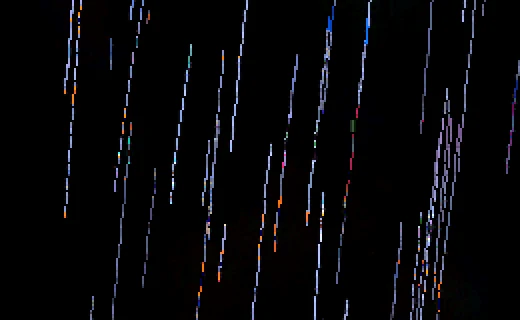
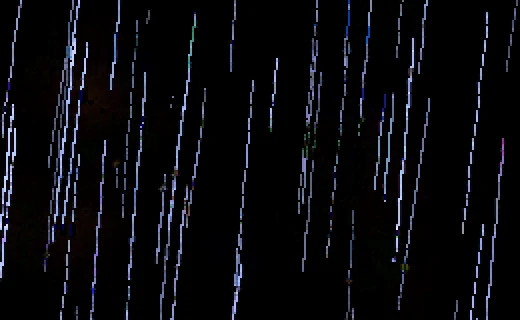
The last group finishes the rain. Behind the drops there is now a fine veil of faint streaks one art pixel wide, in three layers. The far streaks are 3 or 4 art pixels long and fall at 150 art pixels a second, the middle ones are 6 to 8 long at 240, and the near ones 12 to 16 at 360. Each layer is drawn only where the scene lies beyond its depth, so the far rain disappears behind nearer buildings. The pattern is counted from the world’s origin on screen, so it pans with the world in whole pixels. It drifts sideways at the drops’ own slant and leans by a pixel or two in a gust, as the drops do. Every still shows the same veil. Off holds it still over the scene, Reduced lets it fall at half speed, and by day it is drawn at 0.6 of its strength. Dry scenes and the Glade have none.
This is the plan’s default for the rain, which the creator took when approving the second group: the veil as the art review designed it. The build differs from that design in a few recorded ways. The far layer is about seven times as dense per cell, the layers’ strengths are 0.08, 0.11 and 0.16 where the review had 0.07, 0.11 and 0.18, and the review’s fixed slant of one pixel every five rows became the drops’ own drift. The reasons given are the plan’s target of about 5 per cent faint streak pixels and keeping the veil in step with the drops.
A detector for faint vertical streaks was run on the top-left sky of the canal quarter at night, the art review’s own crop. Faint streak pixels went from 1.56 and 1.16 per cent in two captures to 4.70 and 4.81, against the target of about 5, and hard streaks fell from 0.23 and 0.16 per cent to 0.05 and 0.12, under the limit of 1. Up to 1.3 points of every figure are the painted clouds’ dither, so the veil alone adds about 3.2 to 4.5. The detector was not calibrated on the art reference, though: on the reference image it gives 1.07 to 3.78 per cent where the review had measured 5.2, so the veil may be denser than the art it was meant to match. On the Harbour at night, where the default rain is lighter, the share went from 0.2 to 0.4 per cent to 2.5 to 2.9. By day it went from 0.08 to 0.24 per cent, which is close to invisible.
Nothing was drawn over the near buildings. The round tower and the right block brightened on 0.18 and 0.11 per cent of their pixels, the same as between two captures of the same build. At the quarter’s zoom the veil only shows over the sky, the far water and a little of the back roofs, and the near water and quays get only the drops. Panning at 13 art pixels a second under Off, typically 97.8 per cent of the veil’s pixels in a frame, and never less than 94.7, were the previous frame’s moved by a whole-pixel shift of none or one pixel, so it does not crawl. In a gust the share of veil pixels drawn as a one-pixel stair rose from 0.1 to 1.1 per cent to 4.3 to 5.0. Nothing flashes: the sky’s mean brightness changed by at most 0.13 luma from one frame to the next.
The veil adds one draw call on rainy views. Timed against the wind group’s code at 01:00, with the rain at 0.45 (the default is 0.35), the median frame was 0.042 milliseconds slower on the dense scene and 0.057 on the Harbour. By day the Harbour’s slowest frames read 0.62 milliseconds slower, but they spread over the same band in both builds and the cause was not found; the plan’s limit, set on the dense scene’s slowest frames, was not reached. Start-up took about 107 milliseconds longer. The suite passed with 44 suites and 23,482 checks. No perspective, photo-mode, lane or rainy Glade recording was made.


Rain that takes the colour of the lights
From the lit evening on, a rain pixel beside a neon sign, a lit window or a lamp takes that light’s colour. Each streak and drop looks at the picture 6 art pixels to its left, right, above and below, and adds any brightness over a floor of 0.35, times 1.2, in that light’s own hue. This happens at night and at 05:45 and 20:45. It does not happen at 19:30, by day or at golden hour, when every sunlit surface is over the floor. The drops are lit as well as the veil, because at the quarter’s zoom no veil stands in front of the BAR sign. Two early versions stayed blue. Averaging the four looks diluted the colour, and adding the light on top of the rain’s own blue turned drops beside the near-white sign letters white. Now the four looks are summed, and the rain’s own colour gives way to the light and is scaled back into range instead of clipped.
The same change cut the drops the game simulates, from 909 at the default rain and 1,170 at a rain setting of 0.45 to at most 150, as the art review had suggested. Spread through the old volume, so few drops left the island far too dry. In a 180-frame recording of the canal quarter at night the island had 6 times fewer rain pixels than before, and a box round the BAR sign held 36 of them where it had held 2,739, so there was hardly any rain there to turn pink. A second review found that the first colour figures were averages over the whole frame, mostly from veil streaks over the skyline, and the notes were corrected. A recheck then asked why the island’s rain stayed blue. Measuring it showed that only 30.7 per cent of the island pixels that look brighter than the floor were over it in the copy of the picture the rain reads. The glow halos, the water’s reflections and the final grade are drawn after that copy, and the tone curve brightens the mid-tones after it too, so a stored 0.35 shows at about 0.45.
A ruling made overnight under the standing approval, without asking the creator, took two of the options together and rejected a third, which would have stopped the lit rain at the skyline. The drops now number at most 300, and they are born in a box just in front of the camera that turns with it, so every one falls inside the frame; 250 was tried first and left the island 2.16 times drier than before. The floor is now read on the colour the player sees. In a fresh recording of the same view the island has 1.54 times fewer rain pixels than before the change, inside the ruling’s limit of about 2, and the BAR box holds 936. Rain beside pink light now has a hue of 291 degrees, against 217 before, and beside warm light 29 degrees, against 220. In the BAR box it is 332 degrees on 273 pixels, 70 per cent of them pinkish. That is about 5.5 rain pixels a frame in the box, 1.5 of them next to pink light.
The drops and the veil together cost 0.061 milliseconds of median frame on the dense scene and 0.133 on the Harbour, at night with the rain at 0.45 at 1920 by 1080, against a limit of 0.5. The 300 drops cost 0.054 milliseconds a frame, against 0.107 for the 1,170 they replace. Against the code from before the change, the median frame was 0.074 milliseconds faster on the dense scene and 0.058 on the Harbour. Nothing flashes. The twilight skies at 05:45 and 20:45 changed on 6.2 to 7.4 per cent of the horizon band, more than between captures of one build, because more of that sky now counts as light and the veil streaks over it take its colour. Their median brightness did not move. The suite passed with 44 suites and 23,554 checks.
The lit rain is still subtle. A drop is one pixel at an opacity of 0.16 to 0.34 and looks pale next to the near-white cores, so the colour shows clearly when the rain is isolated from the scene and only faintly in a plain frame. Light drawn after the copy, the halos and the reflections, still does not tint it. In light rain the near box puts about 2.2 times as many drops on the frame as before, an estimate from a model and not a recording. The near drops are 2 to 60 metres from the eye, so the distance fog, which starts at 100 metres, no longer touches them. The perspective lens keeps the old volume of drops and was not measured after the cap. No Harbour, lane or light-rain recording and no start-up timing was made, and a Glade with its rain turned up at night reads the lit-rain floor through the canal look’s tone curve instead of its own, which was not tested.
The rain group, measured together
The checks that closed the veil and the lit rain ran in the early hours of 8 October. The suite passed with 44 suites and 23,554 checks, and the integration check at 2880 by 1800 passed. Every rainy view gained one draw call, the veil. The 15 dry and Glade views among the 101 kept their draw calls, and a Glade scene with its rain turned up by hand gets the veil too. In 78 of the 101 views the frames changed by more than the spread between captures: veil streaks in the sky, drops in new places, and rain rings caught at a later moment, since the new build’s captures came a median 108 milliseconds later. The neon cores, the Glade and the approved tree style held. The twilight skies changed on 2.2 to 7.5 per cent of their pixels, against at most 0.9 between captures, from the veil, and their medians moved by at most 0.7 luma.
Timed against the wind group’s code over three interleaved rounds at 01:00, 13:00 and 19:30, with the rain at 0.45 at 1920 by 1080, the whole group moved the median frame by −0.01 to +0.04 milliseconds. The Harbour’s slowest frames spread between about 7.2 and 8.8 milliseconds in both builds, with no direction. The eight-page sheet shows the lit drops clearly in the rain-alone crops and only faintly in a plain frame. The group was first accepted as built under the standing approval, and the creator approved the sheet as built on 8 October, leaving its open questions as they are. No new recordings were made for this close, and perspective, photo mode, Reduced and Off were not captured.
Where the stage stands
All four groups of the motion stage are built, reviewed and closed, and the creator has approved all four: the first two on 6 October, the wind group on 7 October after its sheet and the rain veil and lit rain group on 8 October, each with its open questions left as built. No separate close of the whole stage ran after the four group closes. A sheet collecting every recording of the stage was planned for its end and has not been made.
Still open from the rain group: the lit rain is faint in a plain frame and ignores the halos and reflections, the near box puts more drops on screen in light rain, the near drops are out of the fog’s reach, the veil stands still under Off instead of hiding, the Harbour’s slowest frames by day are unexplained, and the perspective lens, photo mode and the Glade in rain were not filmed. Still open from the wind group, all kept as built when it was approved: the pale dust, the blocky splash ring, the pale line under the horizon, the flickering stones under Off, the faint daytime ruffle that ignores the weather, the cloth pixels that still hold for less than a step, and the tree-house crowns that shear in the metre above the house. Still open from the first two groups: a faulty sign’s reflection streaks do not blink, the dusk turn-on threshold still rounds differently from the glass on half-centimetre positions, the rain is not part of the shader warm-up, and the timing shift in the automated captures is not explained. Everything ran on a Mac. Windows was not run.
From the project notebook
This chapter draws on the project’s records as they stood on 8 October 2026.
- docs/visual-handoff.md · Beautify ambient-motion preference, motion clock and recording recipe entry, 6 October
- docs/visual-handoff.md · Beautify night life in the shaders entry (faulty tubes, breathing pools, stopped-clock fix), 6 October
- docs/visual-handoff.md · Beautify night life on the real lights entry, with its review and fix pass, 6 October
- docs/visual-handoff.md · First motion group close: suite, journey, protected looks, benchmark and summary sheet, 6 October
- docs/visual-handoff.md · Beautify rain drops one art pixel wide entry, with its three review fixes, 6 October
- docs/visual-handoff.md · Second motion group close: suite, journey, protected looks, benchmark and summary sheet, 6 October
- docs/visual-handoff.md · Beautify one wind I entry (wind field and whole-pixel crowns), with its two fix passes, 6 October
- docs/visual-handoff.md · Beautify one wind II entry (bending trunk and limbs), 6 October
- docs/visual-handoff.md · Beautify one wind III entry (cloth for flags, pennants and valances), with its review fix, 6 October
- docs/visual-handoff.md · Beautify one wind IV entry (washing, bunting and smoke gusts), 6 October, with the 7 October cloth timing fix
- docs/visual-handoff.md · Beautify one wind V entry (rain slant and water cat’s-paws), 7 October
- docs/visual-handoff.md · Beautify boats bob in whole art pixels and more fireflies and moths entry, 7 October
- docs/visual-handoff.md · Beautify cloud shadows entry, with its second review and fix, 7 October
- docs/visual-handoff.md · Beautify placement dust and splash puffs entry, with its second review and the 7 October fix pass
- docs/visual-handoff.md · Third motion group close (wind and weather): suite, journey, protected looks, benchmark and summary sheet, 7 October
- docs/visual-handoff.md · Beautify rain veil entry (layered, depth-gated streaks), 7 October
- docs/visual-handoff.md · Beautify lit rain entry, with its second review, the recheck and the 8 October fix pass under the overnight ruling
- docs/visual-handoff.md · Fourth motion group close (rain veil and lit rain): suite, journey, protected looks, benchmark and summary sheet, 8 October
- artifacts/beautify/owner-decisions.md · Rulings after the faulty-tube part, the creator’s approval of the first two motion groups, the first three wind parts and the whole wind group, both standing approvals, the notes after later parts, the lit-rain ruling and the creator’s approval of the rain group, 6 to 8 October
- artifacts/beautify/26-P8/, 26-P8-I/, 26-P8-II/, 26-P8-III/ and 26-P8-IV/ · Per-part recordings, captures, metrics, benchmarks and suites, the wind parts’ look crops, and all four closed groups’ captures and sheets