In this chapter
In this chapter
Violet instead of teal
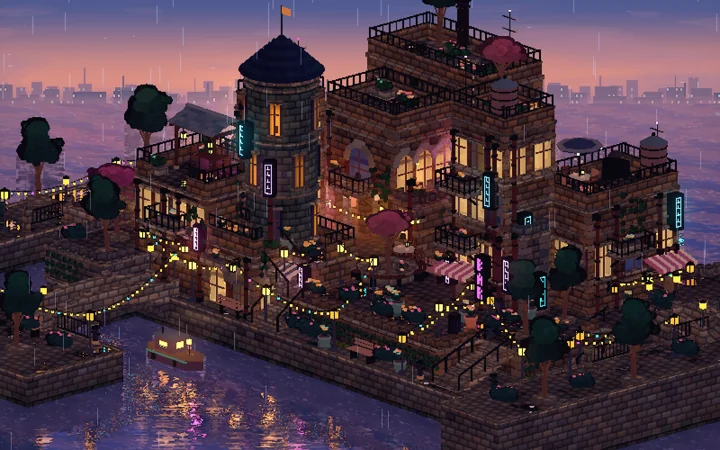
The first change touched only colour data. The Canal night’s sky, horizon haze, clouds, distant city and water moved from blue-teal toward indigo-violet. Lights, windows and lamps stayed as they were, and the blue-hour and sunset settings changed only their water.
Four of the art review’s colours were adjusted after the first capture came out a little dark at the top of the sky and too saturated in the Harbour water. In the quarter view the top of the sky went from a median luma of 31.1 to 49.9, inside its 45 to 55 target, and its hue from 221 to 233 degrees. The bright band along the horizon dropped from 88.8 to 72.7, so the city blocks still sit darker than the haze. Walls under the distance fog kept their exact colours, with no magenta cast.
The Glade look used the same night data, and its sky and water became a saturated royal blue, close to the Canal night. That blurred the difference between the two looks, and a later retune gave Glade its own night back. The creator kept the saturated night water in the Harbour.
The handover and the undersides
Around 21:00 and 06:10 the key light switches between sun and moon, and for a few minutes the town used to drop to black silhouettes under some of its best skies. A twilight skylight now fills in during the switch, for about 21 minutes each time, tinted from the horizon. At 21:00 the town’s median luma rose from 11.8 to 20.4 against a target of 18, and the walls pick up a warm pink-violet from the sky.
Tree undersides at night were the other black hole, with a median of 0 in the lower crowns. The art review’s floor colour did nothing, because the frame turns very dim foliage light, below about 0.035, into pure black. Why it does that was not traced. A calibrated floor lifted the undersides to about 32, over the target of about 26, and the review sent it back with a list. Lamp-lit bushes had gone grey, because the floor was added on top of their light. Crown tops stayed black above lifted undersides, and the colour was too cool and too bright. The fixed version landed at about 26. In it the floor only fills what a leaf’s own light leaves missing, tops get a little more than undersides, and each lobe of a crown gets a slightly different value so the crown doesn’t read as one flat mass.
The quay at 21:00 still read 5.5 against a target of 8. It was not pushed, because a quay brighter at 21:00 than at 20:45 or at full night would flash as the evening passed.
Lifting the darkest tones
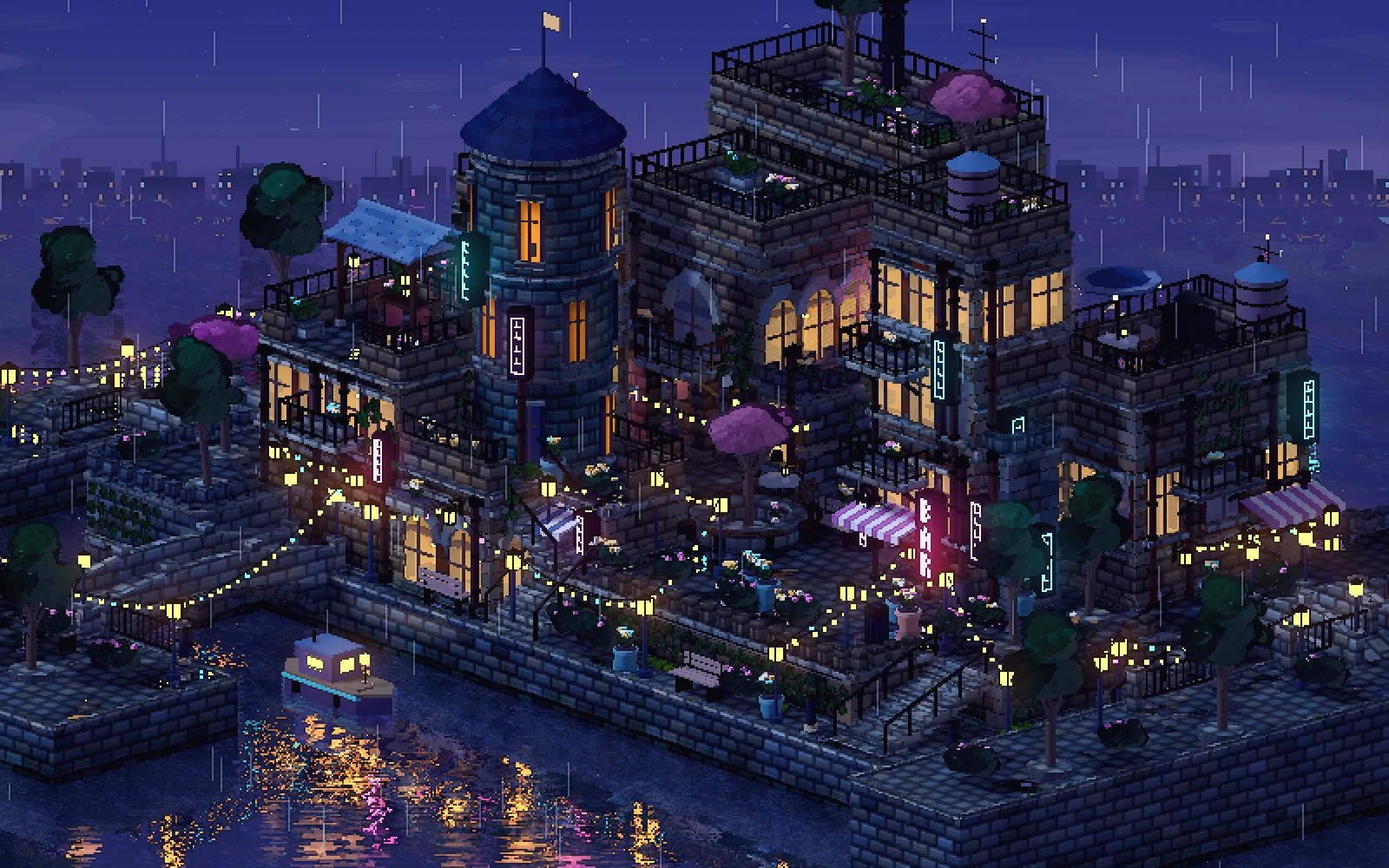
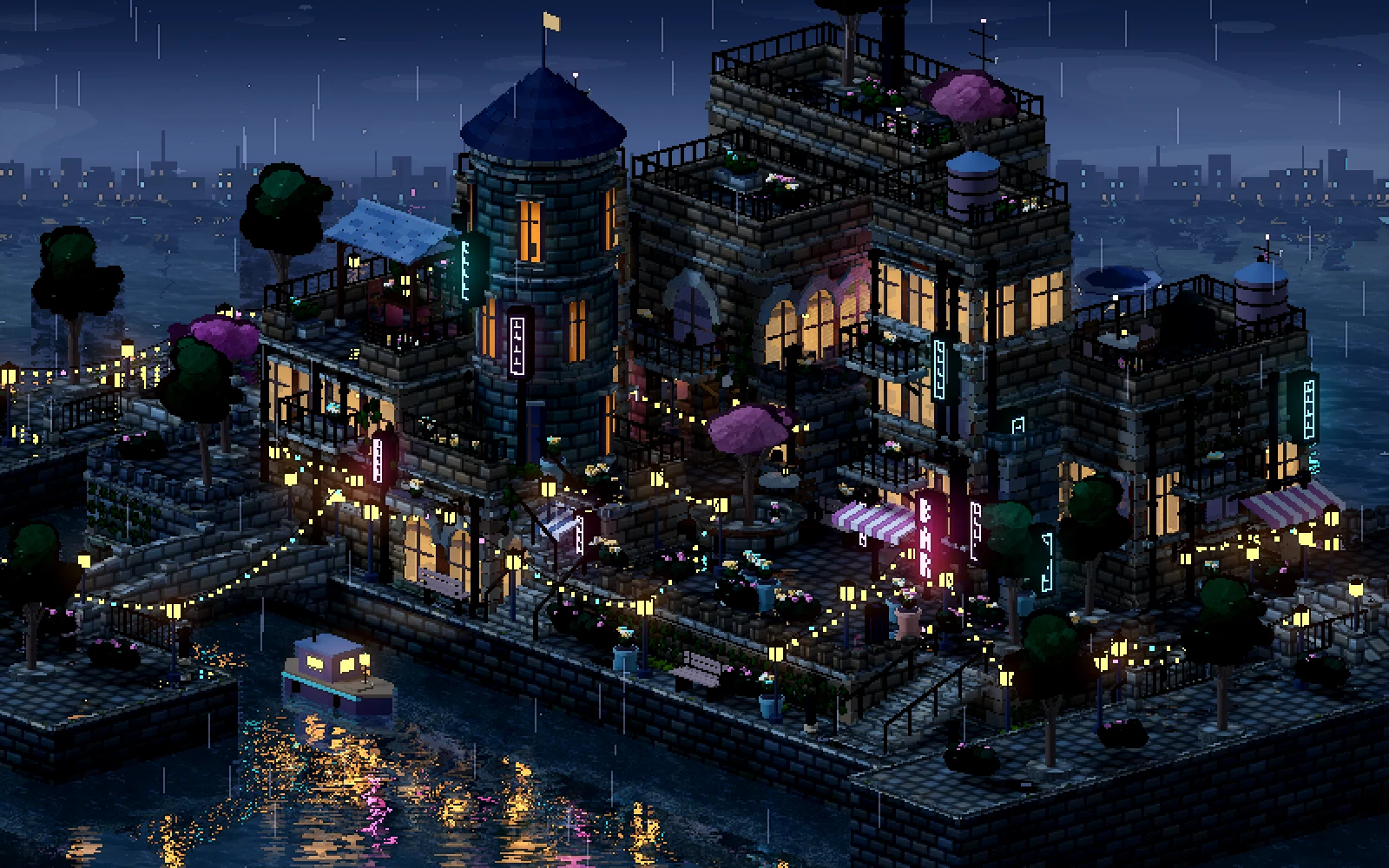
The main lift came next. The night fill light went up, and a violet “toe” joined the final image pass. It raises tones close to black and fades out before the mid-tones, so warm windows and neon stay the brightest things on screen. Fill and toe were tuned together against one target, 28 to 33 per cent of the night quarter below a luma of 0.1, and it went from 44.9 to 32.2 per cent. The narrow lane view came out too light at 25.5 per cent. No single setting put both views in range, so the work stopped at the numbers.
Other targets slipped. Mid-tones were meant to move by less than 0.01 and moved by a median of about 0.012 to 0.016, pushed by the plan’s own fill values. Dusk and dawn now had about eight percentage points more dark pixels than full night. With the toe on top, the crown floor sat at 35 instead of 26. In the Harbour scene the grade cost 0.11 milliseconds a frame, 1.3 per cent.
Here the stage paused, as the creator had asked before it began. Eleven questions went out with before-and-after sheets, and on 28 September the creator accepted every recommendation. Four of them called for a retune before the stage could continue.
Retuned, and warmed at dusk
The retune lowered the night fill from 0.55 to 0.51 and let the toe do more of the work, raising it from 0.55 to 0.76. On pixels that stayed stable between repeat captures, mid-tones now moved by a median of 0.0073 to 0.0081 against the build before the lift. The night quarter held 32.3 per cent below 0.1, inside its range. Dusk and dawn became slightly lighter than full night, the lower crowns came back to about 26, and Glade got its original night palette. The review of the retune also found a dark pulse at 22:00, and a stronger fill at that hour removed it.
Two leftovers were accepted. The Harbour bank margins at night fell a little further, to 3.7 and 4.5 against the target of 8. Holding them would have broken the mid-tone limit, and the planned rebuild of the island edges already owes that number. Between 21:00 and 21:30 the view has 2 to 4 points fewer dark pixels than on either side, which shows in the measurements but not as a visible step.
The brighter fill at 20:45 had a visible cost: warm sunset stone on shaded walls turned grey-violet. The creator chose to keep the lift and make it warm. The 20:45 ambient colour became a dusty rose close to the horizon’s hue, at almost the same brightness. On shaded stone the hue moved from 342 degrees, a violet, to 27 degrees, slightly warmer than before any of the night work. Lit stone kept its brightness, and dusk still had no more dark pixels than full night.
Light from the water
Quay and pier faces were close to black at night. Now the stone of a quay face is lighter, and masonry standing in the water gets a little light bounced up from it. At the strength the review proposed, the bounce adds less than half a luma, so nearly all of the lift comes from the lighter stone. The creator asked for the bounce to stay subtle.
The ratio of quay to paving brightness, which the retune had already nudged past its 0.55 target, went from 0.567 to 0.725 on the night quarter, and the left pier from 10.5 to 20.0. Land walls did not change. Through the evening the quay now reads 38.9 at 20:45, 33.1 at 21:00, 25.7 at 22:00 and 23.6 at night. That is brighter than before at every hour and still in order, so nothing flashes.
Tide marks came next. Every stone or plaster face standing in water now has a dark, glossy algae band from the waterline up to a wandering tide top between 0.41 and 0.49 metres, with a pale line one art pixel wide along the top. First, a check that decides what counts as standing in water had to be fixed, because island kerbs were passing it. At night the band on an already dark face goes nearly black, and the line and the gloss carry the detail. Stepping stones sit below the tide top, so they are all band and no line. Pillars in the canal, including those under the Harbour boathouse, now look lighter along the shaft with a darker foot. The creator accepted both.
Paint on the railings
Railings, posts, street furniture, sign cabinets and pipe runs used the bare metal material, which read as black cut-outs by day. They now use a new painted metal that is far less metallic, 0.18 against 0.65, and a little rougher. Pipes lean partway toward copper, by a different amount on each run. Brackets, collars, vents, lamp cages and similar fixings stay bare.
The pipes changed most. In the quarter by day their median luma went from 0.4 to about 10.7, and the share of pipe pixels below 0.05 fell from 93 to 95 per cent to 58 or 59 per cent. Railings and the painted edges of the sign cabinets got lighter, but only a little, because their paint colour is itself nearly black. The creator chose to keep that paint. Iron at night stayed as dark as before.
This part has a real cost. A mesh that mixes painted and bare metal draws one more surface, so the dense test scene went from 2,140 to 2,360 draw calls, and its median raw frame time from 13.73 to 14.24 milliseconds with vsync off, over three interleaved rounds. The creator accepted that for now and put it on the list for a later speed pass.
While looking into why earlier benchmarks seemed tied to the display refresh, this part found that the frame report was misleading. Its vsync field was a label set by the benchmark mode, not the window’s actual state. On top of that, Godot’s delta smoothing snaps frame times to the refresh interval even with vsync off, which held the 95th percentile at 16.667 milliseconds. The report now records the real vsync mode and the raw frame intervals. The game’s own settings were left alone.
Measured as one stage
When the last part had merged, the build from before the stage and the final build were captured in one sitting, alternating between them, in 24 views. The main targets held on the final code. The top of the night quarter’s sky went from a median luma of 31.1 to 54.4, inside its 45 to 55 range. At 21:00 the town’s median went from 11.8 to 37.7. The share of the night quarter below 0.1 fell from 47.0 to 28.7 per cent, inside 28 to 33, and the quay reached 0.73 of the paving’s brightness against a target of 0.55. Outlines are lighter too, with a median of 25.1 instead of 16.8, so the ink reads as violet-grey.
The plan names some looks that every stage has to leave alone, and these were checked as well. The neon cores kept their brightness: the bar sign’s brightest tenth read 244.3 before and after, and lit windows 175.9 and 176.0. The Glade night kept its exact sky, horizon and water colours, so the two looks stay clearly apart, and the approved tree style changed by day no more than two repeat captures do. The fix for the seam in the canal mirror, from the previous stage, still holds under the new night.
In the six standard views that follow the project from stage to stage, only the draw call and object counts changed, by exactly the amounts the painted metal had declared.
What drifted
Two looks moved more than expected. The coloured streaks in the canal mirror are all still there, but the water between them is lighter and more violet, so they stand out less. Their spread fell by about 8 per cent, where the creator had accepted about 5 at the first review. The top of the 05:45 sky also came out 4.5 luma lighter, from 52.1 to 56.6. That lift comes from the retune that stopped dawn being darker than night. Both are listed for the creator to judge.
The island bank at night still stands only 3.7 to 4.3 luma above the open water beside it, depending on the capture, against the target of 8. That is where the retune left it. The rebuild of the island edges still owes that number.
What the night costs
The stage close also timed the whole stage with the corrected frame report: vsync truly off, and raw frame intervals in place of smoothed ones. The two builds ran in three interleaved rounds at 1920 by 1080, with rain at 0.45, on mains power. On the dense test scene at night the median frame went from 13.15 to 13.70 milliseconds, 0.55 slower, close to what the painted metal’s extra draw calls cost by themselves. At 13:00 the same scene was 1.07 milliseconds slower, from 13.14 to 14.21, though the three rounds ranged from 0.05 to 1.45.
The Harbour at night looked like the surprise. Over six rounds its median frame went from 6.54 to 7.36 milliseconds, about 0.8 slower, and the final build was slower in every round. The part benchmarks had missed any change there, mostly because they read the smoothed frame time, which snaps to 8.33 milliseconds on that scene and hides a change of this size. At 13:00 the Harbour moved by only 0.13. The stage close could not trace the extra night time to a particular part, and a follow-up a few hours later did not reproduce it.
The cost, corrected
Correction, 29 September. The follow-up benchmark timed the build from before the stage, and the build after each of its six parts and the retune, the last of which is the final build, all with the stage close’s settings: vsync off, raw frame intervals, 1920 by 1080, rain at 0.45 and mains power. It ran the Harbour at night for eight interleaved rounds and the other views for five, 216 runs in all. Over the whole stage the Harbour at night went from 6.38 to 6.56 milliseconds, about 0.2 slower, and the final build was slower in all eight rounds. The Harbour at 13:00 was 0.17 slower. On the dense test scene the stage added 0.80 milliseconds at night and 0.82 at 13:00. These figures replace the stage close’s in the previous section.
Two parts account for nearly all of it. The night floor under the tree crowns costs about 0.15 milliseconds on the Harbour and 0.24 on the dense scene. It costs the same at 13:00, when it adds no light, so the time goes on the floor’s own shader work, which runs on every foliage pixel at every hour. The painted metal costs about 0.5 milliseconds on the dense scene through its 220 extra draw calls, and 0.03 on the Harbour. Every other change in the stage, including the violet toe grade and the light bounced up from the water, stayed within 0.03 milliseconds of zero.
The follow-up’s starting build ran close to the stage close’s, at 6.38 against 6.54 milliseconds on the Harbour at night, but its final build ran at 6.56 where the close had 7.36. The close had run its final build from the game’s own project folder and its starting build from a copy. A later benchmark found that this makes no measurable difference, so the close’s 0.8 is best read as a noisy sitting. Its dense figure at 13:00, 1.07, came from three rounds that ranged from 0.05 to 1.45.
The creator approved a speed fix for the tree-underside floor on 29 September. It is planned for later in the fog and smoke stage, before that stage’s closing benchmark, and had not been made when this was written. The painted metal’s draw calls stay as the creator accepted them at the second review, until a later speed pass.
Update, 30 September. The speed fix went in at the end of the fog and smoke stage, and the next chapter describes it. On the dense scene it saves about 0.19 milliseconds at 13:00 and 0.17 at night. Its saving on the Harbour could not be measured in that sitting, because the Mac was too busy.
Where the stage stands
Each part ran the full suite before it was merged, and the stage close ran it once more on the final code: 40 suites and 19,154 checks with no failures, the same count as after the painted metal. The integration check at 2880 by 1800 passed. The smaller 1440 by 900 integration size has an intermittent stall that predates this work, and it was skipped. Everything ran on a Mac; Windows was not run.
The creator answered the second set of review questions on 28 September, before the stage’s summary sheet was finished, and asked for work to move on to the next stage. Any of those answers can still change once the sheet has been seen. Two jobs now wait for the rebuild of the island edges: a bank that stands out from the water at night, and a Glade lip that doesn’t look like tiles.
From the project notebook
This chapter draws on the project’s records as they stood on 30 September 2026.
- docs/visual-handoff.md · Beautify night sky and water, twilight skylight and foliage floor, night fills and toe grade entries, 26 September
- docs/visual-handoff.md · Review verdict, retune with warm dusk, quays, tide line and painted metal entries, 28 September
- artifacts/beautify/owner-decisions.md · First and second review verdicts and the retune rulings
- docs/visual-handoff.md · Night stage close: suite, journey, protected looks and whole-stage bench, 28 September
- docs/visual-handoff.md · Night stage frame-time bisect, with its correction of the close’s Harbour figure, 29 September
- docs/visual-handoff.md · Foliage night-floor speed fix entry, 29–30 September
- artifacts/beautify/owner-decisions.md · Speed fix for the tree-underside floor approved, 29 September
- artifacts/beautify/19-P1/bisect/ · Per-part benchmark runs and summary
- artifacts/beautify/19-P1/ · Per-part captures, sheets, benches and suites
- artifacts/beautify/19-P1/close/ · Stage-end captures, metrics, bench and sheets