In this chapter
In this chapter
Undersides that stay cool
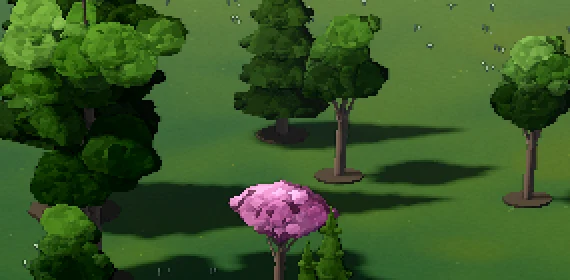
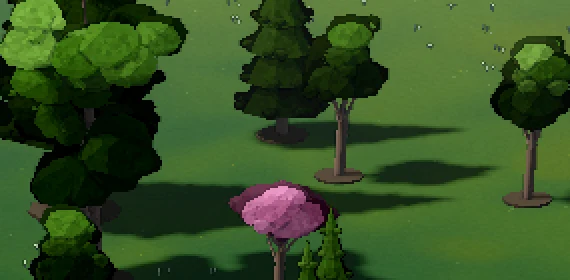
Every leaf colour used to darken toward black on its shaded side. It now darkens toward a cool navy-teal, #1c2c36, or toward plum, #3b2140, under blossom. That covers broadleaf and blossom crowns, conifer tiers and their hems, shrubs, planters, ivy mounds and strands, garden flowers, weeds, wildflowers, ivy rosettes and bonsai. Each leaf vertex also records how far it was darkened, which the lamp light further down uses to rebuild the leaf’s own colour. No vertex moved and the leaf geometry is identical for every kind.
The dark ring around each crown changed too. It darkens 40 per cent where it used to darken 55, and by day it comes off any face turned toward the sun, which gets a slight lift instead. At night it still runs all the way round. The art review had suggested taking the ring off any face even slightly turned toward the sun, but crowns lean upward and the day sun is high, so that removed it almost everywhere. The finished version only removes it from faces turned well toward the sun.
The plan wanted the darkest tenth of the lower crowns at 8 luma or more, which the night stage had already achieved. It rose from 11.7 to 13.7 on the canal quarter in dry weather and from 11.9 to 12.0 at night, and the share of crown pixels below a brightness of 0.1 fell from 51 to 38 per cent and from 52 to 42. In the tree grove by day the ring pixels on sunlit faces went from 1,905 to 316. A brief for the change had also asked that nothing on the sunny side change by day, and that was not met as written: 18 per cent of the brightly lit pixels got brighter by more than 8 luma, and across all of them the average rise was about 4. The shaded side changed much more. The grove’s crowns went from a median of 34.4 to 54.4 and its conifers from 43.9 to 58.0.
Review found that the promised way back did not work. The plan said that setting one switch and flipping one test would restore the black undersides, but with the switch off eleven leaf checks and 24 recorded shrub and flower prints failed. The tests now follow the switch, and a copy of the game with it off passed all 40 suites. Frame time stayed within noise. The creator approved everything on the sheet on 2 October, including the brighter sunny rims and the Glade’s night leaves, which take the cool shading too and moved from #372531 to #402b3c.
A list of lamps for the leaves
The engine draws only 16 of the town’s lights at a time, and a town at night has far more lamps than that, so a crown next to a lantern could miss its light entirely. The leaves now have a list of their own. Up to 32 lamps in view are written into a small texture the shaders can read, along with an 8 by 8 grid over the lit area that names up to four lamps for each cell. Bulbs on a string within 1.5 metres of each other count as one lamp. Each lamp’s strength follows the evening, so leaves light up when their lamp comes on. The list is chosen again after the lights change and when the camera has been still for 0.2 seconds at a new view, and it costs almost nothing while nothing changes. This part drew nothing new by itself.
The first version ranked lamps by brightness and reach, and in the Harbour view it chose 32 of 163. Neon signs reach slightly further than lanterns, so in the canal quarter 14 signs pushed out 37 lamps. Six of the Harbour’s 31 plants, eight of the quarter’s 47 and 55 of the dense test scene’s 87 had a lamp in reach only among those left out. The plan had asked for none left out on the Harbour and the quarter, and that was never possible under a cap of 32. Review also found that the part’s notes had called a slower drag frame noise when the timings showed it in four of six pairs.
Two fix passes followed. A lamp now enters the list only if its light reaches a leaf. Lamps, bulbs and neon always rank before lit windows, and the choice picks whichever lamp lights the most plants that are still dark. That brought the Harbour from six plants to none, the lane view from five to none and the quarter from eight to one. By day the list is emptied once and nothing runs. The second pass made sure the grid keeps a plant’s only lamp in its cell, which took three dark plants in the quarter to none, and spread the choosing over several frames at about 0.3 milliseconds a frame. On the Harbour at night the first lighting frame after you let go of a building went from 1.00 to 1.30 milliseconds, where the first fix pass had made it 3.39. Dragging at night still adds about 0.1 to 0.16 milliseconds to the median frame against the build from before the part, and nothing measurable at 13:00.
The dense scene stays at 55 of 87. It carries about 1,900 lamps that each reach roughly one plant, and lighting more of its plants would mean giving lamp slots to windows. A ruling kept the strict order of lamps before windows, and the creator later kept that result when approving the stage.
Lamp light in the leaves
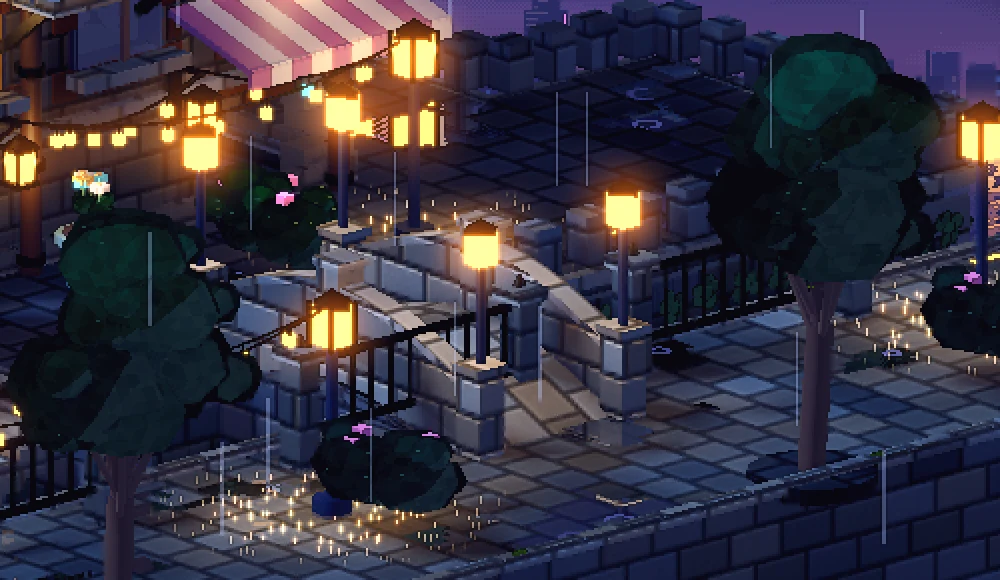
The leaf shader now reads the list at night. Each pixel of a leaf looks up the four lamps of its own grid cell, lights itself from each with a soft wrap, steps the result through the same bands as the leaf’s daylight shading, and adds it as the leaf’s own light, with a small wet glint per lamp in the rain. While the list holds lamps, the engine’s own lights no longer reach the leaves. By day the whole branch is skipped. Ivy uses the same shader, so it is lit the same way. At the plan’s strength the lift measured 1.3 luma and was invisible, so the town looks use a stronger gain with a falloff that ends at the lamp’s range; the Glade keeps the engine’s own falloff at the plan’s strength.
A new camera looks down a lantern-lit street in the canal quarter. On the leaves within a lamp’s reach the median went from 24.7 to 33.0 and 32.5 in two captures, and the share of warm pixels from 8 per cent to 13 and 15. With the engine’s lights switched off entirely the same leaves went from 24.3 to about 32, so the lift does not come from them. The daytime crowns stayed within noise. Lamps are already on at golden hour, so the light shows then too, about 1 luma on the quarter’s crowns.
Review found the blossom turning salmon. Under a lantern or a string of bulbs its red channel clipped: in the Harbour courtyard the clipped pixels went from 108 to 868, and in the quarter from 104 to 672 at night and 88 to 604 at golden hour. The fix bends the lamp light’s brightest channel toward a ceiling and scales all three channels together, so the hue holds, and gives blossom half the gain. After it the clipped counts are about where they started: 108 in the Harbour courtyard, 108 and 112 in the quarter against 104, and 92 and 100 at golden hour against 84 and 76. The blossom on its lamp side reads warm pink, a deeper rose in the quarter. On the Harbour at night the crowns ended up about 6 luma brighter than before the change, where the first version had made them about 15 brighter.
The dense scene’s 55 plants whose only lamp is off the list now lose that lamp at night, because the engine’s lights no longer reach leaves; that comes from the probe’s count and was not captured. When a lamp comes into view during a camera turn, its leaves stay unlit until the camera has been still for 0.2 seconds, then light over about six to eleven frames, which nobody measured frame by frame. Timed over six rounds after the fix, the Harbour’s slowest frames at night were 2.4 per cent slower, within the plan’s 10. The leaves under the lamps stay green and do not turn amber, a choice left to the creator.
Crowns in small clusters
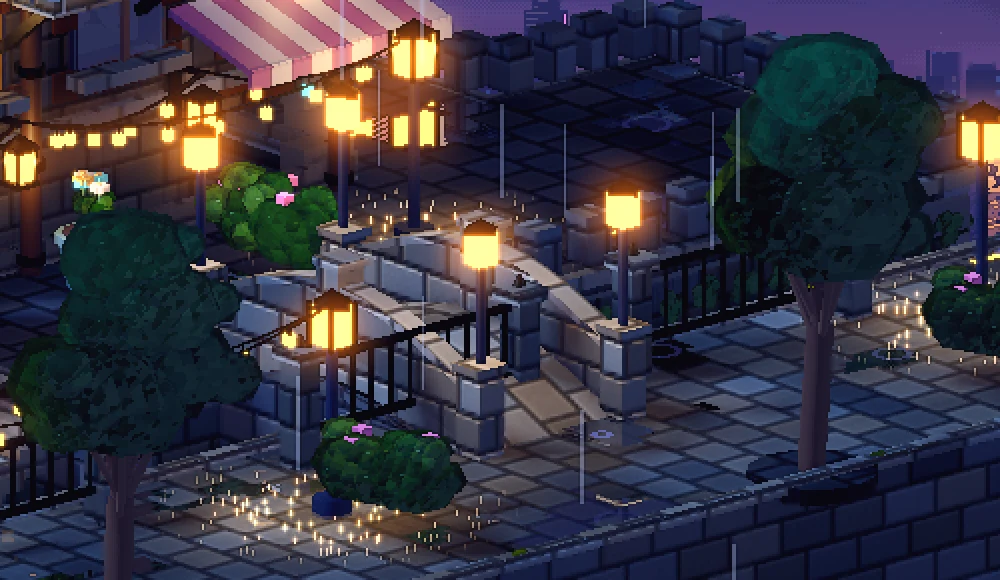
A crown used to shade in two or three flat plates of tone. It now has four tones, on cells sized to the screen’s art pixels so that a cluster is 3 to 12 art pixels across at the usual zooms. Each cell leans its own way and gets a small offset, so the line between lit and shaded is ragged, and each cluster takes a single value at every zoom. On blossom, a few upward cells become pale specks and about one in eight a darker plum crevice. The Glade gets the same at 40 per cent strength. No texture, setting or material was added.
The median cluster on the Harbour by day went from 25 art pixels to 8, on the quarter by day from about 40 to 17, and on the quarter at night from about 490 to 137. Single-pixel clusters went from about 9 to about 15 per cent of the Harbour’s crown pixels. There is no striping, and a strip of stills across a change of cell size shows no jump; it was not filmed as one continuous zoom. Whether the clusters crawl as the camera turns was not settled by a number. Between frames of a slow orbit more crown pixels change than before, 32 to 38 per cent against 25 to 32, which may be the denser texture rather than crawl. At the lantern camera’s close zoom the big crown shows small dark crescents finer than its cells. The forest scene runs about 0.05 milliseconds slower, and its slowest frames did not change beyond noise.
The stage measured as a whole
The checks that closed the stage ran on the final code on the evening of 2 October. The full suite passed with 41 suites and 21,672 checks and no failures, and the integration check at 2880 by 1800 passed. Every count on the six journey views, draw calls included, matched the previous stage. Most of the frame change against the previous stage’s captures is the usual spread between sittings; by eye the crowns are lighter and cooler with lit clusters, and the quarter’s blossom pinker at night.
The protected looks held: the canal’s mirrored light columns, the neon sign cores, the 05:45 and 20:45 skies and the separate Glade night. The approved tree style changed on purpose. The grove’s crowns by day went from a median of 34.7 to 55.3 and its conifers from 43.7 to 55.6, and the quarter’s crown undersides at night from 24.9 to 27.7.
Timed against the build from before the stage, with vsync off at 1920 by 1080, rain at 0.45 and mains power, over three interleaved rounds at night, 13:00 and 19:30, the stage costs under 0.1 milliseconds on the dense scene. The Harbour at night costs about 0.15 to 0.2, which is the lamp light: its median went from 7.70 to 7.92 milliseconds and its slowest frames from 8.98 to 9.16, slower in all three rounds, inside the plan’s limit of 10 per cent. Draw calls did not change. Before the close, a check of the part notes against the saved files corrected several figures, and the text above uses the corrected ones.
Where the stage stands
The stage’s summary sheet has seven pages. It flagged two things and left them as they were. The pale blossom specks reach full red by day and read as near-white flecks, on 94 crown pixels in the Harbour courtyard where there were none, and the quarter’s blossom by the lanterns clips on 200 pixels at golden hour against 88. And at the lantern camera the warmth on the big street trees is modest; most of the visible change there is teal undersides and greener, lit shrubs.
The creator approved the sheet on 2 October as it stood. That keeps the specks, the modest warmth, the Glade’s night crowns turning redder where a lamp lights them, the darker blossom by day with its plum crevices, the extra single-pixel clusters, the unmeasured delay when lamps come into view and the dense scene’s 55 unlit plants. The Windows kit stays deferred, with a later milestone build as the natural point to pick it up. No part of this stage ran on Windows, so how the new lamp texture behaves on a Windows graphics driver is untested.
From the project notebook
This chapter draws on the project’s records as they stood on 2 October 2026.
- docs/visual-handoff.md · Beautify cool ramps, shadow-side outline and darkening stamp entry, with its review fix, 2 October
- docs/visual-handoff.md · Beautify foliage lamp list entry, with its review fix and two fix passes, 2 October
- docs/visual-handoff.md · Beautify lamp term in the foliage shader entry, with its review fix pass, 2 October
- docs/visual-handoff.md · Beautify clustered terminators entry, 2 October
- docs/visual-handoff.md · Trees-lit-by-every-lantern stage close: suite, journey, protected looks, whole-stage benchmark and summary sheet, 2 October
- artifacts/beautify/owner-decisions.md · The creator’s approval of the first sheet and of the stage sheet, the deferred Windows kit and the lamp-list rulings, 2 October
- artifacts/beautify/24-P6/ · Per-part captures, metrics, benchmarks and suites, and the stage-close captures and sheet