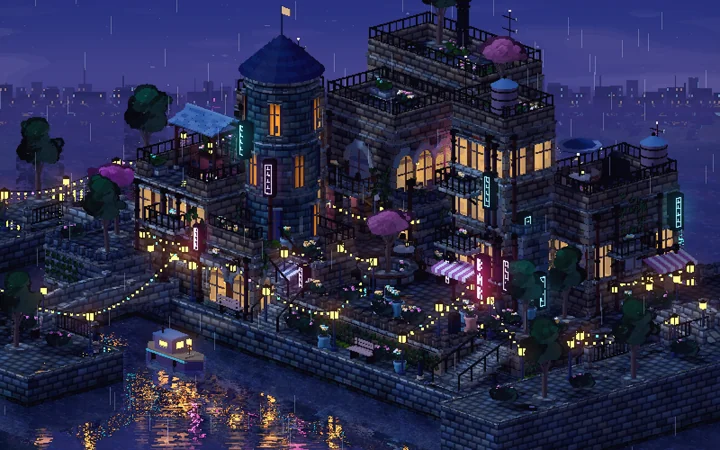
In this chapter
In this chapter
A ruler before the brush
The plan in the previous chapter set numeric targets: a share of dark pixels, a bank a certain amount brighter than the water, no black specks on a roof. Before any of that could be judged, the project needed to measure the same way every time. So the first part of the stage changed no game code at all. It added a capture script, a metrics tool and a file of named screen regions, such as the front quay, the lawn or a strip of sky.
The kit was checked against the art review it was meant to follow and reproduced all 43 of the review’s numbers, including 46.2 per cent of the night quarter below a luma of 0.1. It also showed how noisy captures are. Ripples, rain and star twinkle follow the game clock, so two runs of different lengths disagree more than two runs of the same length. From then on a region counted as unchanged only when its change fell inside that measured spread.
Rain on leaves, one fleck at a time
In rain, every crown carried a pale disc. The foliage shader added a hard highlight wherever a leaf faced the light closely enough. Once the new tree style bent the leaf normals toward one shared shape, those small highlights merged into a single plate per crown, tinted by the light: tan at golden hour, teal at night.
The replacement divides the leaves into cells and gives a few of them a glint, one or two pixels of pale leaf green at a fixed point in the cell. Making that hold still took two extra rounds after review. At first the cells were sized from the wrong origin, which filled a close perspective view with speckle. Then the glints flickered as the camera orbited, because each one depended on which leaf triangle a pixel happened to sample. The final version anchors every glint to a spot on the leaf itself.
The target allowed at most three per cent of crown pixels to brighten, compared with a build that had the gloss switched off at the same rain strength. The final build stayed under one per cent on the absolute reading and under the three per cent limit on the relative one. With the camera orbiting slowly, 94.7 per cent of glints survived from one frame to the next; at faster orbits, following each leaf, 93.6 per cent did. The dense night scene with its lamps lit ran about 0.3 per cent slower. Lamp glints at night are mostly too faint to see and are left for a later lighting stage.
A darker bank and a quieter lawn
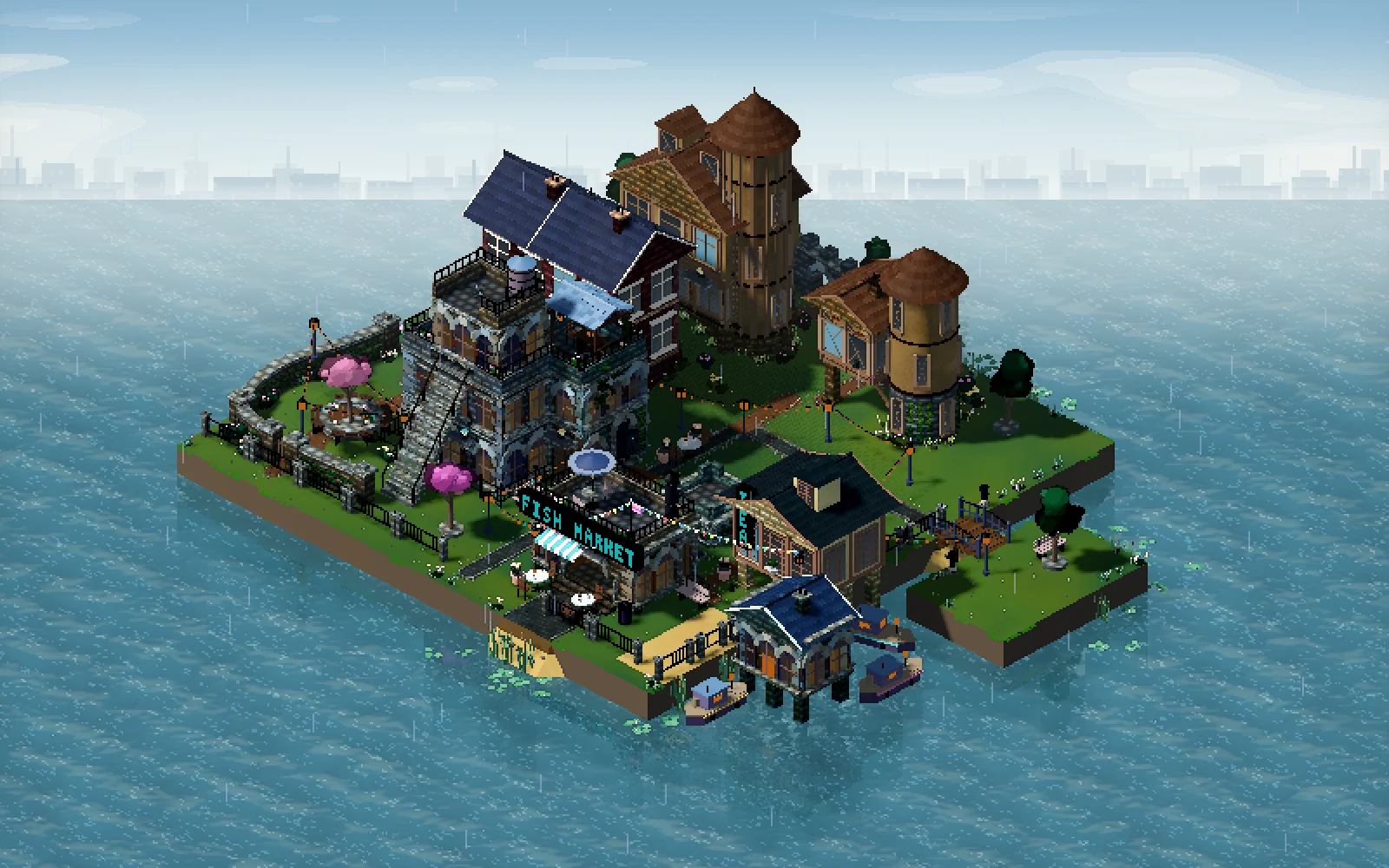
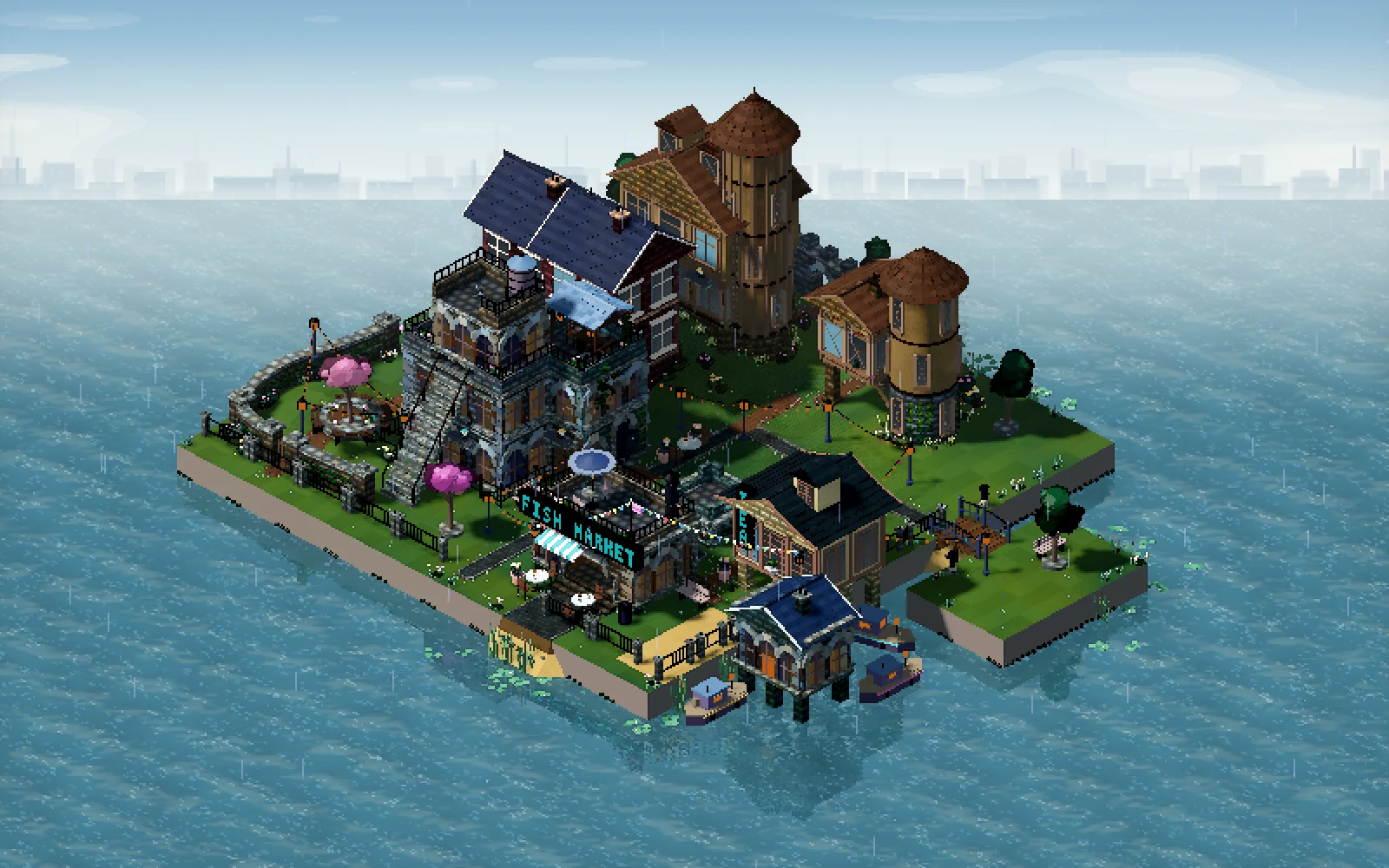
Where an island meets the water, the ground shows a cut side. It used to be lighter than the lawn above it, 1.41 times the lawn’s brightness by day and 1.73 times at night, so the island looked as if it sat on a pale tray. The cut is now a dark wet earth colour, about 0.86 of the lawn by day and at night, and 1.48 at golden hour instead of 2.45. The Glade bank is darker too, and warmer.
Small leaf lobes used to sit on the cut just above the waterline. At normal zoom they came out as a row of black beads, between 24 and 68 black pixels per view. They moved up to the top edge as grass hanging over the lip. The first version reused the leaf shapes, and the look review found they had turned into black ink again, because the camera saw their shaded undersides. They were redrawn as single sheets of the lawn’s own grass drooping over the edge. In the Glade look those flaps read as bright lime squares; the creator left that to a later shoreline stage, which rebuilds the lip anyway.
The Canal lawn also lost its checkerboard. Each meadow cell had its own lightness step, which made a faint quilt, and the tufts grew in rows. Now the meadow is one colour, and each tuft’s position and direction come from a hash of its cell. The first version of that placement still repeated every few cells, which the code review caught. The largest brightness jump between neighbouring cells in the grove view fell from 8.4 to 3.5, and the 3.5 is a shadow edge.
One target was missed. At night the bank should stand at least 8 luma above the water beside it; it reached 4.1 against open water and 3.3 against the water directly below. A tuning trial showed this wasn’t a matter of picking a better colour. The water below reflects the bank, so meeting the line would have needed a bank brighter than the night lawn, which breaks a different target. The line was deferred to the night work in the next chapter, and in the end it moved to a planned rebuild of the island edges.
Pepper on the roofs
Tiled roofs were sprinkled with dark specks: 29 on one slate roof in the Harbour daytime view and 20 across its cone roofs. The art review blamed stone grout on the roof surface under the tiles, so the first fix covered that surface with a plain material. The specks on the slate roof stayed exactly where they were. Worse, every gap between tiles turned pale sky blue or cream, because the plain material picked up a strong reflection of the sky. The work stopped there for a look review.
A diagnostic capture coloured the tiles’ side faces green, and every speck turned green. They were the tiles’ own shaded edges, seen through the narrow joints and then darkened further by the outline pass. The fix shades every face of a tile as if it were the top, so a joint shows lit tile. The surface underneath now uses the same material as the cut tile pieces. Each tile also gets a value change of up to five per cent, a lit lower lip and a shadow where the next row overlaps it, so the rows still read without black lines.
Both speck counts went to zero, and the cream flecks of the first attempt went with them. The dense test scene cost 0.18 milliseconds more per frame, 1.2 per cent, over three interleaved runs. Roofs more than 40 metres from the camera’s focus, or past the tile budget, don’t draw their tiles, and they now show a dark flat surface without the old stone pattern. The creator accepted that.
The seam in the canal mirror
The canal reflection is found by marching a ray across the screen until it meets something. Under the town, some rays ran out of steps while still in front of a building and fell back to the full sky colour. That drew a pale band with a stepped top edge along the bottom of the quarter views.
Rays that run out in front of geometry now fade toward a darker floor instead of plain sky, weighted by how close they came, and the march doubles its stride after 48 steps so it reaches further. That removed the long band, but a bright patch stayed in one corner. Those rays had passed within two metres of low bushes on the pier, stepped over them and ended over open sky. A second change records each ray’s closest pass, so a near miss counts as partly a hit. In that corner the share of pixels above luma 130 fell from 43 to 6 per cent by day, and from 41 to about 11.5 per cent at golden hour. Frame time showed no measurable change.
The fix also changed the Harbour water. Under the island in the Harbour daytime view, the water now has a soft darker band, like a shadow of the island’s reflection. About 3.8 per cent of that frame changed by more than 8 luma, against 0.7 per cent between repeated captures. The creator kept it.
Two smaller decisions came from the creator before the stage started. Shoreline foam, which the review had found could never appear, was left alone for the later water-edge work instead of being patched. Stars in rain fade more gently than the review proposed: about half strength at the default rain of 0.35, and gone by 0.6. Measured on the star cells, they kept 0.49 to 0.50 of their dry brightness at 0.35, and 0.03 to 0.04 at 0.6. The test scenes rain at 0.45, so there the faint stars at dusk and dawn mostly disappear. That was kept as well.
What the stage cost
At the end, the whole stage was measured against the build from before it. The full test suite passed with 40 suites and 18,447 checks, plus an integration check at 2880 by 1800. On the dense test scene the median frame went from 14.38 to 14.80 milliseconds, 0.42 milliseconds or 2.9 per cent slower, over three interleaved rounds at 1920 by 1080 on mains power. The parts benchmarked on their own added up to about two per cent, and extra terrain surfaces from the bank work are the likely rest, though that was not isolated.
Draw calls went down in most views, from 925 to 892 in the Harbour ones, because the old waterline lobes had needed surfaces of their own. Separate checks covered the looks the plan had promised to protect. The coloured streaks in the canal mirror, the neon signs and the approved tree style all survived. So did the blue-hour and sunset skies, apart from the fainter stars.
From the project notebook
This chapter draws on the project’s records as they stood on 28 September 2026.
- docs/visual-handoff.md · Beautify measurement kit, wet-leaf glints, island bank and lawn, roof pepper and mirror seam entries, 25–26 September
- docs/visual-handoff.md · Defect sweep stage close, 26 September
- artifacts/beautify/owner-decisions.md · Creator decisions before the stage, rulings and answers on the stage sheet
- artifacts/beautify/18-P0/close/ · Stage suite, bench and before/after captures
- artifacts/beautify/18-P0/d/sheet/lookfix/ · Roof tile crops